
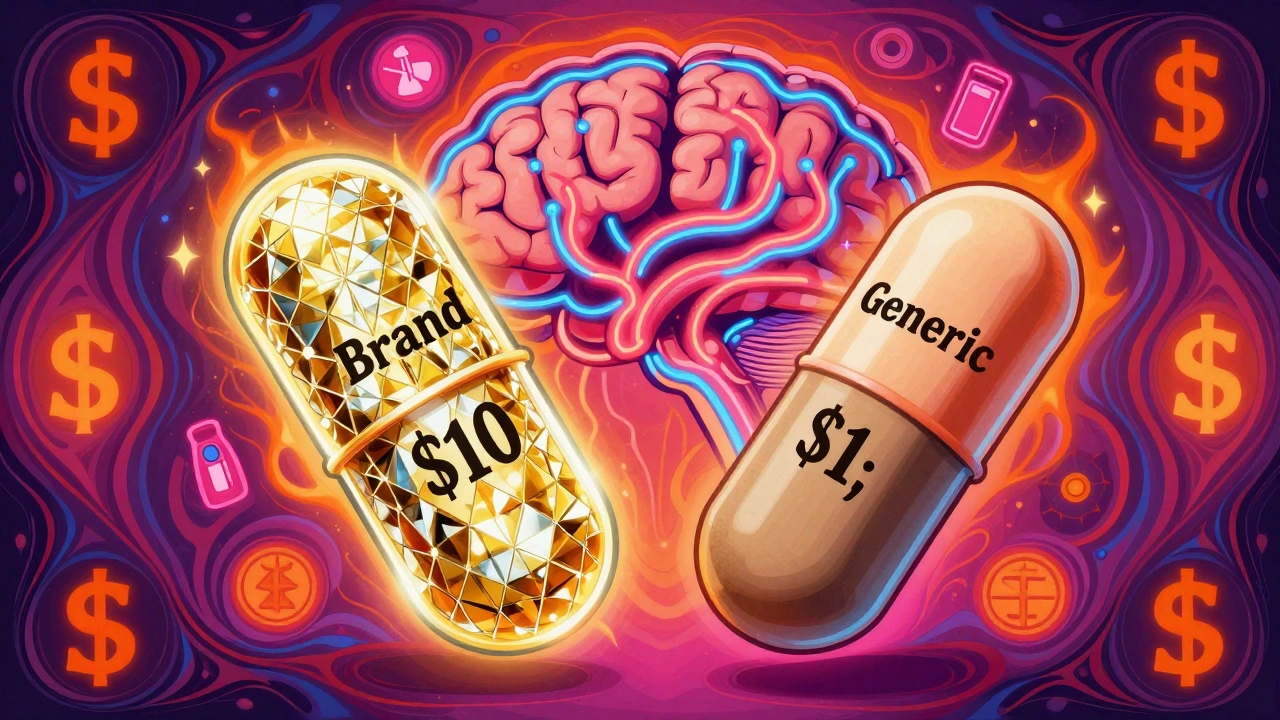
Have you ever taken a generic pill and thought, “This just doesn’t feel like it’s working”-even though your doctor swore it was the same as the brand name? You’re not crazy. You’re not alone. And it’s not because the medicine is weaker.
The truth? Your brain is tricking you. And it’s happening because of something called the price-quality heuristic. That’s just a fancy way of saying: we assume expensive things are better. It works with phones, cars, and yes-medications.
Here’s the kicker: two pills can have identical active ingredients, same dosage, same manufacturer, same shelf life. One costs $1. The other costs $10. The $10 one? You’ll swear it works faster. Stronger. Better. Even if it’s a placebo. And multiple studies prove it.
It’s Not the Drug-It’s Your Expectation
In a 2023 study, 60 volunteers were given a fake drug in a clinical trial. Half were told it cost $100 per dose. The other half were told it cost $2. The catch? Neither pill had any real medicine in it. Just sugar and filler.
Still, the group who thought they were taking the expensive version reported significantly better results. They felt more relief. They believed the drug was working. Even though, objectively, nothing changed.
This isn’t a fluke. It’s a pattern. When people believe a drug is expensive, their brains start expecting results-and then they find them. It’s the placebo effect, powered by price tags.
Another study at the University of Auckland had people take two different-looking pills for headaches. One was branded ibuprofen. The other was a generic version. Both were fake. No actual painkiller inside. But the people who took the generic version reported more pain, more side effects, and less relief. Why? Because they expected less.
Why Do We Trust Expensive More?
We’ve been trained to think cost equals quality. That’s how marketing works. That’s how luxury brands survive. And it’s how pharmaceutical companies built their empires.
Brand-name drugs come in shiny packaging. They have smooth coatings. They taste better. Sometimes they’re even shaped differently-rounded, colorful, easy to swallow. Generic versions? Often plain white tablets. Chalky. Bitter. Sometimes harder to swallow. It’s not about effectiveness. It’s about sensory experience.
When you hold a branded pill, your brain reads it as “premium.” When you get the generic? Your brain says, “This looks like something you’d buy at a discount store.” Even if the science says they’re the same, your gut says otherwise.
And it’s not just about looks. It’s about trust. People remember the last time they took a brand-name drug and it worked. Now, when they get the generic, they’re comparing it to their memory of the brand. The memory is stronger. The expectation is higher. So the generic falls short-even if it’s chemically identical.
What Patients Really Believe
Surveys show this isn’t just a feeling-it’s a widespread belief.
- 25% of Americans think generic drugs are less effective.
- 20% think they’re less safe.
- 34% aren’t sure if generics are any different from brand names.
- 46% worry about side effects from generics.
One patient in a CDC focus group said, “Generic medicine is less potent... other medicine is stronger.” Another said, “Name brand is more powerful than the generic.” These aren’t rare opinions. They’re common. And they’re shaped by years of advertising, packaging, and cultural assumptions.
Even when people know generics are cheaper, they still assume the lower price means lower quality. It’s a mental shortcut. Your brain doesn’t want to dig into pharmacology. It just wants to know: “Will this work?” And price is the easiest answer.
Doctors Don’t Always Help-They Can Make It Worse
Here’s the sad part: your doctor might not fix this. In fact, they might accidentally make it worse.
When a doctor says, “I’m switching you to the generic,” without explaining why, patients hear: “You’re getting the cheap version because you can’t afford the real one.” That’s not what they meant. But that’s how it lands.
Research shows that patients who have a clear, calm conversation with their doctor about generics are much more likely to trust them. But only 1 in 3 patients feel they got enough information. Many don’t even know generics have to meet the same FDA standards as brand names.
The FDA requires generics to be bioequivalent. That means they deliver the same amount of active ingredient into your bloodstream within a tight range-80% to 125% of the brand. If your brand drug gives you 100mg of ibuprofen, your generic gives you between 80mg and 125mg. That’s not a loophole. That’s science. And it’s proven to work.
Still, when a patient says, “I feel worse on the generic,” their doctor might assume it’s a real physical difference. But the evidence says otherwise. It’s perception. It’s expectation. It’s psychology.
Why This Matters More Than You Think
This isn’t just about feeling better. It’s about money. And health.
Generics make up 90% of all prescriptions in the U.S.-but only 23% of drug spending. That’s $37 billion saved every year because people choose cheaper options.
But if more people stop taking generics because they think they’re weaker, that savings disappears. More people end up on expensive brand drugs. Insurance costs rise. Out-of-pocket bills climb. And the system gets harder to afford.
Worse? Some people skip doses or stop taking their meds altogether because they don’t believe the generic is working. That leads to worse health outcomes-higher hospitalization rates, more complications, longer recovery times.
It’s a vicious cycle: low trust → lower adherence → worse outcomes → more fear → even less trust.

Can Education Fix This?
One study tried teaching people about generics. After the lesson, patients understood better. They were more willing to use generics for serious conditions. Their attitudes improved.
But here’s the twist: even after learning the facts, they still didn’t report feeling better on the generic. The knowledge didn’t change their experience.
That tells us something important: facts alone don’t beat feelings. You can explain bioequivalence all day. But if the pill looks cheap, tastes bad, and costs less-you’ll still doubt it.
What does work? Personal stories. Real examples. Conversations that normalize generics.
Imagine your doctor saying: “I take the same generic blood pressure pill my patients do. It’s the exact same drug. I’ve been on it for five years. No issues.” That kind of honesty builds trust faster than any brochure.
Pharmacists can help too. When you pick up a prescription, ask: “Is this the same as the brand?” A good pharmacist will say: “Yes. Same active ingredient. Same strength. Same results. Just cheaper.” That simple sentence changes everything.
What You Can Do
If you’re on a generic drug and feel like it’s not working:
- Don’t assume it’s the medicine. Ask yourself: “Am I expecting less because it’s cheaper?”
- Check the label. Is the active ingredient the same as your brand? (It almost always is.)
- Give it time. Your body may need a few days to adjust to the different fillers or coating.
- Talk to your doctor or pharmacist. Say: “I’m not feeling the same results. Can we talk about why?”
- Try switching back to the brand for a short time-just to test your perception. You might be surprised.
And if you’re a patient who’s skeptical: remember, the FDA doesn’t approve generics lightly. They’re tested. They’re monitored. They’re held to the same standard.
It’s not magic. It’s chemistry. And your brain is the only thing standing between you and real savings-and real relief.
The Bottom Line
Cheaper drugs don’t feel less effective because they are. They feel less effective because we’ve been conditioned to believe they are.
Price doesn’t change the science. But it changes your mind. And your mind changes how you feel.
The next time you get a generic prescription, don’t judge it by the price tag. Judge it by the results. And if you’re still unsure? Ask for proof. Ask for data. Ask your pharmacist. You might find out the truth is simpler-and cheaper-than you thought.
Dan Cole
December 5, 2025 AT 23:29Let me break this down for you: your brain is a prediction engine, not a truth machine. It doesn't care about bioequivalence-it cares about pattern recognition, status signaling, and cognitive ease. You pay more, you expect more, your dopamine hits harder, and suddenly your headache 'disappears.' This isn't placebo-it's neuroeconomics in action. The pill doesn't change. Your neural pathways do. And that's why Big Pharma spends billions on colorants and pill shape. They're not selling medicine. They're selling the illusion of control.
Max Manoles
December 6, 2025 AT 00:15I’ve been on generic metoprolol for five years. My BP is stable. No side effects. But I still feel weird taking it because the tablet looks like it was made in a basement. The psychology here is real. I know it’s the same drug. But my brain still flinches. It’s not irrational-it’s evolutionary. We associate cost with safety. That’s why we buy organic. That’s why we trust a logo over a label. We’re wired for this.
Katie O'Connell
December 6, 2025 AT 11:50One must consider the epistemological implications of this phenomenon. The price-quality heuristic is not merely a cognitive bias-it is a structural artifact of late-stage capitalist epistemic frameworks. When pharmaceutical commodification renders therapeutic efficacy subordinate to aesthetic and symbolic capital, the very notion of 'health' becomes mediated through consumerist signifiers. One cannot, therefore, speak of 'perceived ineffectiveness' without acknowledging the ontological erosion of scientific authority by market logic.
Clare Fox
December 7, 2025 AT 23:44i mean… i get it. i took a generic omeprazole last month and felt like my stomach was gonna eat itself. turned out i was just stressed. but still. the pill looked like a chalk tablet from 1998. my brain just… gave up. like, why would i trust this? even tho i know it’s the same. it’s not logic. it’s vibes. and vibes matter.
Akash Takyar
December 9, 2025 AT 07:48Dear friends, let us not forget the immense responsibility we hold as global citizens. Generics save lives, reduce poverty, and empower communities. In India, where 95% of prescriptions are generics, people live longer, healthier lives because they can afford treatment. Let us not allow psychological bias to undermine public health. Education, compassion, and trust are the true medicines. Please, choose generics-not because they are cheap, but because they are wise.
Arjun Deva
December 10, 2025 AT 14:32They don’t want you to know this… but generics are deliberately made to feel weaker. The FDA? Controlled by Big Pharma. The ‘80-125%’ range? A loophole. The fillers? Toxic binders. The color? Dyes to trick your brain. They want you to doubt the cheap version so you keep buying the expensive one. And guess who profits? The same people who sold you the vaccine, the same people who told you 5G was safe. Wake up. This is a control system.
Inna Borovik
December 11, 2025 AT 16:45Let’s be real: the reason generics ‘feel’ worse is because they’re often manufactured in countries with lax oversight. You think the FDA checks every batch? Please. They inspect 1% of overseas plants. That chalky texture? That’s not filler-that’s contamination. And don’t get me started on the fact that 40% of generic manufacturers have FDA warning letters. This isn’t psychology. It’s negligence dressed up as science.
Jackie Petersen
December 12, 2025 AT 23:29Oh wow, another ‘you’re just being dumb’ article. Newsflash: I don’t care about your studies. My body knows the difference. And if you think I’m gonna take some white powder from a country that doesn’t even speak English and call it ‘equal,’ you’re delusional. America made the brand. America deserves the brand. This is cultural erosion.
Annie Gardiner
December 14, 2025 AT 14:12But what if… the brand name *is* better? What if the placebo effect is actually the *only* thing keeping modern medicine alive? Maybe we’re not being tricked-maybe we’re *choosing* to believe in magic because the alternative-random chemistry-is too terrifying to face. Maybe the real drug isn’t in the pill… it’s in the story we tell ourselves about it.
Dan Cole
December 16, 2025 AT 01:10And here’s the real kicker: the author’s own advice to ‘switch back to the brand to test your perception’? That’s not science. That’s confirmation bias on a prescription pad. You’re not testing the drug-you’re reinforcing the myth. The only valid test is a double-blind, cross-over trial with no labels. And guess what? When you do that? The difference vanishes. But no one wants to hear that. Because admitting you were fooled by a price tag? That’s harder than taking a pill.