
Vitamin E & Warfarin Risk Calculator
This calculator estimates your bleeding risk when taking vitamin E supplements with warfarin based on dosage. Warning: High doses (400 IU+) significantly increase bleeding risk.
If you're taking warfarin for a heart condition, blood clot, or after a valve replacement, you might think popping a vitamin E pill is harmless-maybe even helpful. After all, it's an antioxidant. It's in nuts, seeds, and leafy greens. But here’s the truth: vitamin E can make warfarin dangerously stronger, and you might not know until it's too late.
How Vitamin E Interacts with Warfarin
Warfarin works by blocking vitamin K, which your body needs to make clotting proteins. Without enough of those proteins, your blood takes longer to clot-this is what keeps dangerous clots from forming. But vitamin E doesn’t work the same way. It doesn’t directly interfere with vitamin K. Instead, it messes with platelets, the tiny blood cells that help clots form. Think of it like this: warfarin slows down the main clotting system, and vitamin E dulls the backup system. Together, they leave you with almost no clotting safety net. This isn’t just theory. A 2013 study in the Journal of the American Heart Association followed over 1,000 people on warfarin and found that those with higher vitamin E levels in their blood had significantly more bleeding events-especially dangerous ones like brain bleeds. The risk didn’t jump overnight. It built up over weeks. One patient in a case report bled severely only after four weeks of taking 800 IU of vitamin E daily. That’s the kind of delay that catches people off guard.The Dosage That Matters
Not all vitamin E is risky. If you’re getting it from food-almonds, spinach, sunflower seeds-you’re fine. The danger comes from supplements. Research shows that doses under 400 IU daily are unlikely to cause problems for most people. But once you hit 400 IU or higher, the risk climbs sharply. A 2023 analysis from the University of California San Diego explicitly advises patients on warfarin to avoid doses above 400 IU. Why? Because at that level, vitamin E starts acting like an antiplatelet drug-similar to aspirin or fish oil-which is exactly what you don’t want when you’re already on a blood thinner. Here’s the kicker: some people are way more sensitive than others. A small 30-day study with just three volunteers showed that even 42 IU of vitamin E daily-less than half the dose in a typical multivitamin-was enough to boost anticoagulation in those individuals. Genetic differences in how your body processes vitamin K (thanks to CYP2C9 and VKORC1 gene variants) might explain why. One person might take 800 IU and feel fine. Another might bleed from a minor cut. That’s why blanket statements like “it’s safe” are misleading.What the Research Says-And Why It’s Confusing
You’ll find conflicting advice online. One famous 1996 study from UC Davis claimed vitamin E was safe with warfarin. No change in INR. No bleeding. Sounds reassuring, right? But that study only lasted a few weeks and looked at INR levels, not actual bleeding events. It didn’t measure vitamin E in the blood. It didn’t track long-term outcomes. And it didn’t account for the fact that bleeding risk doesn’t always show up in INR numbers. The 2013 study changed the game. It didn’t just look at INR-it looked at real-world bleeding. And it found that vitamin E serum levels above 4.49 μmol/mmol cholesterol increased bleeding risk. Above 5.56 μmol/mmol cholesterol? That’s when major bleeding, like brain hemorrhages, became much more likely. This suggests that measuring vitamin E in the blood-not just asking if someone takes a supplement-could be a better way to predict danger. Meanwhile, guidelines from the American College of Chest Physicians and the American Heart Association both warn against high-dose vitamin E in patients on anticoagulants. The European Society of Cardiology’s 2023 update even suggests checking vitamin E levels in patients who have unexplained bleeding while on warfarin. That’s a big shift-from “maybe risky” to “test for it.”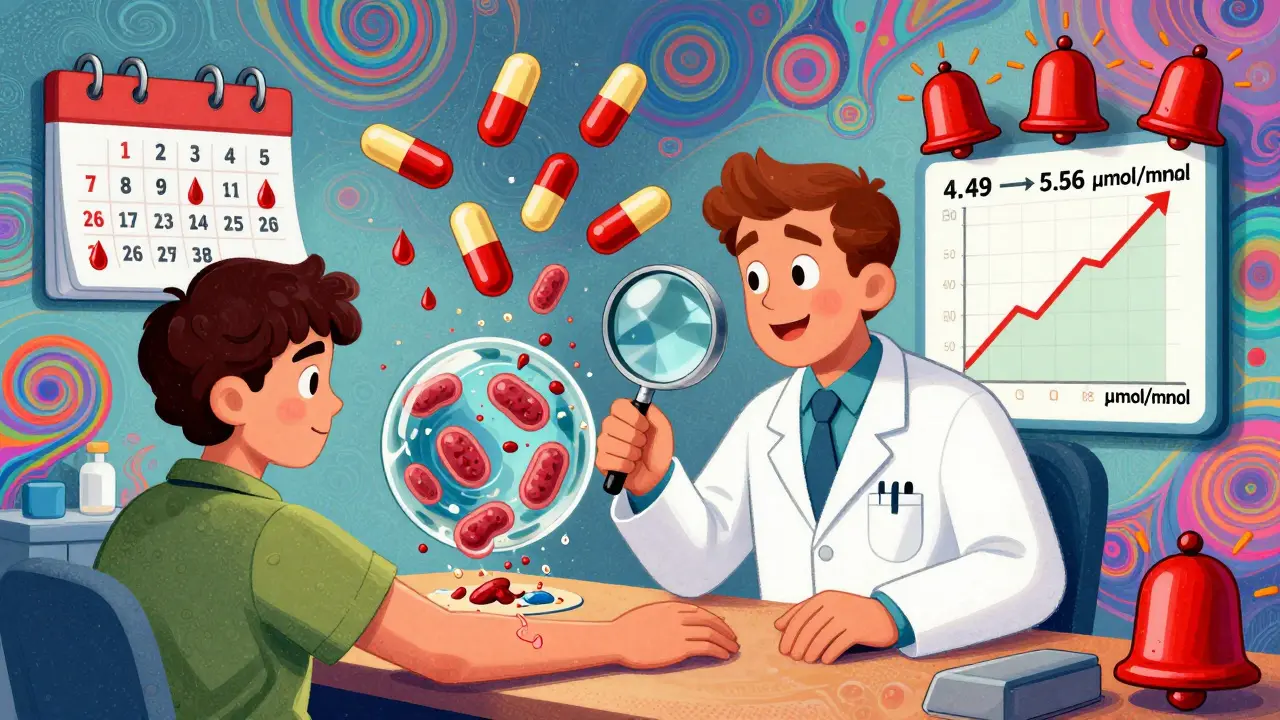
What Clinicians Actually Do
A 2017 survey of 250 anticoagulation clinics across the U.S. found that 78% routinely warn patients not to take vitamin E supplements. Sixty-three percent specifically say: avoid anything over 400 IU. That’s not random. That’s based on real-world experience. If a patient insists on taking vitamin E, clinics don’t just say no. They manage it. They take a baseline INR before starting. Then they check INR weekly for the first month, then every two weeks after that. That’s 3 to 5 extra clinic visits a year just to make sure the patient doesn’t bleed out. It’s not just inconvenient-it’s expensive and stressful. The Coumadin (warfarin) package insert doesn’t name vitamin E specifically, but it does warn about herbal and botanical products. That’s because, under U.S. law, supplements like vitamin E aren’t held to the same standards as drugs. The FDA can’t force manufacturers to prove safety or interactions before selling them. So you’re left guessing.Who’s at Highest Risk?
You’re at greater risk if you:- Take warfarin for atrial fibrillation or a mechanical heart valve
- Are older than 65
- Have a history of falls or bleeding
- Take other supplements that thin the blood-like fish oil, garlic, ginger, turmeric, or ginkgo
- Have a genetic variation in CYP2C9 or VKORC1 genes
- Take vitamin E doses above 400 IU daily
What You Should Do
If you’re on warfarin:- Stop taking vitamin E supplements unless your doctor says it’s okay.
- Don’t assume “natural” means safe. Supplements aren’t regulated like drugs.
- Don’t rely on how you feel. Bleeding doesn’t always come with warning signs.
- If you’ve been taking vitamin E, tell your anticoagulation clinic immediately. They’ll need to check your INR and possibly your vitamin E blood level.
- Get your vitamin E from food instead. A handful of almonds or a spinach salad gives you enough without the risk.
What About New Blood Thinners?
Many people are switching from warfarin to newer drugs like apixaban (Eliquis) or rivaroxaban (Xarelto). These are called DOACs-direct oral anticoagulants. They don’t interact with vitamin K, so they’re easier to manage. But do they interact with vitamin E? We don’t know yet. There’s no solid data. Some experts think the antiplatelet effect of high-dose vitamin E could still increase bleeding risk with DOACs. Until we have better studies, the safest approach is the same: avoid high-dose vitamin E if you’re on any blood thinner.The Bigger Picture
Vitamin E supplements are big business. In 2022, Americans spent $287 million on them. Many people take them thinking they’ll prevent heart disease or slow aging. But the American Heart Association warned back in 2009 that high-dose vitamin E (400 IU or more) might actually increase the risk of hemorrhagic stroke-especially in people on anticoagulants. The truth is simple: if you’re on warfarin, vitamin E isn’t a harmless add-on. It’s a hidden danger. And the longer you take it, the more your risk grows-even if your INR looks fine.Can I take vitamin E if I’m on warfarin?
It’s not recommended. High-dose vitamin E supplements (400 IU or more daily) can increase your risk of bleeding by making warfarin more powerful. Even lower doses can be risky for some people due to genetic differences. Stick to vitamin E from food-like almonds, spinach, or sunflower seeds-and avoid supplements unless your doctor specifically approves them.
How long does it take for vitamin E to affect warfarin?
It can take weeks. One case report showed severe bleeding only after four weeks of taking 800 IU daily. That’s why short-term studies miss the danger. Your INR might stay normal at first, but the antiplatelet effect builds up slowly. This delay is why people get caught off guard.
Does vitamin E raise INR levels?
Sometimes, but not always. The 1996 study found no change in INR, but newer research shows that bleeding can happen even when INR is in range. Vitamin E works differently than warfarin-it affects platelets, not clotting factors. So INR doesn’t tell the whole story. That’s why bleeding events, not just INR numbers, matter most.
What’s a safe dose of vitamin E if I’m on warfarin?
There’s no guaranteed safe dose. Most guidelines recommend avoiding supplements altogether. If you must take it, do not exceed 400 IU daily, and only with close monitoring by your anticoagulation clinic. But the safest choice is to skip supplements and get vitamin E from food.
Should I get my vitamin E blood level checked?
If you’re on warfarin and have had unexplained bleeding, yes. The European Society of Cardiology now recommends checking serum vitamin E levels in these cases. Levels above 4.49 μmol/mmol cholesterol are linked to higher bleeding risk, and above 5.56 μmol/mmol cholesterol, the risk for major bleeding jumps significantly.
Are new blood thinners like Eliquis safer with vitamin E?
We don’t have enough data yet. While DOACs like Eliquis and Xarelto don’t interact with vitamin K, vitamin E’s antiplatelet effect might still increase bleeding risk. Until studies confirm safety, the same advice applies: avoid high-dose vitamin E supplements if you’re on any blood thinner.
anthony epps
December 16, 2025 AT 05:09i didn't know vitamin e could mess with warfarin like that. i thought it was just for skin and stuff. guess i'm gonna stick to almonds now.
Tiffany Machelski
December 17, 2025 AT 13:08my grandma took vitamin e for years and never had a problem. but she never took warfarin either. maybe it's not the supplement, it's the combo?
Dave Alponvyr
December 17, 2025 AT 16:12so let me get this straight. you can eat a whole bag of almonds, but take one pill and you're one sneeze away from a brain bleed? thanks for the clarity.
Souhardya Paul
December 18, 2025 AT 05:55this is why i always tell people: if your doctor didn't prescribe it, don't assume it's safe. supplements fly under the radar, but they hit like freight trains when mixed with meds. i've seen people end up in the er over 'harmless' herbs and vitamins. this post is a wake-up call.
Ron Williams
December 20, 2025 AT 02:09interesting how the science shifted. that 1996 study was cited everywhere back then. now we know it was too short and didn't look at real outcomes. reminds me of how we used to think saturated fat was the enemy. science evolves, but people don't always update their beliefs.
Andrew Sychev
December 20, 2025 AT 21:26so let me get this straight-some guy takes 800 IU of vitamin E, feels fine for a month, then suddenly starts bleeding out like a scene from a horror movie? and the system doesn’t catch it until it’s too late? this isn’t medicine, this is russian roulette with a multivitamin.
Josias Ariel Mahlangu
December 21, 2025 AT 09:07the fact that the FDA doesn't require supplement makers to prove interactions before selling them is a scandal. people die because corporations care more about profit than safety. if this were a drug, it would be pulled from shelves overnight.
Billy Poling
December 22, 2025 AT 19:27While it is indeed a matter of considerable clinical importance that vitamin E supplementation may potentiate the anticoagulant effects of warfarin through non-vitamin K-dependent platelet inhibition, one must also consider the broader pharmacokinetic implications, including hepatic metabolism via CYP450 pathways, potential saturation kinetics at higher dosages, and the influence of serum lipid profiles on vitamin E bioavailability, which may modulate individual risk thresholds beyond the simplistic 400 IU cutoff often cited in general guidelines.
Hadi Santoso
December 23, 2025 AT 22:57my uncle was on warfarin after his valve replacement. he took vitamin e because his buddy said it 'cleans the blood.' one day he got a nosebleed that wouldn't stop. took him 3 hours to get to the hospital. turned out his vitamin e level was through the roof. now he eats spinach and calls it good. i told him, 'if it's in the ground, it's probably fine. if it's in a bottle, ask your doctor.' he still laughs about it.
Aditya Kumar
December 25, 2025 AT 02:21lol why do i even read this. just don't take pills. eat food. done.