

Medication Interaction Checker
Check for Potential Interactions
Before your telehealth medication review, check if any of your medications might interact with each other. This tool identifies common interactions mentioned in the article.
When you’re managing multiple medications, especially with chronic conditions like high blood pressure, diabetes, or depression, a simple mistake can lead to serious problems. That’s where telehealth medication reviews come in. These virtual check-ins with a pharmacist or doctor help catch dangerous drug interactions, reduce side effects, and make sure you’re taking the right doses. But unlike a regular pharmacy visit, you’re not handing over bottles in person. You’re on a video call, possibly from your kitchen table. So how do you make sure it actually works? And what should you ask to protect your health?
Why Telehealth Medication Reviews Matter
Telehealth medication reviews aren’t just convenient-they’re proven to save lives. A 2020 study in the Journal of the American Geriatrics Society found that elderly patients who had virtual medication reviews had 34.7% fewer dangerous drug reactions than those who didn’t. That’s not a small number. It means fewer hospital trips, fewer falls, fewer confusion episodes from medication mix-ups.
In Australia, the government’s 2020 guidelines laid out a clear framework for these reviews, and today, 78% of U.S. healthcare systems use them regularly. Why? Because they work. Pharmacists can review your entire list-prescriptions, over-the-counter pills, vitamins, herbal supplements-and spot problems a busy doctor might miss. The system uses clinical tools to flag risks, like when two drugs together can cause kidney damage or when a blood thinner is mixed with a common painkiller.
But here’s the catch: it only works if you show up prepared. If you forget your supplements or can’t explain why you’re taking something, the review won’t catch what it should.
What to Do Before Your Appointment
Imagine this: you’re on video with a pharmacist. You say, “I take my blood pressure medicine every day.” But you don’t mention the ibuprofen you take for your knees, or the melatonin you use for sleep, or the ginseng tea your sister swore would help your energy. That’s a problem. Studies show that when patients bring all their meds to the call, the review’s accuracy jumps by 37.4%.
Here’s exactly what you need to do before your appointment:
- Collect every pill, capsule, liquid, patch, and supplement you take-prescription and non-prescription. Put them in a clear container or lay them out on a table.
- Write down the dose and time you take each one. Don’t guess. If you’re not sure, check the bottle or your pharmacy app.
- Note any side effects you’ve noticed. Did you feel dizzy after starting a new pill? Did your stomach upset start after adding a vitamin? Write it down.
- Have your pharmacy’s contact info ready. The pharmacist will need to verify your records.
- Test your tech. Make sure your camera works, your mic isn’t muted, and your internet is stable. A weak connection can make it hard to show your pills or hear instructions clearly.
Pro tip: If you’re over 65 or not tech-savvy, ask a family member to help you set up. A 2024 survey found that seniors who got even 15 minutes of tech help were 68% more likely to feel confident during their review.
What to Ask During the Review
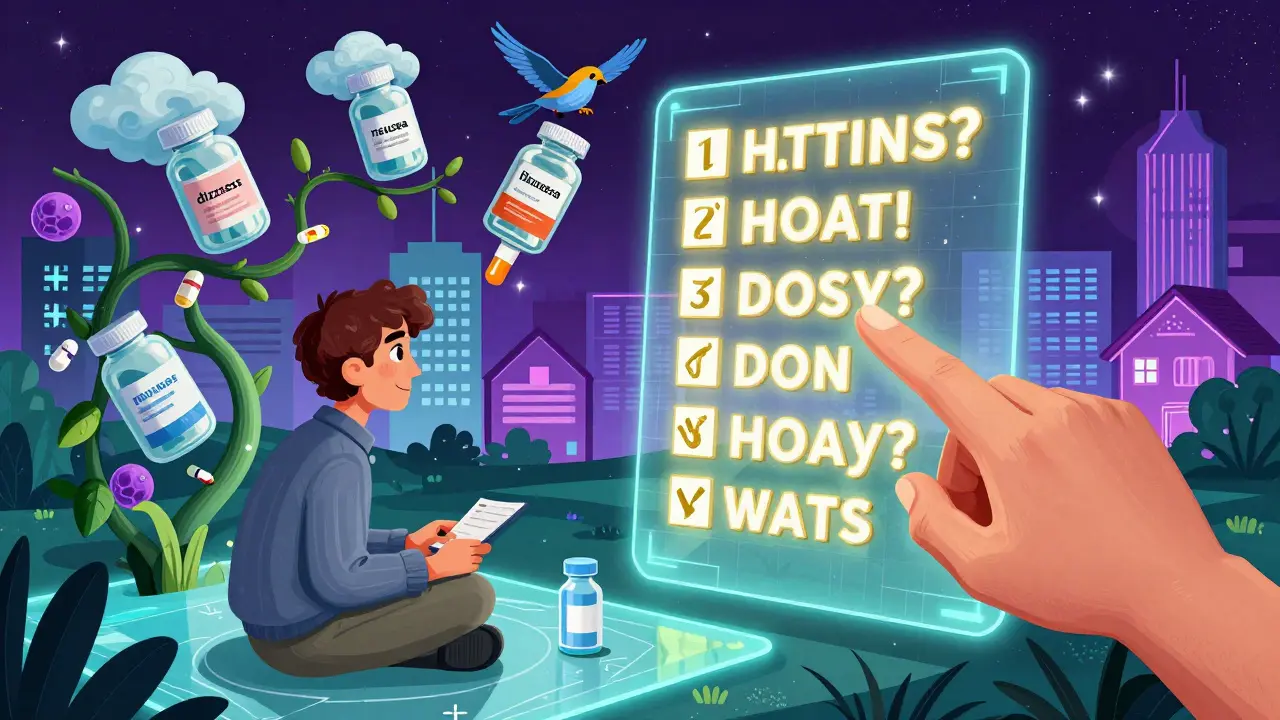
You’re not just there to listen. You’re there to get answers. A good telehealth review isn’t a lecture-it’s a conversation. Don’t be shy. Ask these five key questions:
- “How will you check that my list matches what my pharmacy has on file?” About 43% of medication errors come from outdated or incomplete lists. Pharmacists use electronic systems to cross-check, but they need you to confirm what you’re actually taking.
- “Which of my medications are absolutely necessary, and which can I stop?” Many people take pills they don’t need anymore. A review can help cut the clutter. One study found that 1 in 5 elderly patients had at least one unnecessary drug removed after a virtual review.
- “What side effects should I watch for, and what should I do if they happen?” Don’t just get a list. Ask what’s urgent. For example, if you’re on a blood thinner, is a nosebleed normal-or a red flag?
- “How will you share your recommendations with my doctor?” Only 63% of telehealth services have automatic systems to send changes to your GP. If they don’t, ask how to follow up.
- “How will we know if something goes wrong between visits?” Virtual reviews can’t check your pulse or listen to your lungs. Ask if they’ll schedule a follow-up or if you should call if you feel worse.
These aren’t just nice-to-know questions-they’re safety questions. The more you ask, the more control you have over your health.
What Telehealth Can’t Do
It’s important to know the limits. Telehealth medication reviews are great for checking what’s in your medicine cabinet-but not for checking what’s in your body.
They struggle with:
- Patients who need physical exams-like checking for swelling, skin rashes from reactions, or muscle weakness from nerve damage.
- People with complex mental health conditions, especially if they need a full mental status check. Video can’t replace seeing someone’s eye contact, speech patterns, or responsiveness.
- Those with poor digital access. About 33% of people over 75 don’t use video calls regularly, and without help, they’re left out.
If you have multiple chronic conditions, take more than five medications, or have trouble remembering to take your pills, a telehealth review is still helpful-but it might need to be paired with an in-person visit every few months.
What Happens After the Review
The review doesn’t end when the video ends. A good pharmacist will send a summary to your doctor and give you a written plan. You should get:
- A revised medication list (with doses and times).
- A list of any changes-medications stopped, added, or adjusted.
- Clear instructions on what to watch for and when to call.
If you don’t get this, ask for it. If your doctor doesn’t act on the recommendations, follow up. A 2023 audit found that 28% of telehealth reviews were ignored by primary care providers because no one followed up.
Keep the written plan. Put it on your fridge. Show it to a family member. Use it when you see a new doctor. This is your safety document.

Cost, Insurance, and Access
In the U.S., Medicare and most private insurers now cover telehealth medication reviews. Since late 2024, there are specific billing codes: G2225 for a full review ($142.37) and G2226 for a focused check ($78.92). That means you might pay nothing out of pocket.
In Australia, these services are often covered under the Chronic Disease Management plan, with referrals from your GP. You don’t need to pay extra if you’re eligible.
But access still varies. If you’re in a rural area or don’t have reliable internet, ask your pharmacy if they offer phone-based reviews. Some still do. And if you’re struggling with tech, community health centers often offer free training sessions to help you get ready.
Real Stories, Real Results
One patient in Sydney, 72, was taking six medications for heart disease, arthritis, and anxiety. She didn’t realize two of her pills were making her dizzy. During her telehealth review, the pharmacist noticed the overlap and suggested switching one. Within two weeks, her falls stopped.
Another man in Pennsylvania had been taking a high-dose painkiller for years. His telehealth pharmacist found he was also using a muscle relaxant that, combined, increased his risk of overdose. He was switched to a safer option-and his energy improved.
These aren’t rare cases. They’re common outcomes when people show up prepared and ask the right questions.
Final Tips for Success
Here’s what works:
- Always bring your meds-physically, on camera.
- Write down your questions before the call.
- Don’t be afraid to say, “I didn’t understand that.”
- Follow up if you don’t get a written plan.
- Keep your medication list updated on your phone or in your wallet.
Telehealth medication reviews are one of the safest, most effective tools we have to prevent drug-related harm. But they’re only as good as the person on the other end-and the person on this end. You’re not just a patient. You’re the most important part of the team.
Do I need to be tech-savvy for a telehealth medication review?
No. You just need a device with a camera and internet. If you’re not comfortable, ask a family member to help you set up. Many community centers and pharmacies offer free tech help for seniors. Even a simple phone call with audio-only is better than skipping the review entirely.
Can a pharmacist change my medication during a telehealth review?
No. Pharmacists can recommend changes, but only your doctor can prescribe or stop a medication. The pharmacist will send their suggestions to your GP, who will decide what to do. You’ll get a written summary of the recommendations so you know what was proposed.
What if I forget to mention a supplement during the review?
If you realize after the call that you forgot something-like a new vitamin or herbal tea-call the pharmacy or your doctor right away. Many interactions are serious and can build up over time. It’s better to speak up late than to wait for a problem to happen.
Are telehealth medication reviews covered by insurance?
Yes, in most cases. Medicare and private insurers in the U.S. cover these reviews under new billing codes. In Australia, they’re often included under Chronic Disease Management plans with a GP referral. Always check with your provider, but don’t assume it’s not covered-most plans now include them.
How often should I have a telehealth medication review?
At least once a year. If you’re on five or more medications, have recently been hospitalized, or started a new treatment, you should have one every six months. People with complex conditions like kidney disease or heart failure often benefit from quarterly reviews. Your pharmacist or doctor can recommend the right schedule for you.
Madhav Malhotra
January 10, 2026 AT 12:58Love this! In India, we often overlook supplements like turmeric or ashwagandha, but they can totally clash with blood pressure meds. I showed my grandma how to lay out her pills on the table before her video call-she was nervous, but now she’s the one reminding everyone else to do it. 🙌
Christian Basel
January 11, 2026 AT 05:10Telehealth med reviews are just another cost-shifting mechanism disguised as innovation. Pharmacists aren’t clinicians, and video calls can’t assess renal function or drug metabolism kinetics. We’re optimizing for efficiency, not outcomes. The data cherry-picks outliers and ignores systemic gaps in rural access. It’s a band-aid on a hemorrhage.
Roshan Joy
January 12, 2026 AT 02:03Really appreciate how detailed this is. I’ve had two of these reviews now-first one missed my CBD oil, second one caught it. Pro tip: take a photo of your pill organizer before the call. Helps if your internet cuts out. Also, if you’re on insulin or anticoagulants, ask if they’ll flag high-risk combos in writing. Safety first, always. 😊
Sean Feng
January 13, 2026 AT 08:04Adewumi Gbotemi
January 13, 2026 AT 19:28This is gold. In Nigeria, a lot of folks use herbs with their pills-neem, bitter leaf, ginger tea. No one tells the doctor. I told my uncle to bring his herbs on camera during his review. He was shocked when the pharmacist said, ‘This can lower your sugar too much with your metformin.’ He stopped the tea. No more dizziness. Simple stuff, but life-changing.
Priya Patel
January 14, 2026 AT 14:07OMG I did this last week and cried after. I forgot I was still taking that old anxiety pill my ex gave me-like, 5 years ago. The pharmacist said, ‘Honey, this is a dinosaur med, and it’s making you sleepy.’ I deleted it. I feel like a new person. 🥹💊 Thank you for writing this. I’m sharing it with my whole WhatsApp group.
Alfred Schmidt
January 15, 2026 AT 17:28Let’s be real-this is just a marketing ploy by Big Pharma and telehealth startups to replace human interaction with algorithmic checklists. You think a pharmacist can assess your mental state over Zoom? You think they care about your insomnia? No. They’re ticking boxes for reimbursement codes. This system is designed to fail people who need real care.
Priscilla Kraft
January 16, 2026 AT 23:26So true about the written plan! My mom got a review last month and never got the summary. I called the pharmacy, and they said, ‘Oh, we sent it to her email.’ She doesn’t use email. I had to go pick up a printed copy. Always ask for a hard copy. And if they say ‘We’ll send it to your doctor,’ ask them to call your doctor right then and there. Don’t trust the handoff. ❤️
Vincent Clarizio
January 17, 2026 AT 00:22There’s a deeper philosophical issue here. We’ve outsourced our bodily autonomy to a system that commodifies health into discrete, billable transactions. The telehealth medication review is not a service-it’s a performance of compliance. We are no longer patients; we are data points in a ledger of risk mitigation. The act of laying out pills on a table becomes ritualized obedience to a bureaucratic apparatus that has forgotten that medicine is about care, not compliance. The real question isn’t ‘What should you ask?’-it’s ‘Why are we being asked to perform this ritual at all?’
Sam Davies
January 17, 2026 AT 09:40Oh, so now we’re expected to become amateur pharmacists and tech support staff before we can even get a basic review? How quaint. Next they’ll ask us to calibrate our own ECGs and interpret lab results via FaceTime. Honestly, if I had to organize my meds like a museum exhibit just to get a 15-minute Zoom call, I’d rather just… not. The system is broken. And you’re just giving it glitter.
Alex Smith
January 17, 2026 AT 16:50Love how this post assumes everyone has a camera, internet, and someone to help them. What about the guy in rural Kentucky who still uses a flip phone? Or the woman in Detroit whose WiFi died last week? This isn’t access-it’s exclusion dressed up as innovation. You don’t fix inequality by adding more steps for the people already drowning.
Michael Patterson
January 19, 2026 AT 01:09Most people dont even know what a med review is. I saw a lady on youtube saying she took 12 pills and thought they were all for her heart. She had 4 for anxiety, 3 for sleep, 2 for thyroid. She thought it was all the same thing. This post is great but its preaching to the choir. The people who need it the most? They dont even know they need it. And the system doesnt reach them. Just saying.
Matthew Miller
January 20, 2026 AT 08:47Let’s cut the fluff. This is just a way for pharmacies to bill Medicare for a 10-minute call while the patient is left with zero accountability. You think a pharmacist is going to call your doctor if you forget to mention your OTC painkillers? No. They’ll log a note and move on. This isn’t safety-it’s liability padding. And if you think asking questions makes a difference, you’ve never dealt with a burnt-out pharmacist who’s on their 12th call of the day.