
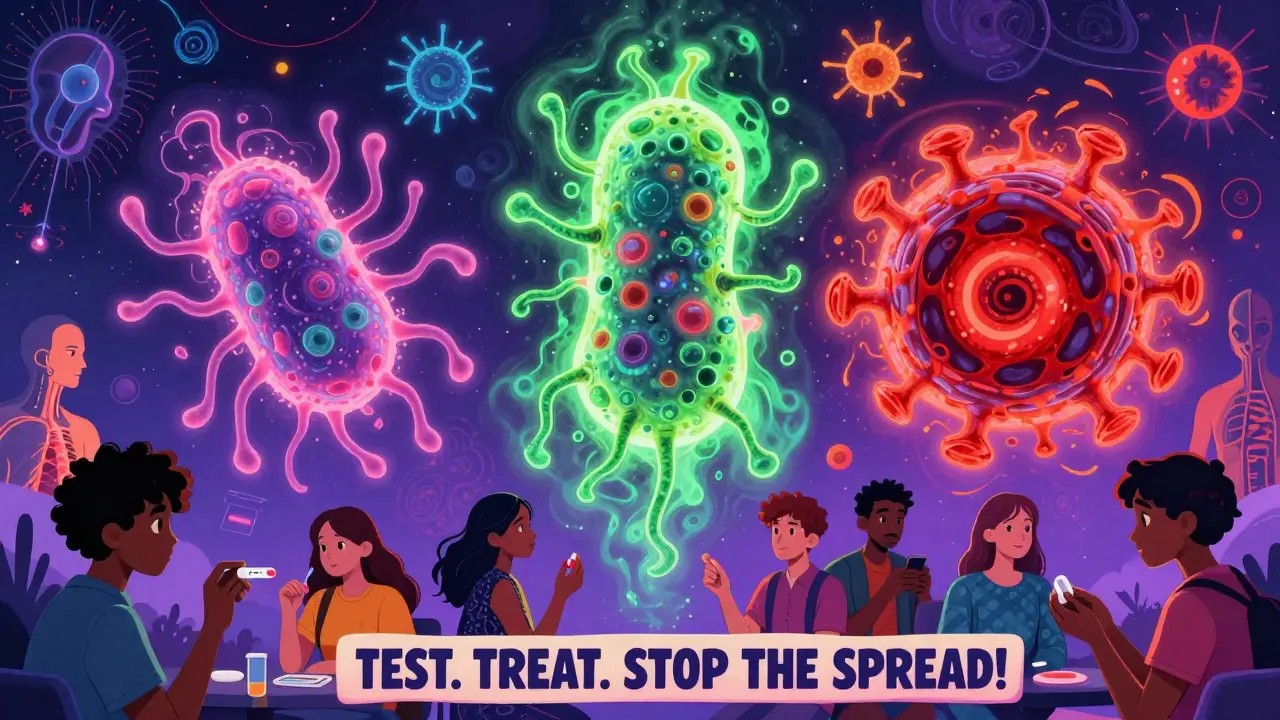
Chlamydia, gonorrhea, and syphilis aren’t just old-school health warnings-they’re rising again, especially among young people. In 2021, the U.S. saw over 2.5 million cases of these three bacterial STIs combined. Even though 2024 showed a 9% drop from the previous year, the numbers are still far too high. What’s worse? Most people don’t know they’re infected. Up to 95% of women with chlamydia have no symptoms. That’s why these infections are called silent epidemics-and why management isn’t just about treatment, but about early detection, smart prevention, and stopping the chain before it spreads.
What You Need to Know About Each Infection
Chlamydia is the most common bacterial STI in the world. It’s caused by Chlamydia trachomatis a bacterium that infects the cervix, urethra, rectum, and throat. It spreads through unprotected vaginal, anal, or oral sex. Most people don’t feel anything. When symptoms do show up, they’re mild: a burning feeling when peeing, unusual discharge, or spotting between periods. But if left alone, it can lead to pelvic inflammatory disease (PID) in women. About 10-15% of untreated cases develop PID, which can cause chronic pain, ectopic pregnancy, or infertility.
Gonorrhea, caused by Neisseria gonorrhoeae a highly adaptable bacterium that thrives in warm, moist areas of the reproductive tract, behaves similarly but is more aggressive. It can cause thick, yellow or green discharge, painful urination, and rectal itching or discharge. In men, it’s more likely to cause noticeable symptoms, but women often don’t realize they’re infected until complications arise. The big danger? Disseminated gonococcal infection (DGI). Though rare (0.5-3% of cases), it can lead to joint pain, skin lesions, and even life-threatening blood infections.
Syphilis is different. It doesn’t just sit quietly-it moves through stages. The first sign is a painless sore, called a chancre, usually on the genitals, rectum, or mouth. It appears 10-90 days after exposure and disappears on its own. That’s when many people think they’re fine. But the infection keeps going. Weeks later, a rash may appear on the palms and soles, along with fever, swollen glands, or hair loss. This is secondary syphilis. If still untreated, it can lie dormant for years, then reappear as tertiary syphilis-damaging the heart, brain, nerves, and eyes. That’s why syphilis was once called the "great imitator." It mimics so many other diseases.
How Testing Works Today
Testing is simple, fast, and often free at public clinics. For chlamydia and gonorrhea, a urine sample is the standard. Some clinics also use swabs from the vagina, urethra, throat, or rectum if there’s reason to suspect infection in those areas. Blood tests are the only way to diagnose syphilis. They look for antibodies your body makes to fight Treponema pallidum the spiral-shaped bacterium that causes syphilis. No symptoms? Still get tested if you’re sexually active, especially under 25. The CDC recommends annual screening for all sexually active women under 25 and for anyone with new or multiple partners.
For men who have sex with men (MSM), testing every 3-6 months is advised, especially if they’re on PrEP. Why? Because the risk is higher, and reinfection is common. In 2024, over 60% of new syphilis cases in the U.S. were among MSM. And don’t forget pregnant women. The CDC now requires syphilis screening at the first prenatal visit and again at 28 weeks in high-risk areas. Congenital syphilis-passed from mother to baby-is on the rise. Between 2017 and 2021, cases jumped 273%. Many babies are born with severe complications: bone deformities, blindness, or even death.
How These Infections Are Treated
Good news: all three are curable with antibiotics. Bad news: treatment is getting harder.
Chlamydia is still easy to treat. First-line is doxycycline-100 mg twice a day for 7 days. Azithromycin (a single 1-gram pill) is an alternative, especially if someone can’t take doxycycline. Cure rates are over 95% if taken correctly. But don’t stop there. Retest in 3 months. About 1 in 5 young women get reinfected, often from an untreated partner.
Gonorrhea is where things get scary. Antibiotic resistance has turned it into an urgent public health threat. The CDC’s current treatment is a one-time shot of ceftriaxone (500 mg into the muscle) plus a single oral dose of azithromycin. But resistance to azithromycin is already found in 30-50% of cases in some areas. That’s why the next big hope is zoliflodacin-a new antibiotic in phase 3 trials with 96% effectiveness. If approved by 2025, it could be the first new gonorrhea drug in decades.
Syphilis treatment depends on how long you’ve had it. Early syphilis (less than a year) gets one shot of benzathine penicillin G (2.4 million units). Late syphilis (over a year) needs three shots, one per week. If you’re allergic to penicillin, alternatives exist but are less reliable. That’s why testing early matters so much.

DoxyPEP: A Game-Changer for High-Risk Groups
There’s a new tool in the toolbox: doxycycline post-exposure prophylaxis, or DoxyPEP. Take a 200 mg pill within 72 hours after condomless sex, and you can cut your risk of chlamydia, gonorrhea, and syphilis by nearly half. Three major studies showed 47-73% reduction in cases among men who have sex with men and transgender women on PrEP. It’s not a magic shield-it doesn’t work for everyone. A trial in cisgender women showed no benefit. That’s why the CDC only recommends it for high-risk MSM and trans women. It’s not for everyone. But for those who need it, it’s a powerful prevention tool.
Why Partner Notification Is Non-Negotiable
Treating yourself isn’t enough. If you test positive, your partners must be treated too. Otherwise, you’ll just pass it back and forth. For chlamydia and gonorrhea, anyone you’ve had sex with in the past 60 days needs to be notified and treated. For syphilis, it’s up to 90 days. Many clinics offer partner services-anonymous notifications, free treatment for partners, even help with talking to people. Don’t try to handle this alone. It’s not about blame. It’s about stopping the spread.

Prevention: More Than Just Condoms
Condoms reduce transmission by 60-90% for chlamydia and gonorrhea, and 50-70% for syphilis. That’s huge. But they’re not perfect. Other steps matter too:
- Get tested regularly, even if you feel fine
- Limit partners or use protection every time
- Ask partners about their last STI test
- Use DoxyPEP if you’re in a high-risk group
- Get vaccinated for HPV and hepatitis B-these also protect your sexual health
And don’t ignore social factors. Black Americans face chlamydia rates 5.6 times higher and gonorrhea rates 6.7 times higher than white Americans. Why? Lack of access to care, stigma, underfunded clinics, and systemic gaps-not biology. Fixing STI rates means fixing those systems too.
What’s Next for STI Management?
The future hinges on three things: new drugs, better tests, and better access. Zoliflodacin could replace ceftriaxone for gonorrhea. Rapid point-of-care tests for syphilis are being developed so results come in minutes, not days. And the WHO’s Global STI Strategy 2021-2030 aims to cut chlamydia and gonorrhea by 70% and syphilis in pregnant women by 90% by 2030. That’s ambitious. But without funding, education, and equity in care, it won’t happen.
Right now, the U.S. spends over $16 billion a year treating STIs. That’s more than $500 million just for chlamydia. Prevention costs a fraction of that. A single test, a single pill, a single conversation can stop a lifetime of pain.
Can you get chlamydia or gonorrhea from kissing or sharing towels?
No. These infections require direct contact with infected mucous membranes-vagina, penis, rectum, throat, or eyes. Kissing, sharing towels, or using the same toilet won’t spread them. They’re not airborne or surface-transmitted. Sex or intimate genital contact is the only way.
If I test negative, does that mean my partner is clean too?
Not at all. STIs can be present without symptoms and show up on tests days or weeks after exposure. You could test negative today and still be infected if you were exposed recently. Always get tested together and wait at least 2 weeks after potential exposure before testing. If one of you tests positive, both need treatment-even if the other test is negative.
Is it safe to have sex again after treatment?
Wait at least 7 days after finishing all your medication. For syphilis, wait until your doctor confirms the infection is cleared. And don’t have sex with anyone until your partners have been treated too. Even if you feel fine, you can still pass it on during this window. Use condoms for at least 3 months after treatment to be extra safe.
Can you get syphilis more than once?
Yes. Having syphilis once doesn’t make you immune. You can get it again-even after successful treatment. That’s why regular testing is critical, especially if you’re sexually active with new or multiple partners. The same goes for chlamydia and gonorrhea. Immunity doesn’t develop after infection.
Why is gonorrhea becoming harder to treat?
Neisseria gonorrhoeae has evolved rapidly. It’s been exposed to antibiotics for decades and has developed resistance to nearly every class of drug used against it-from penicillin to ciprofloxacin to azithromycin. Now, it’s resistant to over 90% of previously effective antibiotics. That’s why we’re down to just one reliable treatment: ceftriaxone. Without new drugs, we could face untreatable gonorrhea within years.
Should I get tested even if I’m not sexually active?
Only if you’ve had any kind of sexual contact in the past-even once. STIs don’t care how often you have sex. If you’ve had unprotected vaginal, anal, or oral sex with someone who might be infected, you’re at risk. If you’ve never had sex, your risk is extremely low. But if you’re unsure, talk to a provider. Testing is quick, confidential, and often free.
Final Thoughts: Don’t Wait for Symptoms
Chlamydia, gonorrhea, and syphilis aren’t just about sex. They’re about access, awareness, and action. You don’t need to be reckless to get infected. You just need to be unaware. The good news? We have the tools. We know how to test. We know how to treat. We even have prevention strategies like DoxyPEP. What’s missing is consistent action-by individuals, clinics, and policymakers. Get tested. Talk to your partners. Use protection. If you’re high-risk, ask about DoxyPEP. And if you’re a provider, don’t wait for symptoms to appear. Screen early. Screen often. Because the next person you save might be someone you know.
dean du plessis
December 27, 2025 AT 01:23Miriam Piro
December 28, 2025 AT 08:10Kylie Robson
December 29, 2025 AT 00:03Caitlin Foster
December 30, 2025 AT 12:34Todd Scott
December 30, 2025 AT 19:53Andrew Gurung
January 1, 2026 AT 03:28James Bowers
January 1, 2026 AT 04:25Janice Holmes
January 3, 2026 AT 01:04Jane Lucas
January 4, 2026 AT 18:31Elizabeth Alvarez
January 5, 2026 AT 21:33Paula Alencar
January 5, 2026 AT 21:48Nikki Thames
January 7, 2026 AT 06:18Chris Garcia
January 7, 2026 AT 15:47