
Every year, more people turn to online pharmacies for convenience - late-night refills, home delivery, price comparisons. But behind that ease is a hidden risk: your medical data. Your prescriptions, diagnoses, even your credit card details are sitting on servers that may not be secure. In 2026, if you’re using an unverified online pharmacy, you’re not just risking your health - you’re risking your identity.
Most online pharmacies are unsafe
The numbers don’t lie. According to the National Association of Boards of Pharmacy (NABP), 96% of websites selling prescription drugs online break the law. That means only 4 out of every 100 sites you might stumble on are actually legal and secure. These rogue pharmacies don’t just sell fake pills - they steal your personal data. A 2025 report found that 78% of non-compliant sites don’t even use proper encryption. Your name, address, and medication history? Easily scraped and sold.What makes a pharmacy actually safe?
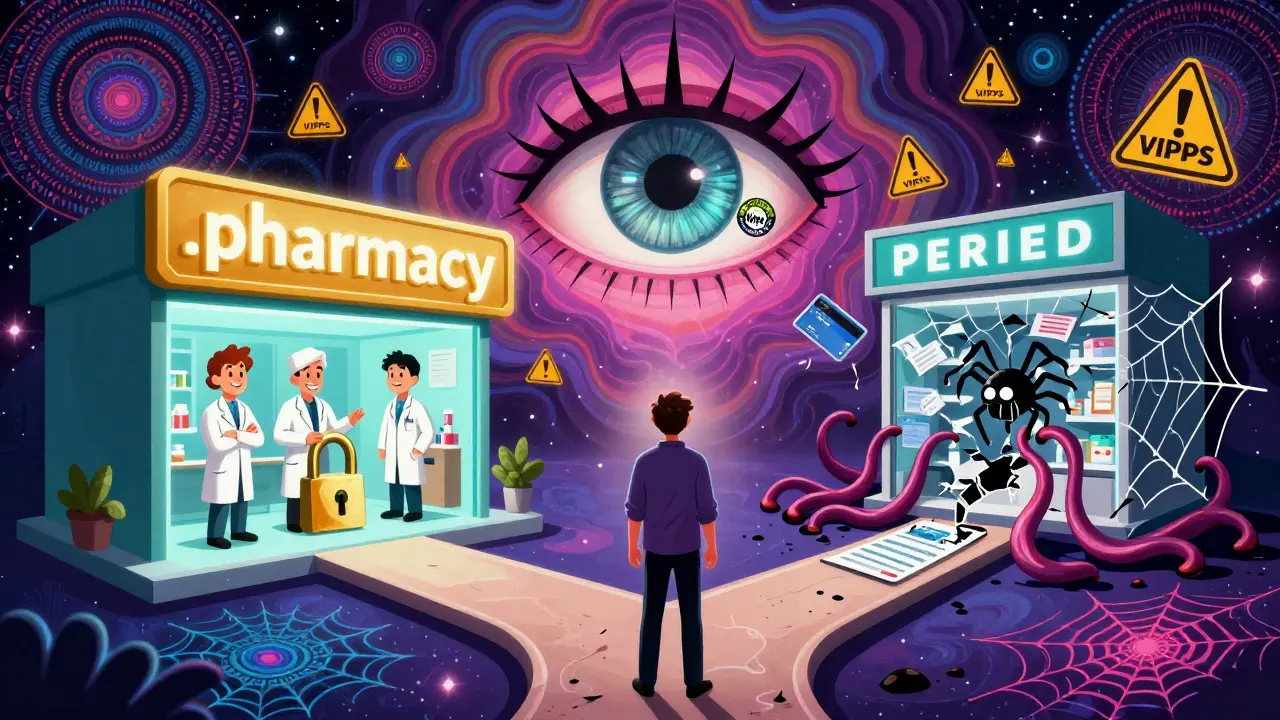
Not all online pharmacies are dangerous. There’s a small group - just 68 in the entire U.S. as of February 2025 - that meet strict safety standards. They’re called VIPPS-accredited pharmacies. To earn that seal, they pass 21 rigorous checks: licensed pharmacists on staff, verified physical addresses, secure data handling, and real-time prescription verification. These pharmacies follow HIPAA rules, meaning your health info is protected by federal law.The easiest way to spot one? Look for the .pharmacy domain. This isn’t just a fancy web address. It’s a verified badge. Only pharmacies that prove they’re licensed in every state they operate in, have a real physical location, and meet federal privacy rules get this domain. If a site ends in .pharmacy, it’s been vetted by NABP - the same group that shuts down illegal operations.
What your pharmacy should never do
Red flags are everywhere. If a site offers:- “No prescription needed” - walk away.
- Prices that are 70% lower than your local pharmacy - too good to be true.
- Only accepts wire transfers or cryptocurrency - real pharmacies use credit cards and insurance.
- Has no phone number or physical address listed - fake sites hide behind PO boxes.
- Asks for your health info before you even upload a prescription - that’s a data grab.
Legitimate pharmacies require a valid prescription from a licensed doctor. They don’t ask you to skip the medical review. They don’t rush you. They protect your records.
How your data gets stolen
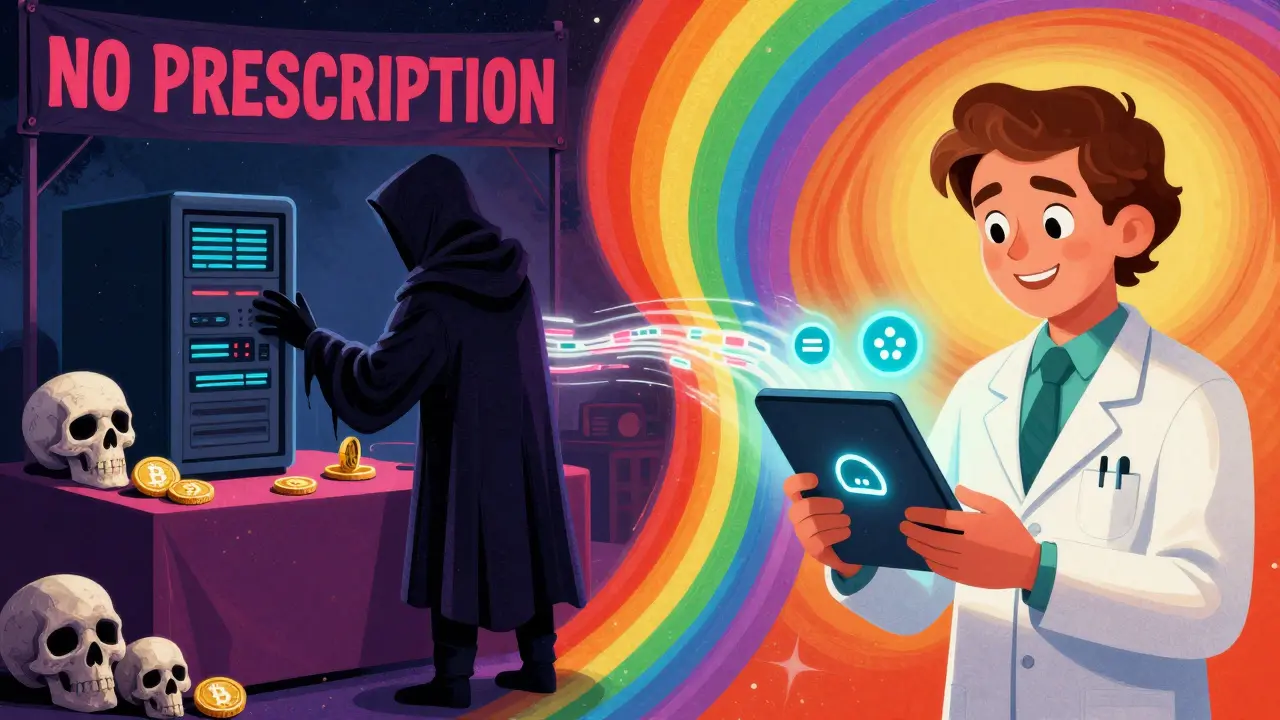
Illegal online pharmacies don’t just sell fake Adderall or Viagra. They harvest your information like a digital thief. Once you enter your name, email, prescription details, and payment info, that data gets sold on dark web marketplaces. Within hours, you might get spam calls asking, “Are you still taking your blood pressure meds?” - because they know exactly what you’re on.Reddit users in r/pharmacy shared stories of getting targeted scam emails referencing their specific prescriptions - one person received an email offering “discounted insulin” just 12 hours after ordering from a sketchy site. Another reported a $4,200 fraudulent charge on their card within 48 hours of submitting their prescription.
Even worse, 39% of fake pharmacy sites now copy real verification badges using high-quality graphics. They’ll show a fake VIPPS seal or mimic the .pharmacy logo. You can’t trust what you see - you have to verify what’s behind it.
How to protect yourself
You don’t need to avoid online pharmacies entirely. But you do need to be smart. Here’s how:- Check for the .pharmacy domain. Type it yourself - don’t click links from ads or emails.
- Verify the VIPPS seal. Click it. It should link to the NABP verification page showing the pharmacy’s license status.
- Call the pharmacy. Ask for their license number and verify it with your state board of pharmacy.
- Use a separate email for pharmacy accounts. Don’t use your main one. This limits damage if your data leaks.
- Never pay with a debit card or wire transfer. Use a credit card - it offers fraud protection.
- Enable two-factor authentication on your pharmacy account if it’s offered.
- Review your bank and insurance statements monthly. Look for unfamiliar charges labeled as “pharmacy,” “meds,” or “health services.”
Consumers who follow these steps report 94% satisfaction with privacy protection, according to NABP’s 2024 survey. Those who skip them? 29% experience some form of data misuse.
The new rules in 2026
Regulations are catching up. As of March 21, 2025, the DEA requires online pharmacies to verify patient identity using government-issued ID with biometric checks before filling controlled substance prescriptions. New York State now requires all prescriptions - even for antibiotics - to be sent electronically, cutting down on forged paper scripts.By September 2025, every pharmacy - online or not - must use multi-factor authentication for remote access to patient records. And by 2026, they’ll need annual third-party security audits. These aren’t suggestions. They’re federal law.
But enforcement is still catching up. Only 21% of online pharmacies currently meet all these standards. That means most still operate in the gray zone - and your data is still at risk.
Why brick-and-mortar pharmacies are still safer
If you’re unsure, stick with your local pharmacy. According to HHS Office for Civil Rights data, 94.3% of physical pharmacies comply with HIPAA privacy rules. Online? Only 58.1%. In-person pharmacies don’t store your data on public servers. They don’t rely on third-party delivery platforms. You talk to a pharmacist face-to-face. You know who has your records.That doesn’t mean online pharmacies are all bad. But it does mean you need to be more careful. Convenience shouldn’t cost you your privacy.
What to do if you’ve already used a sketchy site
If you’ve ordered from a site that didn’t look right:- Change your password on every account that uses the same email or password.
- Place a fraud alert on your credit report through Experian, Equifax, or TransUnion.
- Report the site to the NABP at nabp.net - they track illegal operations.
- File a complaint with the FTC at ReportFraud.ftc.gov.
- Monitor your bank and medical statements for unusual activity for at least 12 months.
Don’t wait. Data breaches from fake pharmacies are fast. Your information is already in the hands of criminals.
Bottom line
Online pharmacies can be safe - but only if you know how to find the real ones. The .pharmacy domain and VIPPS seal are your best tools. Anything else? Treat it like a scam. Your health data is more valuable than your credit card number. Protect it like it.How do I tell if an online pharmacy is legitimate?
Look for the .pharmacy domain and the VIPPS seal. Click both to verify they link to official NABP pages showing the pharmacy’s license status. A real online pharmacy will also list a physical address, provide a working phone number, require a valid prescription, and use secure payment methods like credit cards - never wire transfers or cryptocurrency.
Can I trust online pharmacies that offer no-prescription medications?
No. Any site offering prescription drugs without a valid prescription is breaking federal law. These are illegal operations designed to steal your personal and financial data. Even if the medication looks real, the source is unregulated and dangerous. Legitimate pharmacies always require a prescription from a licensed provider.
What should I do if I think my data was stolen from an online pharmacy?
Immediately change passwords for all accounts using the same email or password. Place a fraud alert with one of the three major credit bureaus. Report the pharmacy to the NABP and file a complaint with the FTC. Monitor your bank and insurance statements closely for the next year. Consider freezing your credit if you see signs of identity theft.
Are .pharmacy websites always safe?
Yes - if they’re the real thing. The .pharmacy domain is only granted after a 47-point verification process by NABP, including checks for valid licenses, physical addresses, and compliance with privacy laws. However, fake sites sometimes copy the look of the .pharmacy logo. Always click the domain link to confirm it redirects to the official NABP verification page.
Why do some online pharmacies have lower prices?
Lower prices are often a trap. Legitimate pharmacies pay for licensing, secure systems, pharmacist consultations, and compliance with federal laws. Illegal sites skip all of that. They may sell counterfeit, expired, or contaminated drugs - or just take your money and disappear. The savings aren’t worth the risk to your health or identity.
Is it safer to use my local pharmacy’s online portal?
Yes. Most brick-and-mortar pharmacies offer secure online portals linked directly to their licensed systems. These portals are HIPAA-compliant, use encrypted connections, and are monitored by trained staff. They’re far safer than third-party online pharmacies you find through search engines or ads.
siva lingam
January 22, 2026 AT 14:54Luke Davidson
January 24, 2026 AT 10:54Don Foster
January 25, 2026 AT 04:52Karen Conlin
January 26, 2026 AT 18:18Patrick Gornik
January 27, 2026 AT 18:58Amelia Williams
January 28, 2026 AT 21:54Chloe Hadland
January 30, 2026 AT 20:39Dolores Rider
January 31, 2026 AT 05:37Jenna Allison
February 1, 2026 AT 08:59Viola Li
February 2, 2026 AT 16:13asa MNG
February 3, 2026 AT 09:17Vatsal Patel
February 5, 2026 AT 01:12Phil Maxwell
February 5, 2026 AT 13:27Heather McCubbin
February 7, 2026 AT 02:04