
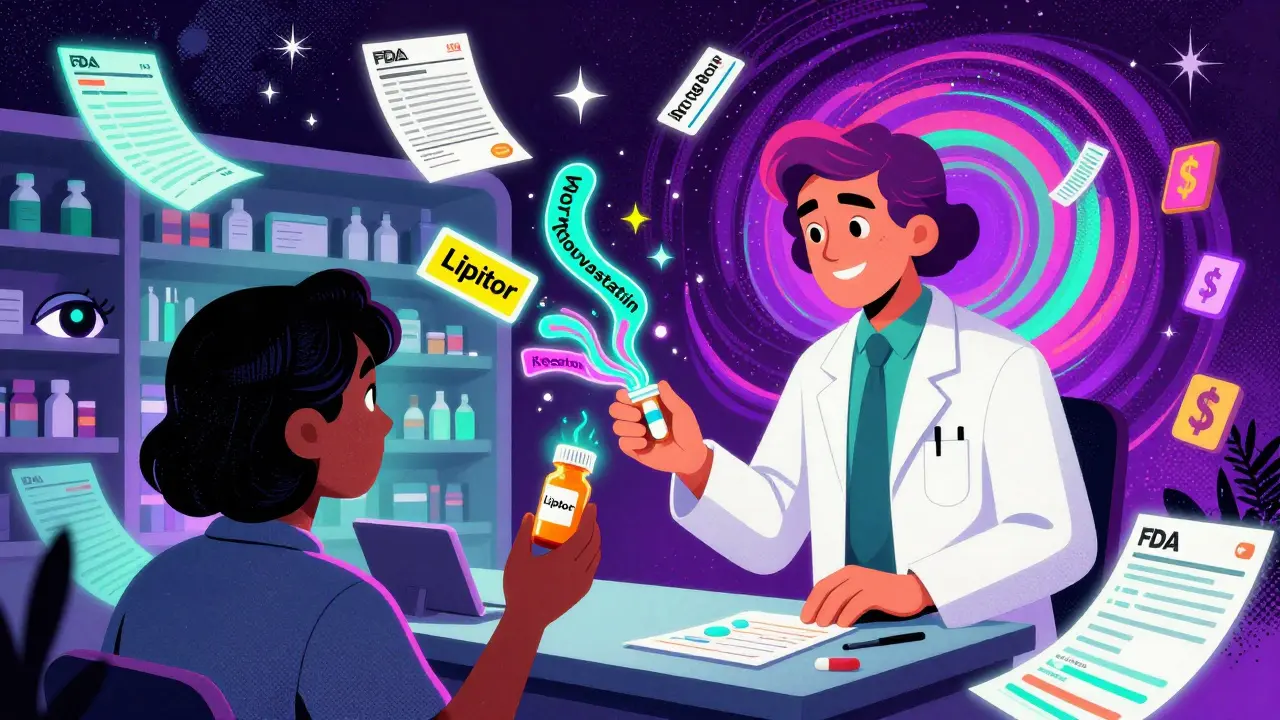
Every time you pick up a prescription, there’s a good chance the pill in your hand isn’t the exact brand your doctor wrote on the paper. That’s not a mistake. It’s the law. In 43 out of 50 U.S. states, pharmacists are allowed to swap your brand-name drug for a cheaper generic version without asking you first. This is called presumed consent. You didn’t say yes. You didn’t say no. But they assumed you’d be okay with it-and in most cases, you are.
How Presumed Consent Works
Presumed consent isn’t about skipping safety. It’s about efficiency. When your doctor prescribes, say, Lipitor for cholesterol, the pharmacy system checks the FDA’s Orange Book-the official list of approved drugs and their therapeutic equivalents. If a generic version is rated "A" (meaning it’s bioequivalent), the pharmacist can dispense it instead, unless your state says otherwise.
It’s not magic. It’s science. Generic drugs have the same active ingredients, strength, dosage form, and route of administration as the brand. They’re tested to work the same way in your body. The FDA requires them to be within 80-125% of the brand’s absorption rate. That’s tight. Most generics are just as safe and effective.
But here’s the catch: you might never know it happened. Unless the pharmacist tells you, or the label changes, you could be taking a different pill for months. And that’s intentional. The goal is to cut costs without slowing down the process. A 2022 study found that presumed consent saves pharmacies about 1.7 minutes per prescription. Multiply that by millions of fills, and you’re talking billions in labor savings.
Where It’s Allowed (And Where It’s Not)
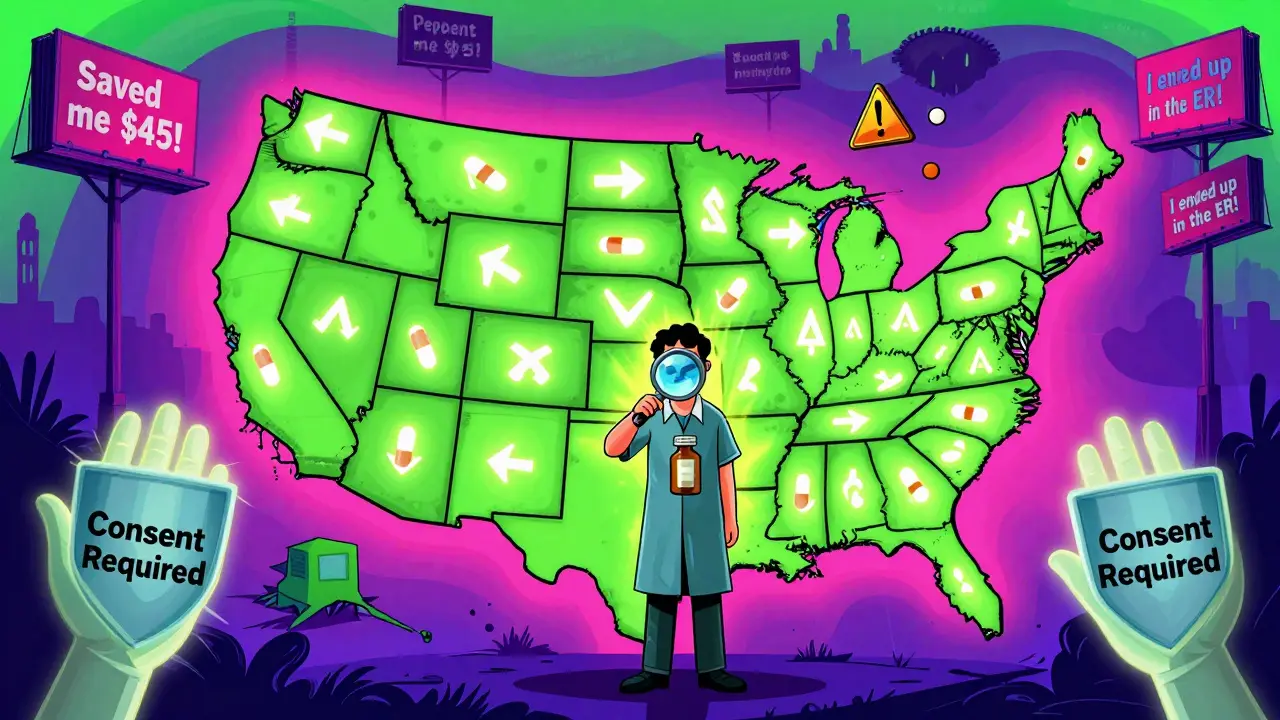
Not every state plays by the same rules. In 19 states, pharmacists are required to substitute generics if available. In 31 others, they’re allowed to-but don’t have to. And then there are the 7 states plus Washington, D.C., that demand your explicit permission before swapping: Alaska, Delaware, Hawaii, Maine, Maryland, New Mexico, and West Virginia.
Why the difference? It comes down to history, politics, and patient advocacy. States with strong pharmacy associations and cost-conscious legislatures pushed for presumed consent early on. Others listened to patient groups worried about control over their own care.
Even within presumed consent states, rules vary. Thirty-one states require pharmacists to notify you after the swap-usually through a sticker on the bottle or a slip in the bag. Others don’t. Some states protect pharmacists from lawsuits if something goes wrong. Others don’t. There’s no national standard. That means if you move from Florida to New York, your pharmacy might suddenly start asking you questions you never heard before.
When Substitution Can Be Risky
Most of the time, switching to a generic is harmless. But for certain drugs, even tiny differences matter. These are called narrow therapeutic index (NTI) drugs. A small change in blood levels can mean the difference between control and crisis.
Antiepileptic drugs like phenytoin or carbamazepine are classic examples. The American Epilepsy Society documented 178 cases of breakthrough seizures between 2018 and 2022 linked to generic switches. That’s not common-but it’s real. Fifteen states now have special rules: no substitution without your consent, or no substitution at all for these drugs.
Other NTI drugs include warfarin (blood thinner), levothyroxine (thyroid hormone), and some seizure and psychiatric meds. In these cases, the FDA says generics are equivalent. But doctors and patients report real-world problems. A 2023 study in Health Affairs found that patients on levothyroxine who switched generics were 30% more likely to have abnormal thyroid levels in the following months.
That’s why some pharmacists quietly avoid swapping these drugs-even in presumed consent states. They know the risk isn’t just theoretical. It’s personal.

Biosimilars: The Next Frontier
Now imagine switching from a brand-name biologic drug like Humira to a biosimilar. These aren’t pills. They’re complex proteins made from living cells. They’re not exact copies. They’re "similar enough." And the rules are even messier.
Only 46 states allow automatic substitution of interchangeable biosimilars. Four states-North Carolina, Oklahoma, Pennsylvania, and Texas-ban it entirely. Why? Because unlike small-molecule generics, biosimilars aren’t tested the same way. Their manufacturing process affects how they work. And patients can develop antibodies to them, making future treatments less effective.
In 2023, California passed a law requiring pharmacists to notify patients and get their consent before switching to a biosimilar. New York followed with similar rules. But in most states? No notification. No consent. Just a swap.
What Patients Actually Think
Most people don’t mind. On Drugs.com, 68% of 1,243 comments about generic substitution were positive. "Saved me $45 a month," one user wrote. Another said, "I didn’t even notice the difference."
But the other 22%? They’re not wrong. "My seizure meds stopped working after they switched," said one patient from Tennessee. "I ended up in the ER."
Pharmacists report the same split. In Ohio, one pharmacist on Reddit said 95% of patients never notice. But the 5% who do? They get angry. They feel tricked. They lose trust-not just in the pharmacy, but in the whole system.
And here’s the irony: patients who are told about the switch are more likely to accept it. A 2022 survey found that when pharmacists explained why the change was made, 89% of patients said they were okay with it. But when they found out after the fact? Only 51% felt the same way.
What You Can Do
You don’t have to wait for a law to change. You have rights, even in presumed consent states.
- Ask for the brand when your doctor writes the script. They can write "Dispense as Written" or "Do Not Substitute." It’s legal. They just have to check the box.
- Check the label every time. If the name, color, or shape changed, ask why.
- Know your meds. If you’re on a narrow therapeutic index drug-like epilepsy, thyroid, or blood thinner meds-be extra careful. Don’t assume the pharmacist knows your history.
- Speak up. If you feel something’s off after a switch, call your pharmacist. They’re trained to help. And if they don’t listen? Call your doctor.
Most pharmacists want you to be safe. They’re not trying to hide anything. But they’re also under pressure to fill scripts fast, save money, and follow confusing state rules. You’re not the problem. The system is.
The Bigger Picture
Presumed consent saves the U.S. healthcare system about $1.68 trillion over ten years. That’s real money. It keeps insurance premiums lower. It helps Medicare beneficiaries save an average of $627 a year.
But savings shouldn’t come at the cost of trust. The real challenge isn’t whether generics work. It’s whether patients feel respected.
Some experts are pushing for a "tiered consent" model: presumed consent for most drugs, but explicit permission for high-risk ones. That’s already happening in 15 states for antiepileptics. It could become the standard.
Right now, we’re stuck in a patchwork. One state lets pharmacists swap without a word. Another requires a signed form. A third bans swaps for certain drugs entirely. It’s confusing. It’s inefficient. And it puts the burden on patients to know the rules.
Maybe one day, there’ll be a national standard. Until then, your best tool isn’t a law. It’s your voice. Ask questions. Check labels. Speak up. You’re not just a patient. You’re the one who takes the pill every day. You deserve to know what’s in it-and why.
Alex Flores Gomez
January 29, 2026 AT 11:05So let me get this straight-we’re okay with pharmacists playing doctor by swapping meds like it’s a fucking game of musical pills? I’m not some lab rat in a corporate cost-cutting experiment. If I’m on a script that keeps me alive, I want the same damn pill every time. No ‘presumed consent’-just give me the brand or shut up.
Pawan Kumar
January 30, 2026 AT 15:00It is fascinating how the American pharmaceutical-industrial complex has normalized the erosion of patient autonomy under the guise of ‘efficiency.’ One must question whether the FDA’s bioequivalence thresholds are truly reflective of individual physiological variance. The data from Health Affairs is not merely statistical-it is a harbinger of systemic negligence.
Keith Oliver
January 31, 2026 AT 15:13Bro, generics are literally the same shit. I’ve switched back and forth between Lipitor and atorvastatin for 5 years. My cholesterol’s fine, I saved $80 a month, and I didn’t turn into a zombie. Stop being dramatic. If you’re paranoid, ask your doc to write DAW. Simple.
Kacey Yates
January 31, 2026 AT 22:50NTI drugs need consent. Period. I’m a nurse. I’ve seen seizures triggered by generic swaps. Stop pretending it’s just about money. People die because of lazy pharmacy protocols. Write DAW on scripts for epilepsy, warfarin, levothyroxine. It’s not hard.
Ryan Pagan
February 2, 2026 AT 16:04Y’all are acting like pharmacists are some kind of shadowy drug cartel. They’re overworked, underpaid, and trying to keep 300 scripts moving before lunch. The real villain? The system that pays them pennies per script and then blames them for cutting corners. If you want control, be proactive. Ask. Check the label. Tell your doc you’re not cool with swaps. It’s not magic-it’s just communication.
Paul Adler
February 3, 2026 AT 00:08There’s a quiet dignity in trusting professionals to make sensible decisions-especially when those decisions are backed by science. The vast majority of patients benefit from generic substitution without even knowing it. The outliers are tragic, yes-but they shouldn’t dictate policy for millions. A tiered approach, as mentioned, seems both pragmatic and humane.
Sheryl Dhlamini
February 4, 2026 AT 23:50I had a friend who went from brand-name levothyroxine to generic and started having panic attacks, hair loss, and zero energy. She didn’t know it was switched until she saw the label. She cried for an hour. I cried with her. This isn’t just ‘cost savings.’ It’s someone’s entire sense of stability being rewritten without consent. I don’t care how many studies say it’s ‘safe’-if it breaks someone’s life, it’s wrong.
Doug Gray
February 5, 2026 AT 08:00Is this not just another manifestation of late-stage capitalist alienation? We outsource autonomy to algorithms and bureaucrats, then wonder why we feel hollow. The pill is a symbol-of control, of trust, of the body as data point. We don’t question the system because we’ve been trained to believe efficiency is virtue. But what is a life measured in minutes saved per prescription?
Kristie Horst
February 5, 2026 AT 19:27Oh, so now we’re supposed to be grateful that our lives are being optimized like a supply chain spreadsheet? How thoughtful. Next time, maybe they’ll just inject the generic version directly into your bloodstream and call it ‘streamlined care.’ 🙃
LOUIS YOUANES
February 6, 2026 AT 12:15They say generics save billions. But who’s paying the price? The guy who has to go back to the ER because his seizure meds ‘weren’t the same.’ The woman whose thyroid went haywire and lost her job. The system doesn’t care. It just wants the numbers to look good. And we’re supposed to nod along like good little consumers.
Andy Steenberge
February 7, 2026 AT 08:12Everyone’s got a point. The system is broken. But the solution isn’t outrage-it’s action. If you’re on a high-risk med, ask your doctor to write ‘Do Not Substitute.’ If you’re not, maybe you can help someone who is. Talk to your pharmacist. Share your story. Push for state-level reforms. Change doesn’t come from yelling. It comes from showing up, one prescription at a time.