
How Pharmacy Reimbursement Laws Direct What You Pay for Generic Drugs
If you’ve ever picked up a generic prescription and been shocked by the price-even though the brand-name version costs way more-you’re not imagining things. The reason isn’t just about drug manufacturing. It’s about a tangled web of laws, reimbursement models, and middlemen that decide how much pharmacies get paid… and how much you pay out of pocket.
In the U.S., 9 out of 10 prescriptions are for generic drugs. But only about 1 in 5 of those prescriptions actually saves patients money at the counter. Why? Because reimbursement rules don’t always match real-world costs. And the laws behind them? They’re designed to cut costs… but often end up shifting them to the wrong people.
The Two Main Ways Pharmacies Get Paid for Generics
When you fill a generic prescription, the pharmacy doesn’t just get paid whatever it paid for the pills. Instead, it gets reimbursed based on one of two systems: Average Wholesale Price (AWP) or Maximum Allowable Cost (MAC).
AWP used to be the default. It’s a list price set by manufacturers-not what pharmacies actually pay. Pharmacies were reimbursed by subtracting a percentage (say, 15-20%) from that inflated AWP. That created a gap: pharmacies could make more on brand-name drugs than generics, even if the generic cost less to buy.
Today, MAC is the standard for generics. It’s a cap set by pharmacy benefit managers (PBMs) based on what the drug actually costs in the market. If a 30-day supply of generic lisinopril costs $4 at the wholesaler, the MAC might be set at $5. The pharmacy gets $5. If the pharmacy bought it for $4.50, it makes 50 cents. If it bought it for $6? It loses money.
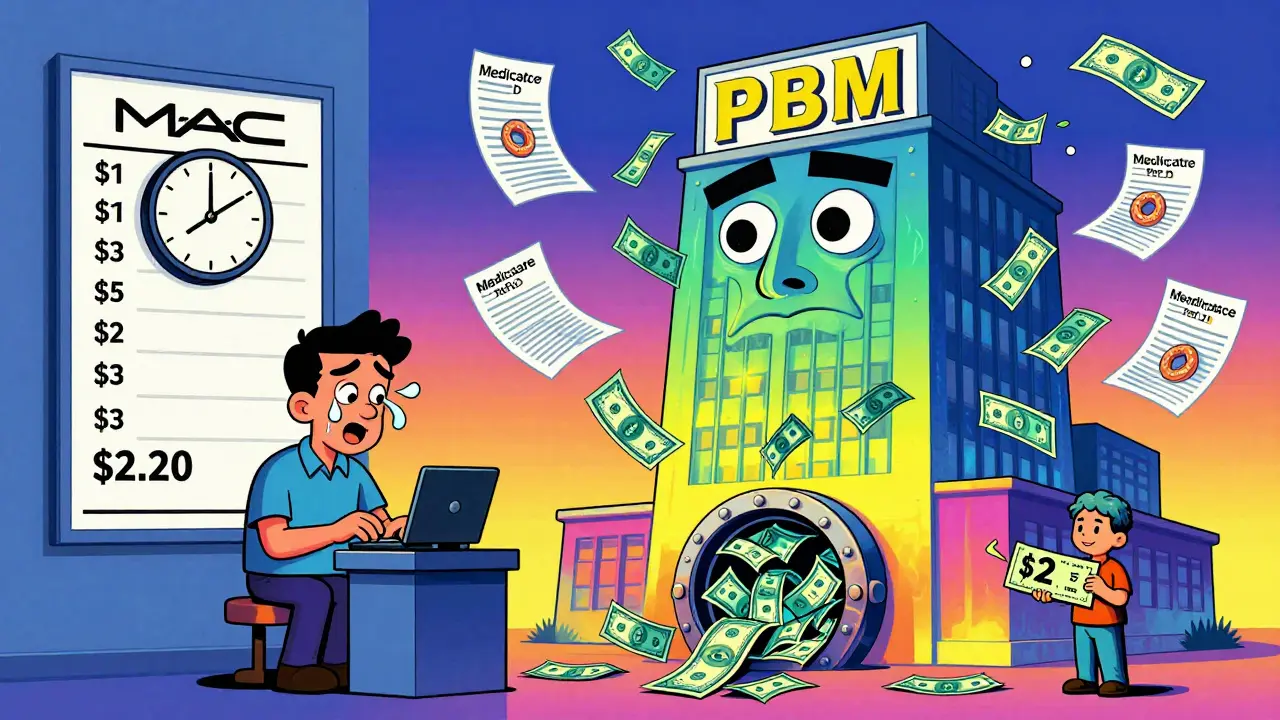
This sounds fair-until you realize MAC lists are rarely updated. Some states update them quarterly. Others, once a year. Meanwhile, drug prices drop fast. A generic that costs $3 today might be $2.20 next month. But the MAC stays at $3. The pharmacy eats the difference. Independent pharmacies, especially, are squeezed. In 2023, the average profit margin on generic drugs was just 1.4%. In 2018, it was 3.2%.
How Medicare Part D Shapes Generic Access
Medicare Part D covers over 50 million seniors and disabled Americans. Its formulary rules directly impact what generics are covered-and how much patients pay.
Part D plans use tiered copays. Generics usually sit on Tier 1, with the lowest copay. But that doesn’t mean low cost. Many plans have high deductibles. You might pay $5 for a generic… but only after spending $500 out of pocket first. In 2022, 28% of Part D plans required prior authorization for at least one generic drug. That means your doctor has to call in paperwork before you can even get it.
There’s also the “donut hole”-the coverage gap. Before 2025, beneficiaries paid 25% of drug costs once they hit the initial coverage limit. Now, thanks to the Inflation Reduction Act, that gap is closing. But the real change? A $2,000 annual out-of-pocket cap starting in 2025. That will force plans to cover more generics earlier in the year.
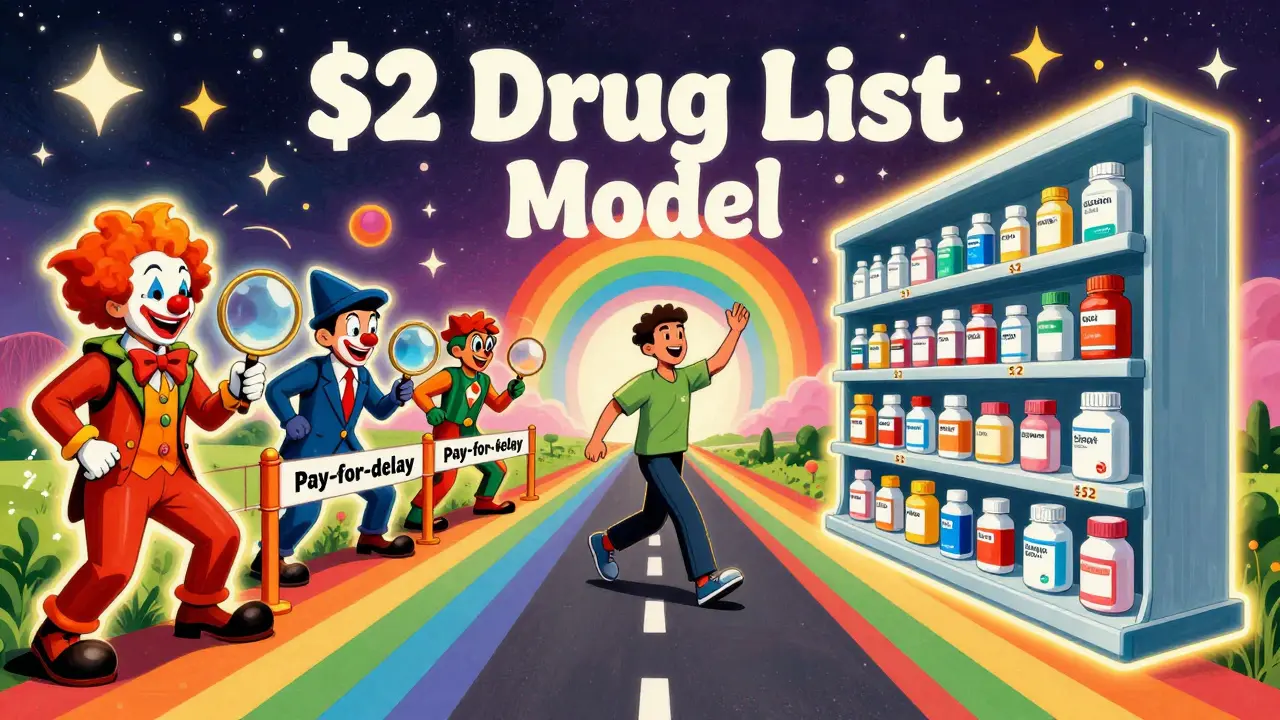
And then there’s the new Medicare $2 Drug List Model. Starting in 2026, Part D plans can voluntarily join a program that caps copays at $2 for about 100-150 low-cost, high-use generics-drugs like metformin, levothyroxine, or atorvastatin. It’s modeled after grocery store generic pricing. If you can buy a 30-day supply of generic ibuprofen for $2 at Walmart, why shouldn’t Medicare beneficiaries pay the same?
The Hidden Middlemen: PBMs and Spread Pricing
Behind every prescription claim is a pharmacy benefit manager (PBM). CVS Caremark, Express Scripts, and OptumRX control over 80% of U.S. prescription claims. They don’t sell drugs. They negotiate prices with manufacturers, set reimbursement rates for pharmacies, and manage formularies.
One of their biggest revenue streams? Spread pricing. Here’s how it works:
- Insurer agrees to pay $10 for a generic drug.
- PBM tells the pharmacy it will be paid $6.
- PBM pockets the $4 difference.
This $4 isn’t transparent. Patients see a $10 copay. The pharmacy gets $6. The insurer thinks it paid $10. The PBM keeps $4. No one knows the real cost of the drug-not even the pharmacy.
That’s why, before 2018, “gag clauses” were common. Pharmacists weren’t allowed to tell you that paying cash for your generic might cost less than your $10 copay. A 2019 study found 1 in 5 prescriptions were affected. Today, those clauses are banned. But the spread pricing? Still happening. And it’s one reason why pharmacies struggle to stay open.
State Laws Are Trying to Fix the System
Federal rules don’t cover everything. That’s why 44 states have passed laws targeting pharmacy reimbursement. Some require PBMs to update MAC lists monthly. Others ban spread pricing entirely. A few, like California and New York, now require PBMs to disclose their reimbursement formulas to pharmacies.
States also run Medicaid Preferred Drug Lists (PDLs). These lists decide which generics are covered-and which need prior authorization. If your state’s PDL doesn’t include a certain generic, your doctor has to jump through hoops to get it approved. Some states even require PBMs to reimburse pharmacies at or above the actual acquisition cost. That’s a big deal for small pharmacies.
But there’s a catch: state laws vary wildly. A pharmacy in Texas might be reimbursed based on a different MAC list than one in Illinois. That creates chaos for national chains and makes it harder for patients to predict costs when they travel.
Why Authorized Generics Are Hurting Real Competition
Here’s something most patients don’t know: sometimes, the “generic” you’re getting is made by the same company that makes the brand-name drug. These are called authorized generics.
Brand-name companies release them to compete with new generics-often right when the first generic hits the market. The result? Instead of 5-10 generic manufacturers driving prices down, you get one: the brand company’s own version. Prices don’t drop as much. Competition stalls.
The FDA and FTC have flagged this as a problem. In some cases, brand companies pay the first generic manufacturer to delay entering the market-a “pay-for-delay” deal. These settlements can delay generic entry for years. The FTC has cracked down, but they’re still happening. And they directly hurt patients who pay more because competition never fully kicks in.
What’s Next? Value-Based Payments and the Future of Reimbursement
The current system is fee-for-service: pay per pill. But that doesn’t reward better health outcomes. Experts are pushing for value-based models-where pharmacies get paid for helping patients take their meds, not just for dispensing them.
Imagine a pharmacy getting paid extra if a patient with high blood pressure sticks to their generic lisinopril for 6 months. Or if a diabetic’s A1C drops because they’re on a low-cost generic metformin. That’s the future. But it’s years away. CMS estimates it’ll take 5-7 years to shift from volume-based to value-based payment.
For now, the biggest changes are coming from the $2 Drug List Model and the $2,000 out-of-pocket cap. These will force PBMs and insurers to be more transparent. They’ll also make it harder to hide spread pricing behind complex formularies.
What This Means for You
If you’re on a generic drug, here’s what you can do:
- Ask your pharmacist: “Is this the lowest price I can get?”
- Check if your drug is on the $2 Drug List (if you’re on Medicare).
- Compare cash price vs. insurance price-even if you have insurance.
- Call your plan’s customer service and ask: “What’s the MAC for this generic?”
- If your copay is high, ask your doctor if there’s a preferred generic on your plan’s formulary.
Pharmacy reimbursement laws aren’t about drug quality. They’re about money-who gets paid, how much, and who ends up footing the bill. Understanding how these systems work gives you power. You don’t have to just accept the price at the counter. You can ask why it’s that high… and push for a better one.
Anna Pryde-Smith
January 22, 2026 AT 09:55Kerry Evans
January 23, 2026 AT 00:10Susannah Green
January 24, 2026 AT 10:38Kerry Moore
January 24, 2026 AT 19:10charley lopez
January 25, 2026 AT 15:21Oladeji Omobolaji
January 26, 2026 AT 21:19Janet King
January 27, 2026 AT 20:20Sallie Jane Barnes
January 29, 2026 AT 07:50Andrew Smirnykh
January 29, 2026 AT 19:36Laura Rice
January 30, 2026 AT 00:02Sue Stone
January 30, 2026 AT 17:21