
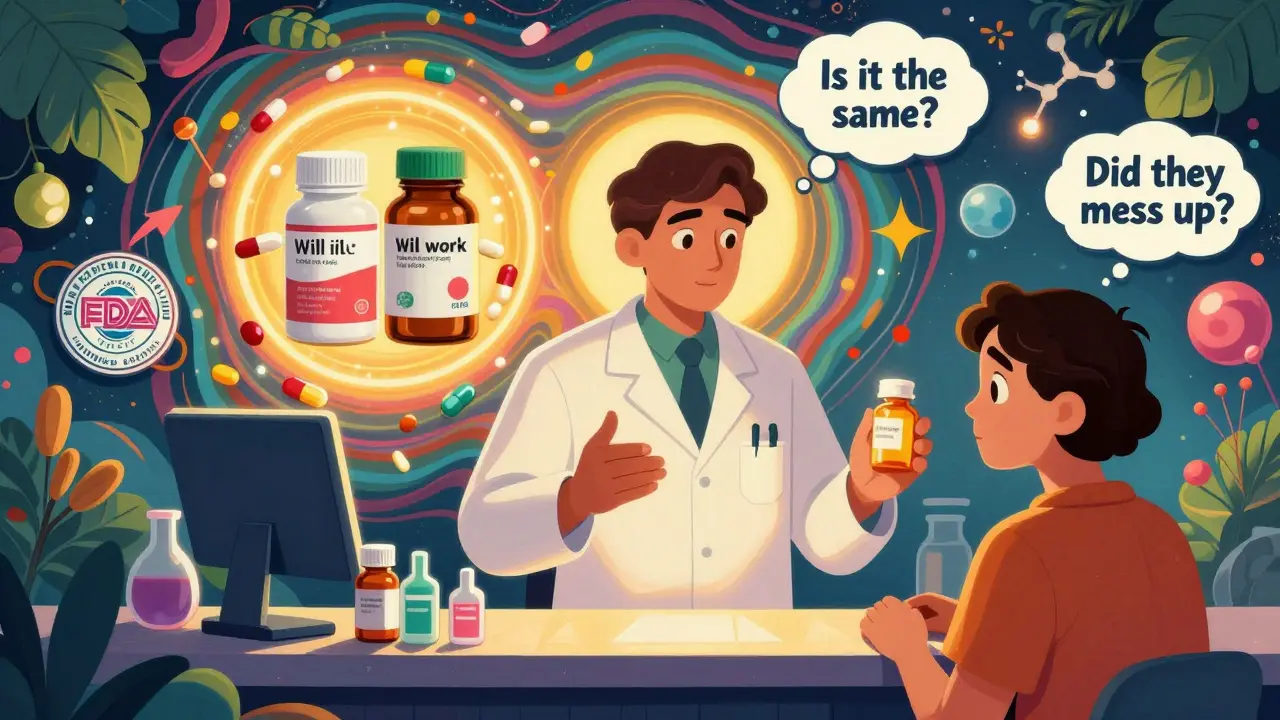
When a patient picks up a prescription and sees that the pill looks different from last time, their first thought isn’t always, ‘Great, I’m saving money.’ More often, it’s, ‘Is this the same drug?’ or ‘Did they give me the wrong one?’ This moment - when a generic replaces a brand-name drug - is one of the most critical touchpoints in pharmacy care. And it’s not enough to just hand over the bottle and say, ‘It’s the same thing.’ Pharmacists have a legal and ethical duty to explain what’s happening. Failure to do so doesn’t just risk confusion - it risks patients stopping their meds altogether.
Why Generic Counseling Isn’t Optional
In the U.S., federal law under OBRA ’90 made patient counseling mandatory for all new prescriptions, and it specifically includes generic substitutions. Every state requires pharmacists to counsel patients when switching to generics - but the rules vary. Some states demand a verbal explanation. Others require written notice. A few still let pharmacists skip it unless the patient asks. That inconsistency doesn’t make the job easier - it makes it harder. What’s clear? Patients are being switched to generics more than ever. In 2023, 90.7% of all prescriptions filled in the U.S. were for generic drugs. But they only account for 23.7% of total drug spending. That’s billions saved. But if patients don’t take their meds because they think the generic is weaker, those savings vanish.
Studies show 43% of patients believe generics are less effective. Another 37% think they cause more side effects. One Reddit user stopped taking blood pressure medication for two weeks because the pills changed color. Another said their pharmacist showed them side-by-side photos of the brand and generic - and that one minute saved them from quitting their treatment. This isn’t anecdotal. It’s systemic. And it’s fixable.
The Five Essential Talking Points
There’s no magic script, but research and regulatory guidelines point to five non-negotiable elements every pharmacist must cover during generic counseling:
- Confirm the patient’s identity. Always verify who you’re speaking with. This isn’t just about safety - it’s about trust. Patients who feel seen are more likely to listen.
- Explain the substitution. Say clearly: ‘Your prescription was filled as a generic version of [brand name]. This is legal and approved by the FDA.’ Don’t assume they know what ‘generic’ means.
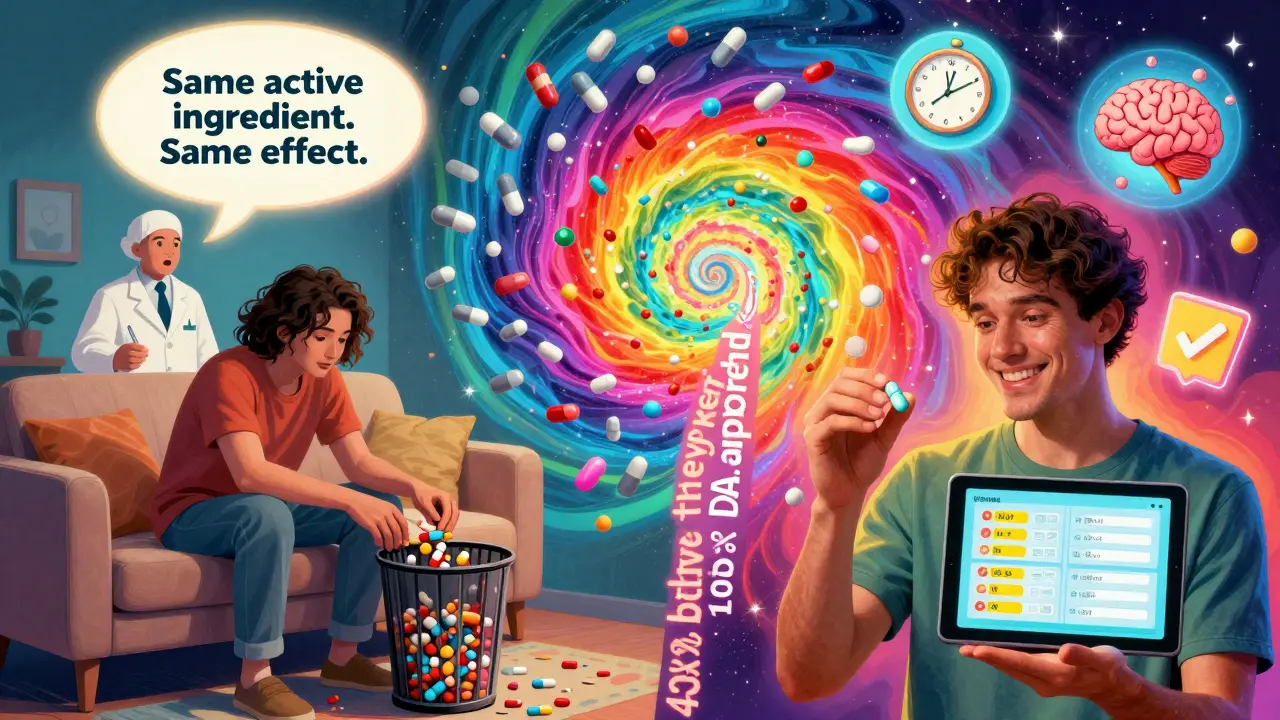
- Describe the physical differences. Patients notice color, shape, size, and markings. If the pill is now oval instead of round, or blue instead of white, show them. Keep printed images or use a tablet to display side-by-side comparisons. Many pharmacies now have these built into their dispensing systems.
- Reaffirm bioequivalence. Use plain language: ‘The active ingredient is exactly the same. It works the same way. It’s been tested to perform just like the brand.’ Avoid jargon like ‘pharmacokinetics’ or ‘AUC.’ Say ‘it gets into your bloodstream the same way.’
- Verify understanding with teach-back. Ask: ‘Can you tell me how you’ll take this?’ or ‘What would you do if you noticed a change next time?’ This isn’t a formality - it’s your safety net. Studies show patients who can explain their meds in their own words are 68% more likely to stick with them.
What Happens When You Skip the Talk
It’s easy to think, ‘They didn’t ask, so they’re fine.’ But that’s the trap. The most common error in generic use isn’t a dosing mistake - it’s a communication failure. A 2024 webinar by the National Community Pharmacists Association highlighted a shocking trend: patients who didn’t receive counseling were three times more likely to stop their medication after a switch. One patient, told only that their pill changed, assumed the pharmacy made a mistake. They threw out the new pills. They called their doctor. They demanded the brand. The doctor had to write a new script. The pharmacy had to refill it. Everyone lost time - and the patient’s blood pressure spiked.
Time is tight. Pharmacists average 1.2 minutes per counseling session. But that doesn’t mean you have to rush. A 90-second conversation that answers the three biggest fears - ‘Is it safe?’ ‘Is it the same?’ ‘Will it work?’ - can change outcomes. And if you’re pressed for time, use your tech. Over 68% of major pharmacy chains now use electronic prompts that pop up when a generic is dispensed. These tools remind you to cover the key points - even when you’re busy.
The Documentation Trap
Since February 2024, the Centers for Medicare & Medicaid Services (CMS) has tightened documentation rules. You can’t just check a box that says ‘Counseling provided.’ You must record what you discussed. In California, you need to note whether you explained the appearance change. In Texas, a general note is still allowed. But the trend is clear: regulators want proof of understanding, not just presence.
Some pharmacy chains require 30 to 45 minutes of annual training on generic counseling. CVS and Walgreens both track compliance. But training means nothing if you don’t apply it. A 2024 pilot by the National Association of Boards of Pharmacy tested a standardized checklist across 12 states. The result? Patient understanding jumped by 28%. That’s not just a number - it’s fewer hospital visits, fewer readmissions, fewer wasted prescriptions.
What’s Next? AI and Value-Based Care
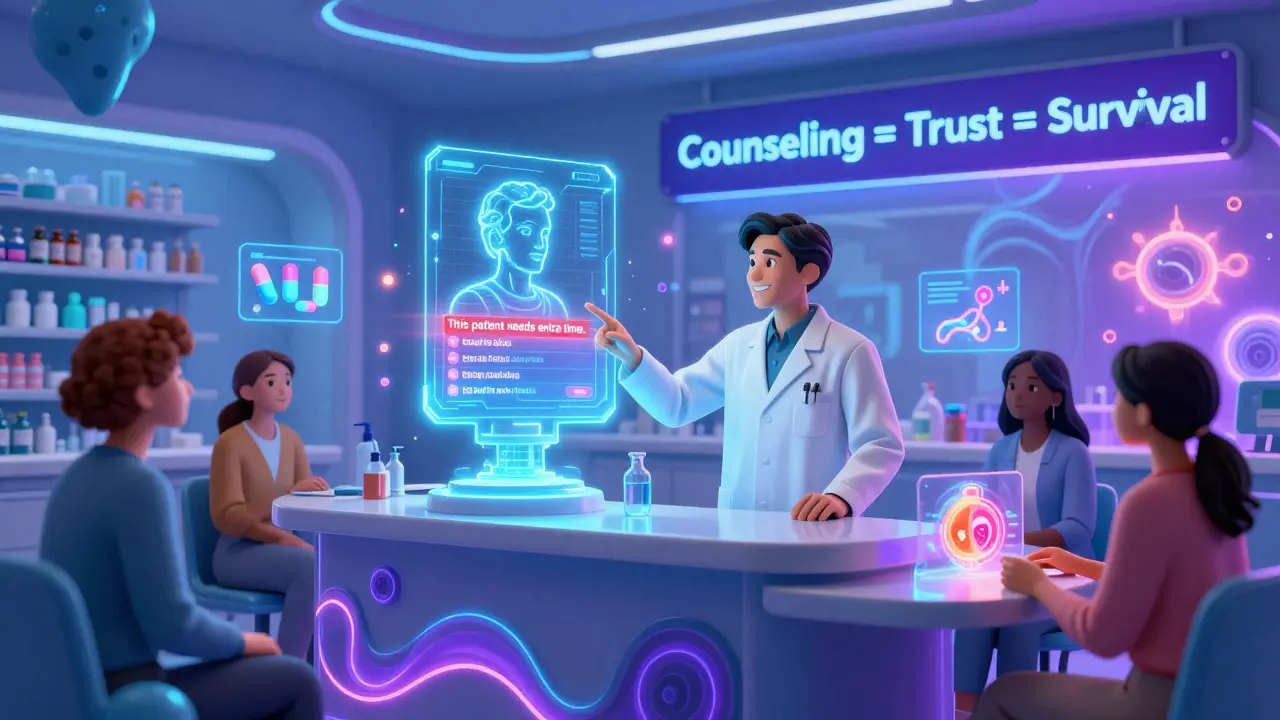
The future of counseling is smarter, not busier. By 2026, 75% of pharmacies are expected to use AI tools that flag patients with a history of stopping meds after a switch. Maybe a patient refused a generic three times last year. The system will alert the pharmacist: ‘This patient needs extra time.’ That’s not replacing the human touch - it’s protecting it.
And it’s not just about compliance anymore. Medicare Part D is starting to tie bonus payments to evidence of proper generic counseling. Pharmacies that can prove patients understand their meds will get rewarded. That’s a game-changer. It turns counseling from a legal chore into a value driver.
Language, Culture, and Accessibility
Counseling isn’t one-size-fits-all. Federal law requires language assistance for patients with limited English proficiency. That means interpreters, translated materials, or bilingual staff. But many pharmacies still rely on family members to translate - which is risky. A patient might say they understand because they don’t want to cause trouble. Always offer a trained interpreter. Use the free resources provided by the Department of Health and Human Services. It’s not optional - it’s required.
Final Thought: You’re Not Just Dispensing - You’re Reassuring
Generic drugs aren’t second-rate. They’re science-backed, FDA-approved, and life-saving. But they’re also invisible to most patients. They don’t see the clinical trials. They don’t read the bioequivalence studies. All they see is a different-looking pill. That’s where you come in. Your job isn’t to explain pharmacokinetics. It’s to answer the quiet, anxious question in their head: ‘Can I trust this?’ When you do that - clearly, calmly, and consistently - you don’t just meet a requirement. You build trust. And that’s what keeps people alive.
Do pharmacists have to counsel every time a generic is dispensed?
Yes. Federal law under OBRA ’90 requires pharmacists to offer counseling for all new prescriptions, including generic substitutions. Most states require it for every refill as well. Even if the patient doesn’t ask questions, the pharmacist must still provide the core information: drug name, purpose, dosage, appearance differences, and bioequivalence. Skipping this step violates legal standards and puts patient safety at risk.
Can pharmacy technicians provide generic counseling?
No. Only licensed pharmacists can provide counseling. Technicians can inform patients that counseling is available, hand out printed materials, or help with scheduling, but they cannot explain how the generic works, answer questions about side effects, or verify understanding. This is a legal boundary in all 50 states. Violating it can result in disciplinary action.
What if a patient refuses generic counseling?
If a patient refuses counseling, the pharmacist must document that counseling was offered and refused. The documentation should include the date, time, and nature of the offer - not just ‘patient declined.’ Some states require a signature or electronic acknowledgment. Even if refused, the pharmacist must still ensure the patient understands the generic substitution. If the patient appears confused, it’s the pharmacist’s duty to try again - even if they say no.
Are generics really as effective as brand-name drugs?
Yes. The FDA requires generics to have the same active ingredient, strength, dosage form, and route of administration as the brand. They must also meet strict bioequivalence standards - meaning they deliver the same amount of medicine into the bloodstream at the same rate. Studies show no meaningful difference in effectiveness or safety between generics and brands. The only differences are in inactive ingredients (like color or filler), which do not affect how the drug works.
Why do some patients still distrust generics?
Many patients equate price with quality. If a drug is cheaper, they assume it’s inferior. Others have had bad experiences - like a generic that didn’t seem to work - which may be due to factors like inconsistent adherence, changing health conditions, or placebo effects. Misinformation from online sources also plays a role. Counseling that directly addresses these myths - with simple facts and visual aids - can reduce distrust. The key is listening first, then correcting.
Marie Crick
February 20, 2026 AT 11:54Pharmacists who skip counseling are literally endangering lives. I’ve seen it firsthand. A friend stopped her statin because the pill looked ‘wrong’-turned out she had a mini-stroke because she didn’t take it for three weeks. No excuse. Just do your job.
Jonathan Rutter
February 22, 2026 AT 07:33Let me tell you something-this whole generic thing is a scam engineered by Big Pharma and the FDA to squeeze more profit out of us. I’ve read the studies. The bioequivalence standards? They’re laughable. One study showed generics vary by up to 20% in absorption rates. That’s not ‘same thing’-that’s Russian roulette with your heart. And don’t get me started on how the FDA lets companies change fillers without retesting. I’ve got a cousin who went from stable to crashing after a generic switch-no one told her. They just handed her a blue pill and said ‘it’s fine.’ Well, guess what? It wasn’t fine. It was negligence. And now she’s on disability. You think that’s acceptable? I don’t. You think your 90-second spiel fixes this? It doesn’t. You need to stop treating patients like dumb robots who just need a checklist. They’re scared. They’re confused. And you’re not listening. You’re just checking boxes. That’s why people die. That’s why trust is gone. And you’re the reason.
aine power
February 23, 2026 AT 11:48Oh please. The real issue isn’t counseling-it’s that pharmacists still think they’re doctors. You’re a dispenser. Not a therapist. Stop overcomplicating it.
Tommy Chapman
February 23, 2026 AT 13:50Y’all act like this is some new crisis. Nah. This is America. We got generics because we’re tired of paying $500 for a pill that’s been around since 1987. If you can’t handle a different color pill, maybe you shouldn’t be on meds. My grandpa’s been on generics for 15 years. Still alive. Still kicking. You wanna cry because the pill’s not white anymore? Get over it. We’re not in Europe. We don’t have time for this.
Robin bremer
February 25, 2026 AT 10:18bro i had this one time where my blood pressure med switched from yellow to green and i thought i was getting scammed 😭 like… i literally called my mom and she said ‘did you check the label?’ i did. it was the same drug. but still. i was shook. like… what if it’s not the same?? 😳 pharmacist didn’t say anything. just handed it over. i almost quit. then i found this post and was like… ohhhhh. so yeah. just TALK to people. please. 🙏
Courtney Hain
February 26, 2026 AT 02:45Here’s the truth no one wants to admit: generics aren’t safe. The FDA allows them to vary by ±20% in absorption. That’s not ‘equivalent’-that’s a gamble. And the companies? They use cheaper fillers that can trigger autoimmune reactions. I’ve got a friend who developed lupus after switching to a generic. The lab tests showed her body was reacting to the dye. The FDA doesn’t require disclosure of inactive ingredients across brands. So you’re telling me a woman on levothyroxine who switched generics and started having panic attacks-she’s just ‘overreacting’? No. She’s being poisoned. And now the government wants to reward pharmacies for doing the bare minimum? This isn’t healthcare. It’s corporate negligence wrapped in a white coat. You think counseling fixes this? It doesn’t. It just makes people feel better while they’re still being dosed with unregulated chemicals. The real solution? Ban generics. Or at least require full ingredient disclosure. Until then, every pharmacist who says ‘it’s the same’ is lying. And you’re complicit.
Caleb Sciannella
February 28, 2026 AT 02:21As someone who has worked in community pharmacy across three continents-from rural Appalachia to urban Nairobi-I can confirm that the core issue transcends borders: trust is built through clarity, not compliance. In Kenya, where brand-name drugs are often counterfeit, patients are trained to inspect pill markings meticulously. In Germany, pharmacists are required to show patients the FDA-approved bioequivalence certificate. Here, we treat patients like they’re incapable of understanding science. But they’re not. They’re just not given the tools. The five talking points outlined here are not just best practices-they’re universal human rights in healthcare communication. Language, culture, and visual aids are not ‘extras.’ They are the foundation. When we reduce counseling to a checkbox, we reduce human dignity to a liability. This isn’t about saving money. It’s about honoring the patient’s autonomy. And that requires more than a 90-second script-it requires presence.
Ashley Paashuis
February 28, 2026 AT 08:40Thank you for this comprehensive breakdown. I’ve been a pharmacist for 18 years, and I’ve seen how easy it is to fall into the trap of assuming patients ‘know’ what’s going on. But you’re absolutely right-the moment the pill changes, fear takes over. I’ve started using the side-by-side images on my tablet, and I’ve seen a dramatic drop in refill abandonment. One elderly patient told me, ‘I thought you gave me the wrong medicine because I’ve been taking this blue one for 10 years.’ I showed her the brand and generic side by side. She cried. Said she felt stupid. I told her: ‘You’re not stupid. You’re careful.’ That’s the moment counseling becomes care. And yes, it takes time. But every minute you invest now prevents a hospital visit later. This isn’t just policy. It’s humanity.