
Every year, the FDA issues dozens of safety notices about medications you or someone you care about might be taking. These aren’t ads. They aren’t rumors. They’re official updates from the U.S. Food and Drug Administration about new risks, changes in how a drug should be used, or even when a medication might be unsafe for certain people. But if you’ve ever tried to read one, you know they can feel like a legal document written in invisible ink. The good news? You don’t need a medical degree to understand them. You just need to know where to look.
What Exactly Is an FDA Safety Communication?
An FDA Safety Communication is a public notice issued when new safety information comes to light after a drug has already been approved and is being used by millions of people. These aren’t about new drugs on the market-they’re about things that were missed during initial testing. Maybe a rare but serious side effect showed up in thousands of real-world patients. Maybe a drug interacts dangerously with something common, like grapefruit juice or a blood thinner. Or maybe the way it’s supposed to be taken needs to change because new data shows it’s more risky than we thought.
Since 2007, the FDA has had stronger powers to monitor drugs after they’re sold. That means these communications happen more often-and they’re more detailed. In recent years, the agency has issued between 50 and 70 major safety notices annually. They cover everything from opioids and diabetes drugs to cancer treatments and antidepressants. And they’re not just for doctors. The FDA now writes separate sections for patients, so you can find out what this means for you.
How to Spot the Most Important Parts
Every FDA Safety Communication follows a clear structure. You don’t have to read the whole thing. Start with these four key sections:
- What Safety Concern Is FDA Announcing? This is the headline. It tells you in plain language what the issue is. For example: "FDA warns that certain opioid medications can cause serious harm if stopped too quickly." That’s your first clue.
- Boxed Warning This is the FDA’s highest level of safety alert. It’s called a "Boxed Warning" because it’s printed in a bold black box in the official prescribing guide. If this section changes, it means the risk is serious enough that the FDA wants every prescriber and patient to see it immediately. Changes here often mean you should talk to your doctor right away.
- For Patients This section is written in simple language. It tells you what to do: "Do not stop taking this medicine without talking to your doctor," or "Call your doctor if you notice new muscle weakness." If you’re a patient, this is the only part you absolutely need to read.
- Highlights of Prescribing Information This part shows exactly what changed in the official drug label. It uses bold text for additions and strikethrough for deletions. For example, if the old label said "Do not abruptly discontinue," and the new one says "Do not rapidly reduce or abruptly discontinue," you now know the warning got stronger. This helps doctors and pharmacists update their records.
Don’t get distracted by the long technical sections unless you’re a healthcare provider. If you’re a patient, focus on the "For Patients" section and the Boxed Warning.
What Do the Changes Actually Mean for You?
Not every safety update means you need to stop your medication. The FDA uses specific language to tell you how urgent the change is:
- "STOP using this medication immediately" - This is rare, but serious. It usually means a life-threatening risk has been confirmed. If you see this, call your doctor or go to the emergency room.
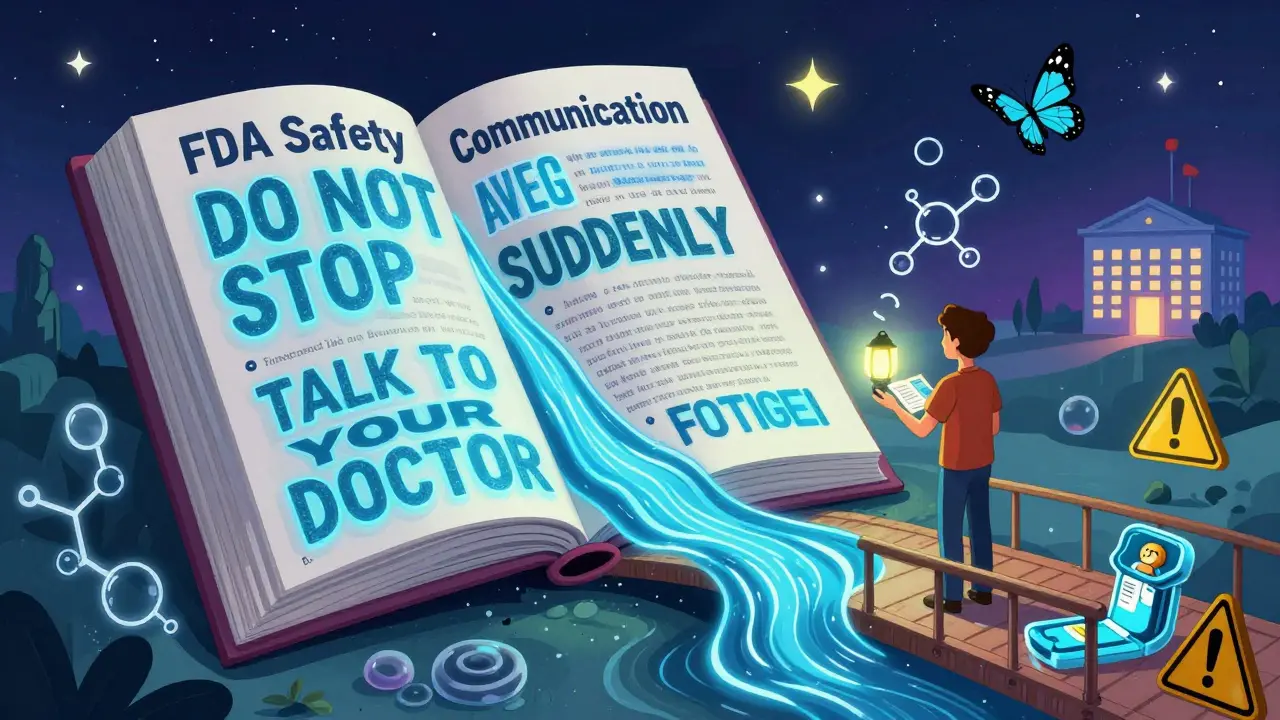
- "Do not stop suddenly" - This is more common. It means stopping the drug too fast could cause withdrawal, seizures, or other dangerous effects. You still need to talk to your doctor before making any changes.
- "Consider this information when prescribing" - This is informational. It doesn’t require immediate action, but your doctor should be aware. You might see this for side effects that are rare or only affect certain groups, like older adults or people with kidney disease.
For example, in 2025, the FDA updated safety labels for all opioid painkillers to say you can’t stop them suddenly. That didn’t mean everyone had to switch drugs. It meant if you’ve been taking opioids for more than a few weeks, you need to taper off slowly under medical supervision. The change was about how to stop safely-not whether to take the drug at all.
What to Do When You See a Communication About Your Drug
Here’s a simple three-step plan:
- Check your medication name. Make sure the communication is about the exact drug you’re taking, including the brand and generic name. Sometimes the FDA updates an entire class of drugs-like all SSRIs or all statins-so read carefully.
- Look for the "For Patients" section. This will tell you what to do. If it says "Talk to your doctor," then schedule a call or appointment. Don’t panic. Don’t stop cold. Just get advice.
- Read the Medication Guide. Every prescription comes with a small paper insert called a Medication Guide. The FDA requires it to be written at an 8th-grade reading level and to highlight serious risks. If you haven’t read yours lately, get a new copy from your pharmacy. They’re required to give you one every time you refill.
Don’t rely on Google searches or social media. The FDA’s website (fda.gov/drugs/drug-safety-and-availability) is the only place that has the official, up-to-date version. Other sites might misinterpret or exaggerate the message.
How to Stay Updated Without Checking Every Day
You don’t have to check the FDA website every week. Here’s how to get updates without the hassle:
- Sign up for email alerts. Go to the FDA’s Drug Safety page and subscribe to notifications for specific drugs or drug classes. You can choose to get alerts only for your medication, or for all blood pressure drugs, for example.
- Ask your pharmacist. Pharmacists get these updates too. When you pick up your prescription, ask: "Has there been any new safety info about this drug?" Many pharmacies now flag high-risk changes automatically.
- Use your EHR portal. Some electronic health record systems (like MyChart or Epic) now include FDA safety alerts. If yours doesn’t, ask your doctor’s office if they can add it.
Pro tip: If you take multiple medications, make a list of all your drugs and their generic names. Keep it in your phone or wallet. When a new safety alert comes out, you can quickly scan your list to see if anything matches.
Why These Updates Often Come Years After the Problem Starts
It’s frustrating, but true: many serious drug risks are known for years before the FDA makes a public announcement. A 2020 study found that for high-risk medications, it takes an average of 4.2 years between the first warning from doctors or patients and a formal FDA labeling change.
Why the delay? The FDA needs strong, consistent evidence-not just one or two reports. They wait for patterns to emerge across thousands of cases. That’s why a single person’s bad reaction doesn’t trigger a warning. But when 200 people report the same issue, and multiple studies confirm it, then the FDA acts.
That doesn’t mean you should wait passively. If you notice a new side effect, report it. The FDA has a free system called MedWatch where patients and doctors can submit safety reports. Your report could help trigger an earlier warning.
What’s Changing in the Future
The FDA is working to make these communications easier to understand. Since 2023, they’ve been testing plain-language summaries for high-risk drugs. These are short, one-page versions written in everyday English and available in both English and Spanish. They’re still being rolled out, but you’ll start seeing them on the FDA website under "Patient-Friendly Summaries."
By 2025, the FDA plans to send personalized safety alerts directly to patient portals-like your doctor’s online system or your pharmacy app. That means you might get a message saying, "Your medication, metformin, has a new safety update. Here’s what you need to know."
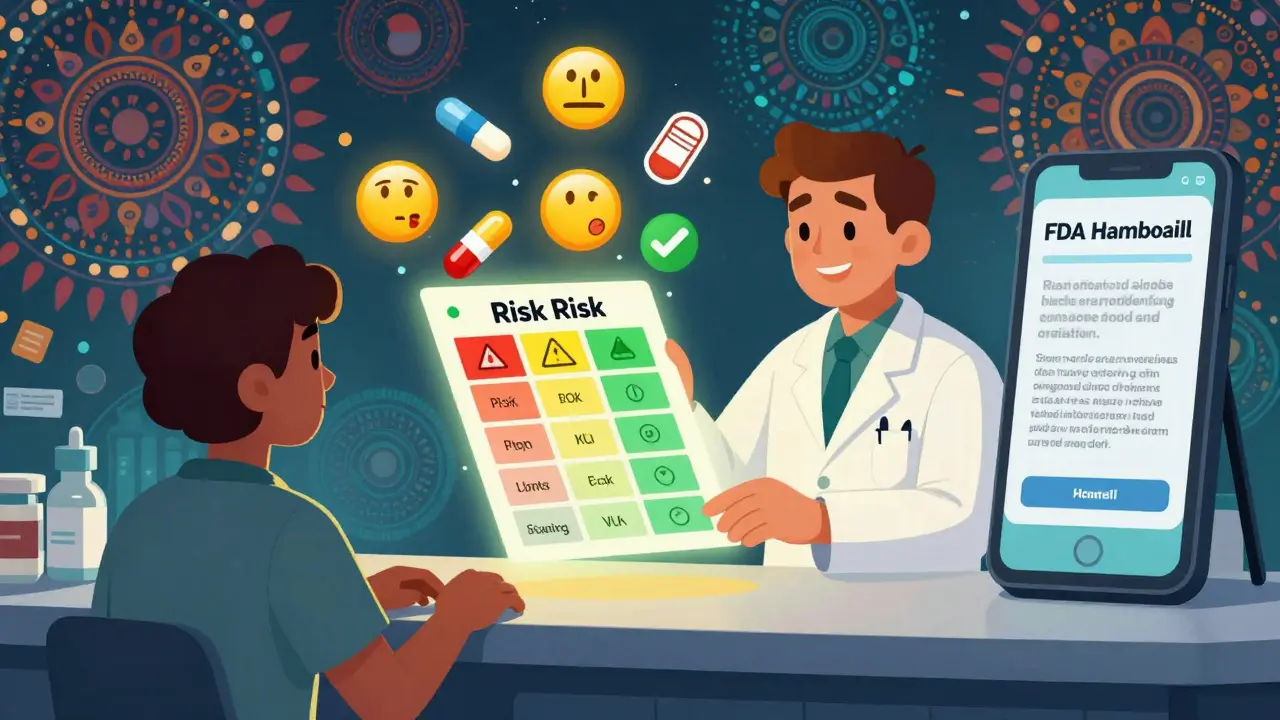
They’re also adding visual aids-charts, icons, and color-coded risk levels-to help people understand severity at a glance. Right now, only 54% of patients fully understand these notices. The goal is to raise that to 75% by 2027.
Common Mistakes People Make
Even when people read the safety communication, they often misunderstand it. Here are the top three errors:
- Thinking "new warning" means "stop now." Most warnings are about how to use the drug safely, not that it’s dangerous to take. Always talk to your doctor before stopping.
- Confusing "Drug Alert" with "Drug Safety Communication." Drug Alerts are shorter and less formal. They’re for urgent issues-like a batch of pills being recalled. Safety Communications are more detailed and often include labeling changes. Don’t treat them the same.
- Ignoring the Medication Guide. It’s small, it’s boring, and you get it every time you refill. But it’s the only document the FDA legally requires to be written for patients. If you skip it, you’re missing the most important part.
Remember: FDA Safety Communications aren’t meant to scare you. They’re meant to help you use your medication safely. The goal isn’t to stop treatment-it’s to make sure you’re getting the most benefit with the least risk.
What should I do if I see a new FDA safety alert about my medication?
Don’t panic. Don’t stop taking your medication unless the alert says "STOP immediately." Instead, check the "For Patients" section of the alert for clear instructions. Then, call your doctor or pharmacist to discuss what the change means for you. Most changes require a conversation-not an emergency.
Do I need to read every FDA safety communication?
No. Only read the ones about medications you’re currently taking. You can sign up for email alerts from the FDA so you only get notifications for your specific drugs. If you take multiple medications, keep a list of their generic names and check the alert against your list.
Can I trust the FDA’s safety information?
Yes. The FDA is the only U.S. agency with the legal authority and scientific resources to evaluate drug safety after a medication is on the market. Their decisions are based on data from thousands of patients, clinical studies, and reports from doctors and pharmacists. While no system is perfect, the FDA’s process is the most rigorous in the world.
What’s the difference between a Drug Alert and a Drug Safety Communication?
A Drug Alert is a quick notice about an urgent issue-like a recall, contamination, or immediate safety risk. A Drug Safety Communication is a detailed update that often includes changes to the official prescribing label. Alerts are short and urgent; Safety Communications are thorough and may affect how doctors prescribe the drug long-term.
Why do I get a new Medication Guide every time I refill my prescription?
The FDA requires pharmacies to give you a new Medication Guide each time because the safety information can change. Even if the drug name hasn’t changed, the risks, dosing, or warnings might have. Always read the latest version-it’s your best source of patient-focused safety info.
Cheryl Griffith
January 17, 2026 AT 10:33Just read the FDA alert about my blood pressure med yesterday-turned out it was just a tweak to the dosing window, not a red flag. So glad I didn’t panic. The 'For Patients' section really saved me from googling doom scenarios at 2 a.m.
Melodie Lesesne
January 18, 2026 AT 06:20I used to ignore these entirely until my mom had a bad reaction to a drug she didn’t even know had a warning. Now I print out the 'For Patients' section and stick it on the fridge. Simple, but it works. Thanks for the reminder that you don’t need a medical degree to stay safe.
waneta rozwan
January 18, 2026 AT 07:33Oh, so now we’re trusting the FDA? LOL. They approved OxyContin. They let Big Pharma bury data for years. This whole thing is a PR stunt wrapped in bullet points. You think they care about you? They care about lawsuits and liability. Read the fine print-there’s always a loophole.
Ryan Hutchison
January 18, 2026 AT 12:15Why are we even talking about this? In America, you get your meds from your doctor-not some government website. If you’re too lazy to read the pill bottle, that’s your problem. Stop looking for hand-holding and take responsibility. We’re not in Sweden here.
Samyak Shertok
January 20, 2026 AT 03:18Ah yes, the sacred FDA. The same agency that once said smoking was "not clearly harmful." Progress, my friends. We’ve moved from cigarettes to antidepressants, but the playbook’s the same: wait for the bodies to pile up, then issue a pamphlet. Meanwhile, your cousin’s still on that drug because the pharmacist didn’t mention it. 🤷♂️
Joie Cregin
January 21, 2026 AT 09:46My grandma started getting these email alerts after I signed her up-she calls them her "Medicine Newsletters." She reads them over tea with her glasses on. It’s cute, but also kind of brilliant. You don’t need to be tech-savvy, just consistent. Small habits > big panic.
Jody Fahrenkrug
January 22, 2026 AT 17:28Just wanted to say I’ve been reading the Medication Guides for years. They’re boring as hell, but they’ve saved me from two bad interactions. Never skip them. Ever.
Nicholas Gabriel
January 24, 2026 AT 04:41One thing people overlook: the FDA doesn’t just wake up one day and say, "Hey, let’s warn people!" It’s a slow, meticulous process-data from thousands of reports, peer-reviewed studies, and sometimes, patient submissions through MedWatch. So if you’ve noticed a weird side effect? Report it. Seriously. It might save someone’s life. I reported my migraines after starting that antidepressant-two months later, they added it to the warning list. My report was #417. Who knows? Maybe I helped.
Also, if you’re on multiple meds, keep a list. I use Notes on my phone: generic name, dosage, pharmacy, last refill. I update it every time I get a new script. It takes 90 seconds. It’s worth it.
And don’t trust Reddit threads or TikTok "drug experts." I saw someone say, "Stop all SSRIs immediately if you feel tired." That’s not a warning-that’s a horror story. The FDA says "talk to your doctor." That’s the golden rule.
Also, if your pharmacy doesn’t give you the Medication Guide every refill, ask for it. They’re legally required to. I’ve had pharmacists roll their eyes, but I just smile and say, "I’m trying to be responsible. Can you help?" It works.
And yes, the updates come late. But they come. And they’re better than nothing. The fact that they’re now doing plain-language summaries? That’s huge. I’ve seen non-native speakers breathe easier because of it. Small wins matter.
Don’t be the person who says, "I didn’t know." You know now.
Kasey Summerer
January 24, 2026 AT 18:41So the FDA finally figured out that people can’t read legal jargon? 😂 Took ‘em 70 years. But hey, at least they’re trying now. 🙌
kanchan tiwari
January 26, 2026 AT 02:20Wait… you really think this is about safety? Nah. This is about control. They’re making you dependent on their alerts so you never question the system. What if the FDA is part of the problem? What if they’re the ones suppressing early reports? You think they want you to know how many people died before the warning? They don’t. They want you to feel safe… so you keep taking the pills.
Bobbi-Marie Nova
January 27, 2026 AT 00:20Okay, but can we just appreciate how the FDA finally started writing for actual humans? I mean, I used to skip these like spam emails. Now? I read the "For Patients" section like it’s a text from my best friend. "Hey, don’t stop cold. Talk to your doc." Yeah, okay, I got it. 🙏