
Why Heatwaves Make Overdose More Likely
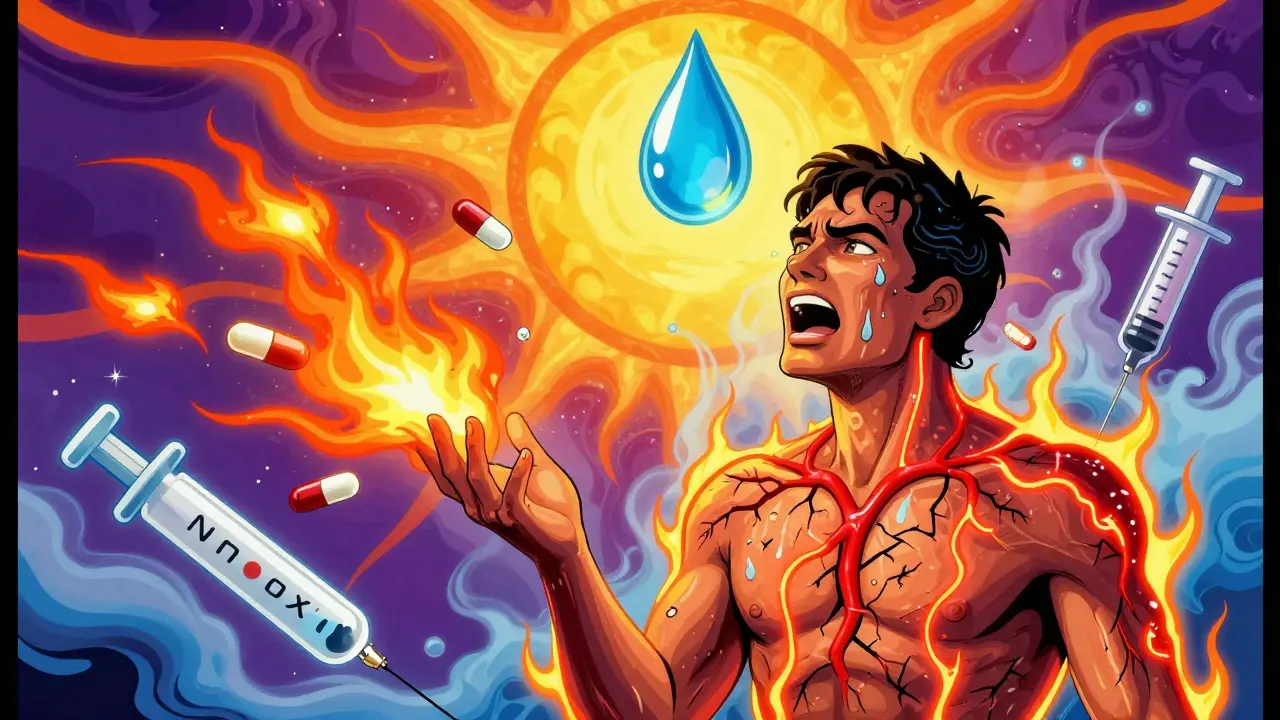
When the temperature hits 24°C (75°F) or higher, the risk of overdose rises-especially for people using stimulants like cocaine or opioids. It’s not just about feeling hot. Your body starts fighting to stay cool, and that fight makes drug effects stronger and more dangerous. A 2010 study from Columbia University found that in New York City, overdose deaths jumped sharply during those weeks when temperatures stayed above that threshold. Heat doesn’t just make you uncomfortable-it changes how your body processes drugs.
When you’re dehydrated, even by just 2%, your blood becomes more concentrated. That means the same amount of drug you usually take now hits harder. Think of it like pouring the same shot of liquor into a smaller glass-it’s stronger. Studies show this can increase drug concentration in your bloodstream by 15-20%. For someone using cocaine, that’s deadly. Cocaine already pushes your heart rate up by 30-50%. Add heat, and your heart is working 10-25% harder just to keep you alive. That’s a recipe for cardiac arrest.
Opioids are just as risky. Heat slows down your body’s ability to breathe properly. Normally, your body compensates when you take opioids by breathing a little faster. But when it’s hot, that safety net shrinks by 12-18%. You might not even realize you’re in trouble until it’s too late. The CDC’s Heat & Health Tracker shows that in places like the Pacific Northwest, where people aren’t used to extreme heat, overdose risk spikes up to 3.7 times higher than normal. In Arizona, where it’s always hot, the increase is lower-because people’s bodies have adapted. But that doesn’t mean it’s safe.
How Illness Makes Things Worse
Being sick-whether it’s the flu, a bad cold, or even a mild infection-changes how your body handles drugs. Fever raises your core temperature, which adds to the heat stress. Vomiting and diarrhea cause dehydration, which, again, concentrates drugs in your blood. If you’re taking medications for mental health-like antipsychotics or antidepressants-heat can make those drugs less effective or cause dangerous side effects. About 70% of antipsychotics and 45% of antidepressants behave differently in high heat, according to research published in JAMA Internal Medicine.
People with chronic illnesses like heart disease, diabetes, or kidney problems are at even higher risk. Their bodies are already working harder just to stay stable. Add drugs and heat on top, and the system can collapse. The Colorado Department of Public Health found that 35% of people hospitalized for heat illness also have a substance use disorder. That’s not a coincidence. It’s a dangerous overlap that most emergency systems don’t plan for.
What You Can Do: Practical Harm Reduction Steps
If you or someone you know uses drugs, here’s what actually works during heatwaves:
- Reduce your dose by 25-30%. Your body is already under stress. Don’t test it. Use less, even if you feel like you need more.
- Use less often. Give your body time to recover. Skip a day or two if you can.
- Drink water-on a schedule. Don’t wait until you’re thirsty. Drink one cup (8 oz) of cool water every 20 minutes. Not soda. Not energy drinks. Just water. NYC’s Harm Reduction Coalition saw a 17% drop in heat-related overdose calls after pushing this simple rule.
- Stay in the shade or air-conditioned space. If you don’t have AC, go to a library, community center, or mall. Even 30 minutes in cool air helps.
- Never use alone. If you’re using, have someone with you who knows how to use naloxone. If you’re helping someone, stay alert. If they’re confused, dizzy, or not responding, act fast.
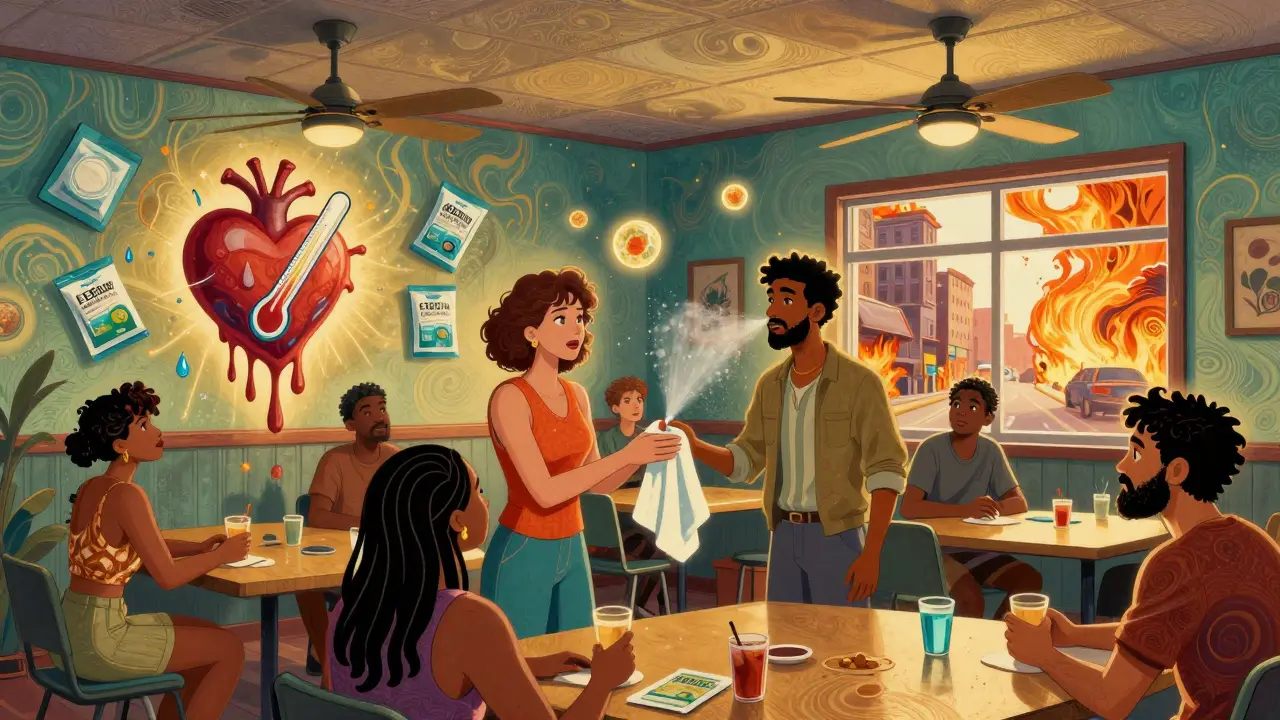
Some harm reduction groups hand out cooling kits with electrolyte packets, misting towels, and cold packs. These aren’t luxuries-they’re lifesavers. If you’re part of a community group, consider starting a kit distribution program. It costs little but saves lives.
Why Shelters and Emergency Services Often Fail People
Too many shelters turn away people who are actively using drugs during heat emergencies. That’s not just cruel-it’s deadly. When someone can’t get inside, they’re forced to stay on the street, where temperatures can be 5°C hotter than in nearby neighborhoods. That’s the urban heat island effect. Cities like Phoenix and Sydney have this problem badly.
Some police departments have confiscated cooling supplies from outreach workers, calling them ‘drug paraphernalia.’ That’s not safety-it’s punishment. People who use drugs don’t need to be criminalized during a heatwave. They need water, shade, and someone who cares.
Only 12 out of 50 U.S. states have official heat emergency plans that include people who use drugs. Canada’s Vancouver solved this by opening 7 air-conditioned respite centers next to supervised consumption sites. During the 2021 heat dome, overdose deaths dropped by 34%. That’s proof it works.
What Communities and Health Workers Should Do
Health workers need to screen for heat risk. The CHILL’D-Out Questionnaire-used in Colorado-asks 12 simple questions: Do you have AC? Are you on meds that affect heat tolerance? Have you been drinking enough water? Are you homeless or housing unstable? These aren’t just medical questions. They’re survival questions.
Community groups should train volunteers in naloxone use and heat safety. In Maricopa County, Arizona, volunteers made over 12,000 wellness checks during the 2022 heat season and intervened in 287 overdoses. That’s not luck. That’s organized care.
Local governments need to include substance use in their heat emergency plans. It’s not optional anymore. The Biden administration just allocated $50 million to make this happen by December 2025. But waiting for policy isn’t enough. People are dying now.
What’s Coming Next
By 2050, we could see 20-30 more days each year above the 24°C overdose risk threshold. Heatwaves aren’t rare anymore-they’re regular. Climate change isn’t a future threat. It’s here, and it’s making overdose deaths worse.
New research is showing that heat might even change how your gut processes drugs. Early studies from the NIH suggest the gut microbiome shifts by 15-20% in extreme heat, which could alter how drugs are absorbed. We don’t fully understand this yet, but it means today’s harm reduction advice might need updating soon.
For now, the rules are simple: use less, hydrate more, stay cool, don’t use alone. If you’re helping someone, don’t wait for permission. Don’t wait for a program. Just act. Water. Shade. Naloxone. Presence. These aren’t fancy tools. But they’re the only things standing between someone and death when the heat rises.
What to Do If Someone Overdoses in the Heat
If someone is unresponsive, not breathing, or has blue lips:
- Call emergency services immediately.
- Give naloxone if you have it. Even if you’re not sure it’s an opioid overdose, it’s safe to try.
- Move them to a cooler place. Get them out of direct sun. Fan them. Wet their skin with cool water.
- Keep them on their side if they’re unconscious. Don’t let them choke.
- Stay with them until help arrives. Heat makes recovery slower. Don’t leave.
Don’t assume they’re just ‘passed out.’ Heat + drugs can kill faster than you think.
Jake Moore
January 17, 2026 AT 01:58Just got back from handing out cooling kits at the park today. One guy said he’d been using alone because he didn’t want to bother anyone. I handed him a water bottle, a cold pack, and a naloxone kit. He cried. That’s the thing-most of these people aren’t reckless. They’re just isolated. Simple stuff like this saves lives. No fancy policy needed. Just presence.
Joni O
January 17, 2026 AT 23:42i just wanna say drinkin water every 20 mins sounds so simple but i never thought of it like that… like, it’s not ‘drink when thirsty’ it’s ‘drink like your life depends on it’ bc it kinda does. thanks for this.
Max Sinclair
January 18, 2026 AT 19:51This is one of the most well-researched and compassionately written pieces I’ve seen on harm reduction in a long time. The data on dehydration and drug concentration is chilling-pun intended. I’ve shared this with my local public health board. We need to train EMTs on heat-related overdose protocols. It’s not just about naloxone anymore. It’s about cooling, hydration, and recognizing the subtle signs before cardiac arrest hits.
Praseetha Pn
January 19, 2026 AT 12:35HAHAHAHA so this is why the government is pushing ‘climate change’-they want to kill the junkies! 🤣 They’ve been poisoning the water with fluoride since the 50s and now they’re using the sun to finish the job! You think the CDC cares? Nah. They’re just happy when the ‘useless eaters’ drop like flies. Wake up, sheeple! The heat dome? A psyop. The real danger is the 5G towers in the libraries where you’re told to ‘cool off’-they’re syncing with your brainwaves to make you crave more drugs! 🌞📡 #MindControl
Emma #########
January 20, 2026 AT 04:26I work at a shelter. We had a guy come in last week with a heat rash and a half-used bag of coke. We gave him water, a fan, and let him rest. He didn’t say thank you. But he came back two days later with a bag of snacks for the others. Small things matter. We’re not fixing the system. But we’re keeping people alive until they’re ready to try.
Naomi Keyes
January 20, 2026 AT 11:28While the intent of this article is commendable, the methodology of the cited studies is questionable. The Columbia University study referenced (2010) did not control for concurrent polysubstance use, and the CDC’s Heat & Health Tracker does not differentiate between intentional and accidental overdose. Furthermore, the claim that ‘70% of antipsychotics behave differently in high heat’ is misleading-pharmacokinetic shifts are dose-dependent and vary by individual metabolism. Without stratified data, these generalizations risk stigmatizing vulnerable populations under the guise of harm reduction.
Wendy Claughton
January 21, 2026 AT 06:48Just sat outside for 20 minutes in 98°F heat with a cold towel on my neck… and I get it. Your body is screaming. Now imagine that while your heart is racing from a drug you didn’t even know was cut with fentanyl. I’ve been sober 3 years, but I still carry naloxone. Not because I use. But because I’ve lost too many friends who thought ‘just one time’ was safe. Please. Don’t wait until you’re a statistic. Water. Shade. Someone who cares. That’s the whole toolkit.
rachel bellet
January 22, 2026 AT 03:43Let’s be real: this isn’t about heat. It’s about personal responsibility. If you’re choosing to use illegal substances, you’re already accepting risk. Blaming climate change or dehydration is just another form of victim-blaming in reverse. You want to survive? Stop using. Period. The ‘harm reduction’ industry thrives on dependency. They don’t want you well-they want you coming back for more kits, more education, more funding. This is a business model disguised as compassion.
Pat Dean
January 22, 2026 AT 16:30Oh great, now we’re giving out cold packs to drug addicts because the planet got warm? Next they’ll be handing out free Uber rides to the ER for people who OD on meth while binge-watching TikTok. This country is collapsing. We used to have pride. Now we coddle self-destructive behavior with ‘cooling kits’ and ‘respite centers.’ Wake up! The real crisis is moral decay-not heatwaves.
Jay Clarke
January 22, 2026 AT 19:22Bro. I was on the street last summer when it hit 110. I used once. Just once. Thought I could handle it. Ended up in the ER with my buddy holding my hand while they pumped ice water into my veins. I didn’t die. But I saw two guys go. One was 19. Had a baby. Didn’t even have a water bottle. That’s it. That’s the whole story. Don’t use alone. Drink water. Stay cool. If you’re reading this… you’re still here. That’s a sign. Don’t waste it.
Selina Warren
January 23, 2026 AT 07:28They say by 2050 we’ll have 30 more dangerous heat days. But what if the real problem isn’t the temperature? What if it’s the loneliness? The isolation? The fact that no one sees us as human until we’re collapsing on the pavement? I used to think harm reduction was just about pills and water. Now I know it’s about showing up. Even if you’re scared. Even if you don’t understand. Just show up. That’s the only antidote that’s never been patented.