
Medication Metabolism Calculator
How Smoking Affects Your Medications
This calculator helps you understand how smoking impacts the effectiveness and safety of your medications. Smoking can increase liver enzyme activity by 30-50%, which may significantly alter how your medications work.
When you smoke, your body doesn’t just get nicotine-it triggers a chemical chain reaction that changes how your medications work. This isn’t a myth or a vague warning. It’s a well-documented, measurable shift in your liver’s ability to break down drugs. For people taking medications like theophylline, clozapine, or even common painkillers, smoking can make those drugs less effective. And when you quit? That same change can suddenly turn a safe dose into a dangerous one.
Why Smoking Makes Medications Less Effective
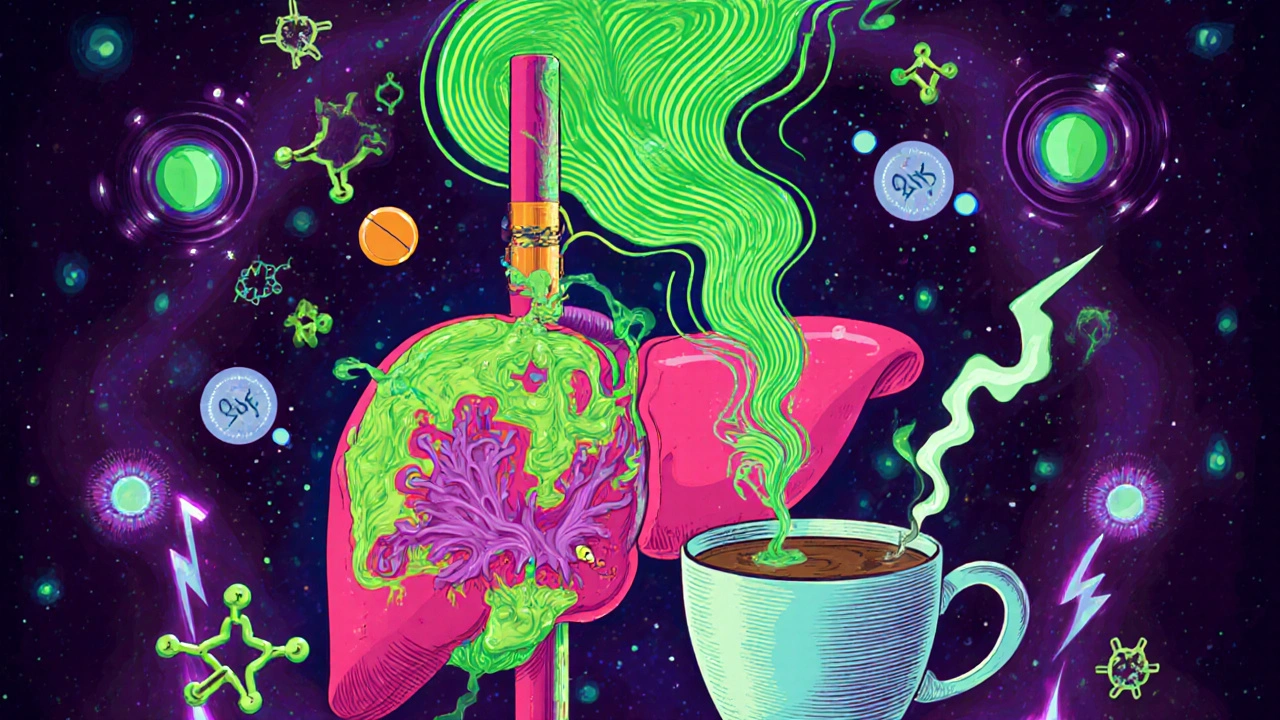
Tobacco smoke contains chemicals called polycyclic aromatic hydrocarbons (PAHs). These aren’t just toxins-they’re powerful signals to your liver. When PAHs enter your bloodstream, they bind to a receptor called AhR, which turns on genes that produce enzymes. The most important of these are CYP1A2, CYP1A1, and CYP2E1. These enzymes are part of your body’s natural detox system, but when they’re overactive, they start breaking down medications too fast.For example, caffeine is a common marker used to measure CYP1A2 activity. Smokers clear caffeine from their blood 30-50% faster than non-smokers. If your body processes coffee this quickly, it’s also processing your meds the same way. The result? Lower drug levels in your blood. That means your medication might not work as well.
This isn’t just theoretical. Studies show that smokers taking theophylline-a drug used for asthma and COPD-need up to 50% more of the drug to reach the same blood levels as non-smokers. Without adjusting the dose, the drug fails to control symptoms. The same pattern holds for antipsychotics like clozapine and olanzapine. In fact, smokers on clozapine often need nearly double the dose to get the same effect. If you don’t know this, you might think the medication isn’t working, and your doctor might increase the dose unnecessarily.
Which Medications Are Most Affected?
Not all drugs are impacted the same way. The ones at highest risk are those primarily broken down by CYP1A2. Here’s what you need to watch for:- Theophylline: Used for lung diseases. Smokers clear it 63% faster. Half-life drops from 8 hours to just 3 hours.
- Clozapine: An antipsychotic. Smokers need 50% higher doses. Stopping smoking can cause toxic buildup within days.
- Olanzapine: Another antipsychotic. Clearance increases by 98% in smokers.
- Duloxetine: An antidepressant. Smokers metabolize it 30-40% faster.
- Tacrine: Used for Alzheimer’s. Rarely prescribed now, but still a strong example of CYP1A2 sensitivity.
- Acetaminophen: Common painkiller. CYP2E1 induction increases liver toxicity risk, especially with alcohol use.
- Mexiletine: An antiarrhythmic. Clearance increases by 25%, half-life drops 36%.
Drugs metabolized by CYP2D6-like many SSRIs (sertraline, fluoxetine)-show little to no change. That’s good news for people on those meds. But if you’re on any of the drugs listed above, smoking isn’t just a habit-it’s a pharmacokinetic variable.
What Happens When You Quit Smoking?
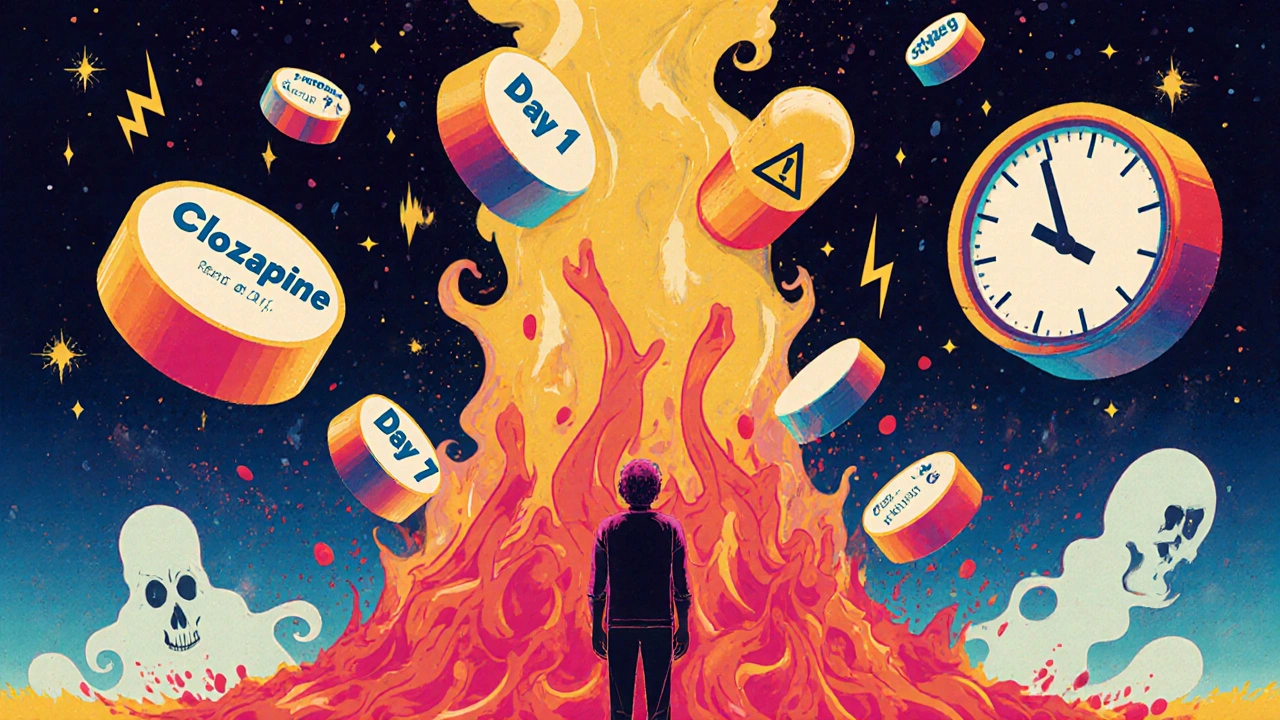
This is where things get dangerous-and often overlooked.When you stop smoking, the enzyme-inducing chemicals leave your system. But your liver doesn’t turn off the extra enzymes overnight. CYP1A2 activity starts dropping within 72 hours. By day 7, it’s down 30-40%. By week 3, it’s back to normal. But here’s the problem: most people don’t tell their doctor they quit smoking. And doctors rarely check.
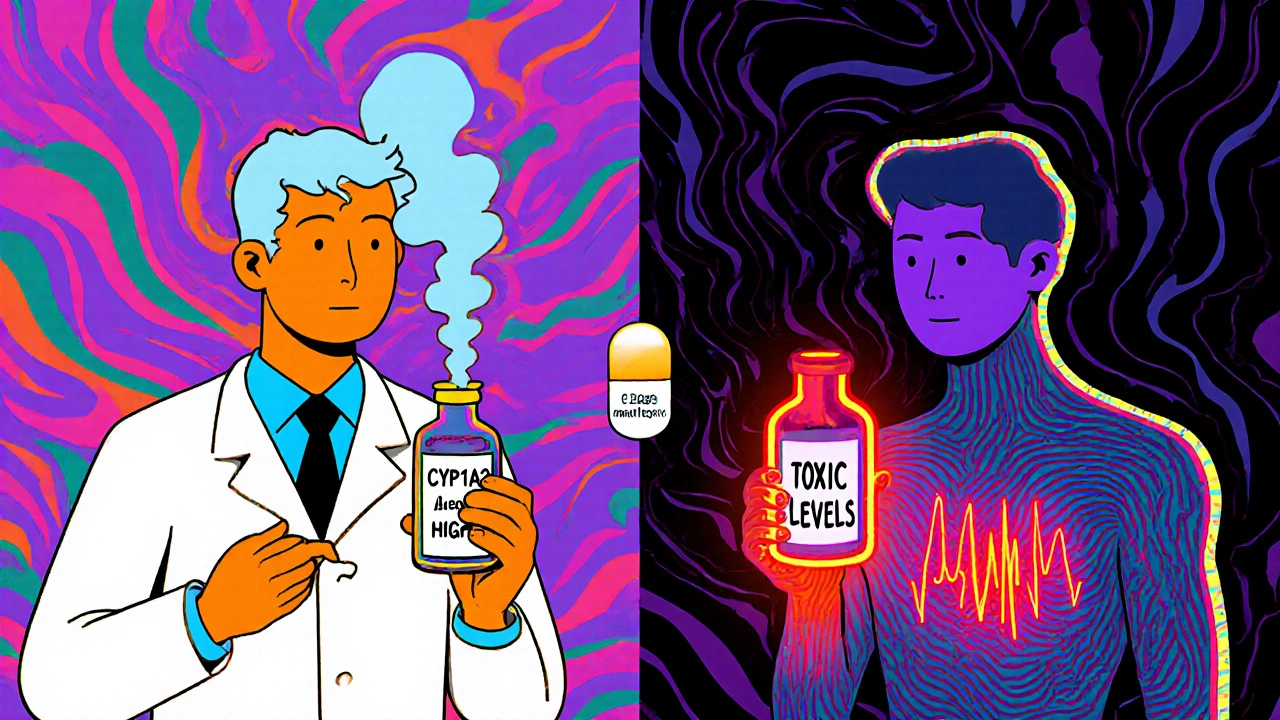
That means your medication dose-adjusted for smoking-is now too high. Your body is no longer breaking it down quickly, so levels rise. Toxicity follows.
There are documented cases of people hospitalized for theophylline poisoning just 10 days after quitting smoking. Their dose hadn’t changed. Their blood levels went from subtherapeutic to toxic. Clozapine toxicity after smoking cessation is so common that the FDA has logged 147 cases between 2020 and 2022, with 89% occurring within two weeks of quitting.
Even diabetes meds are affected. Pioglitazone, used for type 2 diabetes, is partially broken down by CYP1A2. When patients quit smoking, their blood sugar can drop sharply-sometimes into dangerous territory. One patient reported their A1C falling from 7.8% to 5.9% in two weeks after quitting, with no change in diet or medication. Their doctor didn’t know why.
How Doctors Should Adjust Doses
The solution isn’t to quit smoking-it’s to manage the interaction properly. Here’s what works:- Always document smoking status. Not just ‘yes’ or ‘no.’ Record how many cigarettes per day. A person smoking 15 cigarettes daily has different enzyme levels than someone smoking 3.
- For new smokers: Start with standard doses, then monitor drug levels weekly for 2-3 weeks. Increase dose if needed. Don’t assume the drug isn’t working-check enzyme activity first.
- For patients quitting: Reduce doses of CYP1A2 substrates by 25-50% within 3-7 days of quitting. This isn’t optional. It’s a safety step.
- Monitor closely during weeks 2-4. This is the peak risk window. Symptoms of toxicity-nausea, dizziness, confusion, irregular heartbeat-can be mistaken for other problems.
Some hospitals now require smoking status to be recorded in electronic health records. Institutions that did this saw a 42% drop in adverse drug events tied to smoking changes. That’s not just better care-it’s fewer hospital stays and lower costs.
Genetics and Individual Differences
Not everyone responds the same way. Your genes matter. The CYP1A2*1F gene variant makes people more sensitive to enzyme induction. Carriers can see up to 30% greater increases in enzyme activity from smoking than non-carriers. That means two people smoking the same amount can have very different drug levels.Now there’s a test for it. In 2023, the FDA approved SmokeMetrix®, a simple caffeine metabolism test that measures your CYP1A2 activity. You drink a set amount of caffeine, then a blood or saliva sample is taken a few hours later. The results show your enzyme level-like a personal drug metabolism fingerprint. It’s not widely available yet, but it’s coming.
Researchers at the NIH are tracking 5,000 people through smoking cessation to build a predictive algorithm. Early data shows that combining your CYP1A2 genotype with your smoking history can predict 37% of dose adjustments needed after quitting. That’s a big step toward personalized medicine.
What You Should Do
If you smoke and take medication:- Ask your doctor or pharmacist: “Is this drug affected by smoking?”
- If you’re on clozapine, theophylline, olanzapine, or duloxetine-keep a log of your cigarette use.
- If you’re planning to quit, tell your provider before you stop. Don’t wait until you feel sick.
- If you’ve recently quit and feel worse, or your symptoms return-get your drug levels checked.
It’s not about judging smoking. It’s about making sure your medicine works the way it should. Whether you quit or keep smoking, your treatment plan needs to adapt.
Why This Matters Beyond the Individual
This isn’t just a personal health issue. It’s a system-wide problem. In the U.S., 34 million adults smoke. One in four people with schizophrenia smokes. One in three COPD patients do. These are the very people on the most vulnerable medications.Pharmaceutical companies now have to prove their new drugs aren’t dangerously affected by smoking. The FDA requires it. The European Medicines Agency will soon require specific dosing guidelines for smokers and quitters on all new antipsychotics.
The cost? In 2021, Pfizer spent $187 million just managing theophylline dose adjustments tied to smoking changes. The U.S. healthcare system spends $2.3 billion annually treating preventable hospitalizations from this interaction.
It’s not a small issue. It’s a hidden driver of medication failure, hospital stays, and unnecessary suffering.
Does smoking affect all medications?
No. Only medications primarily broken down by enzymes that smoking activates-mainly CYP1A2, CYP2E1, and some UGTs. Common drugs affected include theophylline, clozapine, olanzapine, duloxetine, and acetaminophen. Medications like sertraline or metformin, which use other pathways, are generally unaffected.
How long after quitting smoking should I worry about drug levels changing?
The biggest risk is between days 3 and 14 after quitting. Enzyme activity drops quickly, but your medication dose hasn’t changed yet. This is when toxicity risks peak. If you’re on clozapine, theophylline, or similar drugs, contact your doctor within 72 hours of quitting.
Can I just stop smoking to make my meds work better?
Quitting smoking improves your health-but if you’re on certain medications, it can make your drug levels rise dangerously high. You can’t assume quitting will automatically fix your condition. Always talk to your doctor before quitting if you’re on a medication affected by smoking.
Is there a test to know if smoking is affecting my meds?
Yes. The SmokeMetrix® test, approved by the FDA in 2023, measures CYP1A2 enzyme activity using a caffeine challenge. It’s not yet routine, but it’s available in some clinics and research centers. Ask your pharmacist if it’s an option for you.
What should I do if I’ve quit smoking and my symptoms are worse?
If your symptoms return or you feel unwell after quitting smoking-especially if you’re on clozapine, theophylline, or an antipsychotic-get your blood levels checked immediately. You may need a dose reduction. Don’t wait. This is a known, preventable cause of hospitalization.
Should I avoid quitting smoking if I’m on medication?
No. Quitting smoking is one of the best things you can do for your health. But you need to do it safely. Work with your doctor to adjust your medication dose before or right after quitting. The goal isn’t to keep smoking-it’s to quit without risking a medical emergency.
Next Steps for Patients and Providers
For patients: Write down every medication you take. Look up each one online or ask your pharmacist: “Is this affected by smoking?” Keep a note of your smoking habits-daily cigarette count, when you last smoked, and when you quit. Bring this to every appointment.For providers: Make smoking status a mandatory field in every prescription and EHR system. Add alerts for high-risk drugs. Educate your staff. The tools are here-the knowledge is there. What’s missing is routine action.
This interaction has been known for over 50 years. It’s not new. It’s not rare. It’s ignored. And every day it’s ignored, someone gets sick because their medicine stopped working-or started working too well.
Patrick Marsh
November 23, 2025 AT 04:50Smoking changes drug metabolism? No shocker. But I had no idea it could turn a safe dose toxic after quitting. My uncle got hospitalized after quitting cold turkey on clozapine. No one warned him.
Ravi Kumar Gupta
November 23, 2025 AT 17:35Bro, this is why India’s mental health system is a disaster! We give clozapine like candy, no one checks smoking status. My cousin’s doctor doubled his dose after he quit-then he had seizures. No one even asked if he smoked! This isn’t science-it’s negligence.
Rahul Kanakarajan
November 24, 2025 AT 01:19Wow. So smoking is basically a free drug booster? And you’re telling me people just quit cold turkey without telling their doctors? That’s not just dumb-that’s dangerous. You don’t mess with liver enzymes like they’re a video game cheat code.
New Yorkers
November 25, 2025 AT 15:14Look, I’m not here to judge. But if you’re on clozapine and you smoke, you’re playing Russian roulette with your brain. And if you quit without telling your doc? Congrats-you just turned your meds into poison. This isn’t just pharmacology. It’s survival.
David Cunningham
November 26, 2025 AT 13:52Man, I never thought about this. I smoke, take duloxetine, and thought my anxiety was just flaky. Turns out my meds were being flushed out like a toilet. Gonna talk to my GP tomorrow. Thanks for the heads-up.
luke young
November 27, 2025 AT 21:50This is such an important post. I’m a nurse and I’ve seen this happen-patients get sicker after quitting smoking and no one connects the dots. We need to train more staff on this. It’s not just about the patient, it’s about the whole system.
james lucas
November 28, 2025 AT 00:04ok so i just found out my zoloft is fine but my pain meds are getting wiped out by my ciggies?? i thought i was just getting used to the pain lol. i quit last month and now i feel like a zombie and my doctor thinks i’m faking it. maybe i need that smoke metrix test??
Jessica Correa
November 28, 2025 AT 07:05I’m on theophylline and smoked for 12 years. Quit 6 months ago. My doctor never adjusted my dose. I’ve had three ER visits since. They kept saying it was anxiety. It was the drug building up. I’m lucky I didn’t die.
manish chaturvedi
November 28, 2025 AT 22:10This is a profound insight into the intersection of lifestyle and pharmacology. In many developing nations, smoking is normalized while medical systems remain under-resourced. The responsibility lies not only with the individual but with institutions to integrate smoking status into routine pharmacokinetic assessments.
Nikhil Chaurasia
November 29, 2025 AT 16:08I’m not saying this to be dramatic, but… I almost lost my brother because no one told him about the clozapine risk after he quit. He started having tremors, hallucinations-thought he was going crazy. Turns out his blood levels were off the charts. We’re lucky we caught it in time.
Holly Schumacher
December 1, 2025 AT 06:42It’s infuriating that this is still not standard protocol. The FDA has data. Hospitals have EHR systems. Doctors have 15 minutes per patient. And yet, we’re still letting people get poisoned because no one bothered to ask, "Do you smoke?" This isn’t negligence-it’s systemic malpractice.
Michael Fitzpatrick
December 1, 2025 AT 07:05Just wanted to say I really appreciate this post. I’ve been trying to quit for a year and was terrified my antidepressants would stop working. Turns out, I was on duloxetine, and my doc actually knew about the smoking interaction-she lowered my dose before I even quit. I felt so cared for. It’s not about shaming smokers-it’s about helping them transition safely. That’s what real medicine looks like.
Shawn Daughhetee
December 1, 2025 AT 20:42my mom’s on theophylline and smoked for 40 years she quit last year and now she’s always dizzy and nauseous i told her to call her doctor but she said "i don’t wanna be a bother" please someone tell her this isn’t normal