

When a pharmacist fills a prescription for a brand-name drug like Lipitor, they don’t just grab the first pill bottle they see. They check something called therapeutic equivalence-a precise, science-backed process that ensures the generic version will work just as well. This isn’t guesswork. It’s a legal and clinical standard built on decades of research, regulation, and real-world data. In the U.S., this system is anchored by one document: the FDA’s Approved Drug Products with Therapeutic Equivalence Evaluations, better known as the Orange Book.
The Orange Book: The Law of the Land
The Orange Book isn’t just a reference guide. It’s the official legal tool pharmacists must use to decide if a generic drug can be swapped for a brand-name drug. Created in 1980 and updated monthly, it lists over 16,500 drug products approved by the FDA. Each entry includes the brand name, the generic name, the manufacturer, and-most importantly-a two-letter code that tells pharmacists whether substitution is allowed.
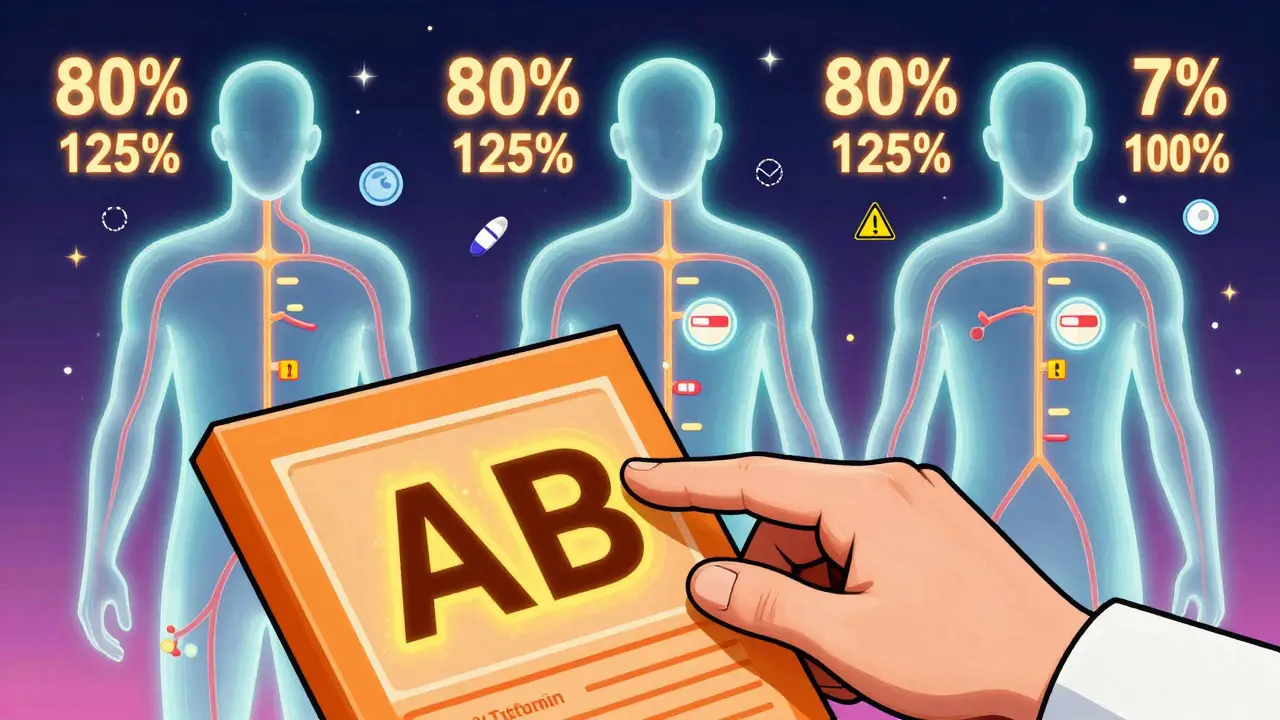
The first letter is the key: A means the generic is considered therapeutically equivalent to the brand. B means it’s not. If a drug has an AB rating, it’s been proven to have the same active ingredient, strength, dosage form, and route of administration-and more importantly-it’s been shown through human studies to deliver the same amount of medicine into the bloodstream at the same rate. That’s bioequivalence.
Over 98% of all rated drugs in the Orange Book carry an AB rating. That’s not an accident. It’s the result of strict standards. For a generic to get an AB rating, its pharmacokinetic data must show that the ratio of its maximum concentration (Cmax) and total exposure (AUC) compared to the brand falls between 80% and 125%. That’s not a random range. It’s based on statistical models that ensure no more than a 10% difference in how the drug works in the body.
What Makes a Generic Truly Equivalent?
Three things must line up for a generic to be approved:
- Pharmaceutical equivalence: Same active ingredient, same strength, same form (tablet, capsule, injection), same route (oral, topical, etc.).
- Bioequivalence: The generic must deliver the drug into the bloodstream at the same rate and extent as the brand. This is tested in healthy volunteers using blood samples over time.
- Therapeutic equivalence: The final verdict. Even if the first two are met, the FDA only gives an ‘A’ rating if there’s no clinical reason to believe the drugs behave differently in patients.
For most drugs, this works perfectly. But not all drugs are simple. Take warfarin, levothyroxine, or phenytoin-drugs with a narrow therapeutic index. A tiny difference in blood levels can mean the difference between no effect and serious toxicity. For these, the FDA sometimes tightens the bioequivalence window to 90-111%. The Orange Book flags these drugs with special notes, and pharmacists are trained to pay extra attention.
How Pharmacists Actually Verify It Day-to-Day
Most pharmacists don’t pull out a printed Orange Book anymore. They use digital tools. The FDA’s free Orange Book mobile app has been downloaded over 450,000 times as of March 2024. Many pharmacy systems like PioneerRx and QS/1 integrate the Orange Book data directly into their dispensing screens. When a prescription comes in for Brand X, the system automatically checks the generic alternatives and shows the TE code.
The verification process takes seconds:
- Identify the reference listed drug (RLD) from the prescription.
- Check if the generic has the same active ingredient, strength, and dosage form.
- Confirm the TE code is ‘A’ (or ‘AB’).
- Ensure the prescriber hasn’t written ‘Dispense as Written’ or ‘Do Not Substitute’.
A 2022 time-motion study found this whole check takes between 8 and 12 seconds per prescription. That’s faster than reading a label. But it’s not automatic. Pharmacists are trained to question anomalies. What if the generic isn’t listed? What if the TE code is ‘B’? What if it’s a complex product like an inhaler or a topical cream?
When the Orange Book Doesn’t Have the Answer
Not every generic makes it into the Orange Book right away. About 5.7% of substitutions involve drugs not yet listed. In those cases, pharmacists turn to FDA guidance: Non-Orange Book Listed Drugs. They compare labeling, review FDA approval letters, and sometimes consult peer-reviewed studies. But they don’t just wing it. The American Pharmacists Association says pharmacists must document their reasoning-especially if they’re substituting a non-Orange Book product.
And some products are just harder to evaluate. Inhalers, nasal sprays, topical creams-these don’t always show clear differences in blood levels. The FDA admits this. That’s why they’ve created over 1,850 product-specific guidances since 2020. These documents outline exactly how to test equivalence for complex drugs. But until those products get an official TE code in the Orange Book, pharmacists rely on professional judgment-and that’s where liability risks creep in.
Why This System Works-and Why It Matters
Generic drugs now make up 90.7% of all prescriptions filled in the U.S. That’s 8.9 billion prescriptions in 2023. Without reliable equivalence verification, that savings wouldn’t be possible. Patients save billions. But more than that, they get the same treatment.
Studies back this up. A 2020 FDA meta-analysis looked at over 1.2 million patient records and found no meaningful difference in adverse events between brand and generic drugs (0.78% vs. 0.81%). A 2023 review of 2,147 bioequivalence studies showed most generics differed from brands by less than 5% in AUC and under 8% in Cmax.
But the system isn’t perfect. Critics point out that some complex products-like multi-dose inhalers or transdermal patches-don’t always behave the same way in real patients, even if they meet lab standards. The FDA is working on better metrics. In 2024, they allocated $28.5 million through GDUFA III to research new ways to measure equivalence for these tricky drugs.
What Happens When Pharmacists Get It Wrong?
There are consequences. In 2019, a Texas pharmacist was sanctioned after substituting a drug not listed in the Orange Book. The state board ruled that using any other source-no matter how reputable-wasn’t enough. The law is clear: if it’s not in the Orange Book with an ‘A’ rating, you can’t substitute unless the prescriber says so.
Pharmacies train new hires for 2-4 hours on this topic. Competency tests show 89.3% accuracy after training. But mistakes still happen. That’s why the system is built around one thing: consistency. The Orange Book isn’t the only resource-but it’s the only one that’s legally binding.
What’s Next?
The biggest challenge coming? Biosimilars. These are complex biological drugs-like insulin or monoclonal antibodies-that aren’t chemically identical to their reference products. The FDA’s Purple Book is the equivalent of the Orange Book for biosimilars, but as of June 2024, only 47 of 350 approved biosimilars are listed there. Pharmacists are still figuring out how to verify equivalence for these. The FDA says it’s a priority. For now, pharmacists rely on prescriber guidance, product labeling, and clinical judgment.
One thing won’t change: pharmacists will still be the final gatekeepers. They’re not just dispensing pills. They’re ensuring safety, legality, and therapeutic outcomes. And they do it by following a system that’s been tested, refined, and trusted for over 40 years.
What does an 'A' rating in the Orange Book mean?
An 'A' rating means the generic drug is therapeutically equivalent to the brand-name drug. It has the same active ingredient, strength, dosage form, and route of administration, and has been proven through human studies to deliver the same amount of medicine into the bloodstream at the same rate. Pharmacists can legally substitute an 'A'-rated generic unless the prescriber says 'Dispense as Written'.
Can a pharmacist substitute a generic if it's not in the Orange Book?
No-not under standard substitution laws. All 50 U.S. states require pharmacists to use the Orange Book as the primary source for determining therapeutic equivalence. If a generic isn’t listed, substitution is not permitted unless the prescriber explicitly authorizes it. Pharmacists may use other resources for information, but only the Orange Book’s TE code provides legal protection against liability.
Why do some generics have a 'B' rating?
A 'B' rating means the FDA does not consider the generic therapeutically equivalent to the brand. This usually happens when the generic fails to meet bioequivalence standards, has different inactive ingredients that affect absorption, or hasn’t been adequately tested. Some products may also get a 'B' rating if they’re complex (like inhalers) and lack sufficient data. These drugs should not be substituted without prescriber approval.
Are all generic drugs required to be bioequivalent?
Yes. Under FDA regulations, every generic drug seeking approval must demonstrate bioequivalence to its brand-name counterpart. This is done through controlled clinical studies measuring how much of the drug enters the bloodstream (AUC) and how fast (Cmax). The FDA requires these ratios to fall between 80% and 125% for most drugs. For narrow therapeutic index drugs, stricter limits of 90-111% may apply.
Do state laws differ on generic substitution?
All 50 states require pharmacists to use the FDA’s Orange Book as the legal standard for determining therapeutic equivalence. Forty-nine states allow automatic substitution of 'A'-rated generics unless the prescriber prohibits it. Massachusetts is the exception-it requires patient consent before substitution. But no state permits substitution based on commercial databases, pharmacy manuals, or personal judgment alone.
Kelsey Vonk
March 13, 2026 AT 20:47Just want to say how much I appreciate this breakdown 🙌 I used to think generics were just "cheap copies," but learning about the 80-125% bioequivalence range blew my mind. It’s not magic-it’s math, and it’s *rigorous*. The fact that they test this in real humans? That’s next-level care. I’m so glad pharmacists are the gatekeepers.
Emma Nicolls
March 15, 2026 AT 04:32so like… if its ab rated its basically the same right?? like no cap??
Tim Schulz
March 16, 2026 AT 10:19Oh wow, a *detailed* post about pharmacy regulation? Who knew this was a thing people cared about? 🤭 Let me guess-you’re either a pharmacist or someone whose insurance got cheaper and you’re weirdly emotional about it. Either way, props. The Orange Book is basically the Bible of generic drug shenanigans. And yes, I used the word shenanigans. You’re welcome.
douglas martinez
March 17, 2026 AT 06:52Thank you for this comprehensive overview. The systematic rigor applied by the FDA to ensure therapeutic equivalence is one of the most underappreciated public health achievements of the past half-century. The statistical thresholds-80% to 125%-are not arbitrary; they are derived from decades of pharmacokinetic modeling and clinical outcomes data. This is science as policy, and it works.
Sabrina Sanches
March 17, 2026 AT 18:13AB rating means it's the same... really? like... same?!!? I just got my refill and it looked different... I'm scared... I need to know...
Shruti Chaturvedi
March 17, 2026 AT 21:42in india we dont have orange book but pharmacists still check bioequivalence studies and lab reports. the system works even without the official list. trust in science over paperwork
Katherine Rodriguez
March 18, 2026 AT 08:00So you’re telling me the government just says "yeah this generic is fine" and we all just take it? What if they’re lying? What if Big Pharma owns the FDA? I’ve seen videos. The pills are made in China. How do we know they’re not using chalk? 🤔
Devin Ersoy
March 20, 2026 AT 06:46Let’s be real-the Orange Book is a glorified Excel sheet with a fancy cover. The real truth? Some generics are *slightly* different. I’ve had patients swear their blood pressure went haywire after switching. But hey, if the FDA says 80-125% is "equivalent," then I guess we’re all just lab rats in a very expensive, very bureaucratic experiment. 🧪✨
Scott Smith
March 21, 2026 AT 20:28This is exactly why pharmacists deserve more respect. They’re not just handing out pills-they’re preventing medical disasters every day. The fact that this process is automated in most systems doesn’t make it less critical. Human oversight is still the final line of defense. Kudos to everyone in this field.
Sally Lloyd
March 21, 2026 AT 21:04Interesting. But have you considered that the Orange Book might be manipulated? The FDA has ties to pharmaceutical conglomerates. The 98% AB rating isn’t proof of safety-it’s proof of collusion. What if the studies are cherry-picked? What if bioequivalence is measured under lab conditions that don’t reflect real human metabolism? The system is designed to make us feel safe. That’s not the same as being safe.
Emma Deasy
March 23, 2026 AT 01:58Oh. My. GOSH. I just read this entire post. And I am... *stunned*. The precision. The rigor. The sheer, unadulterated, beautifully bureaucratic *artistry* of the Orange Book. I mean-80-125%? That’s not a range-it’s a symphony! A sonnet of science! A ballet of bioequivalence! I’ve never been so moved by a government database. Tears. I have tears. 🎻💊
tamilan Nadar
March 23, 2026 AT 10:40in india we rely on pharmacovigilance and real-world data more than official lists. many generics work better here because they're made with local bioavailability in mind. orange book is american. but science? science is global.
Adam M
March 25, 2026 AT 02:17AB rating = you’re fine. B rating = don’t touch it. Everything else is noise.