
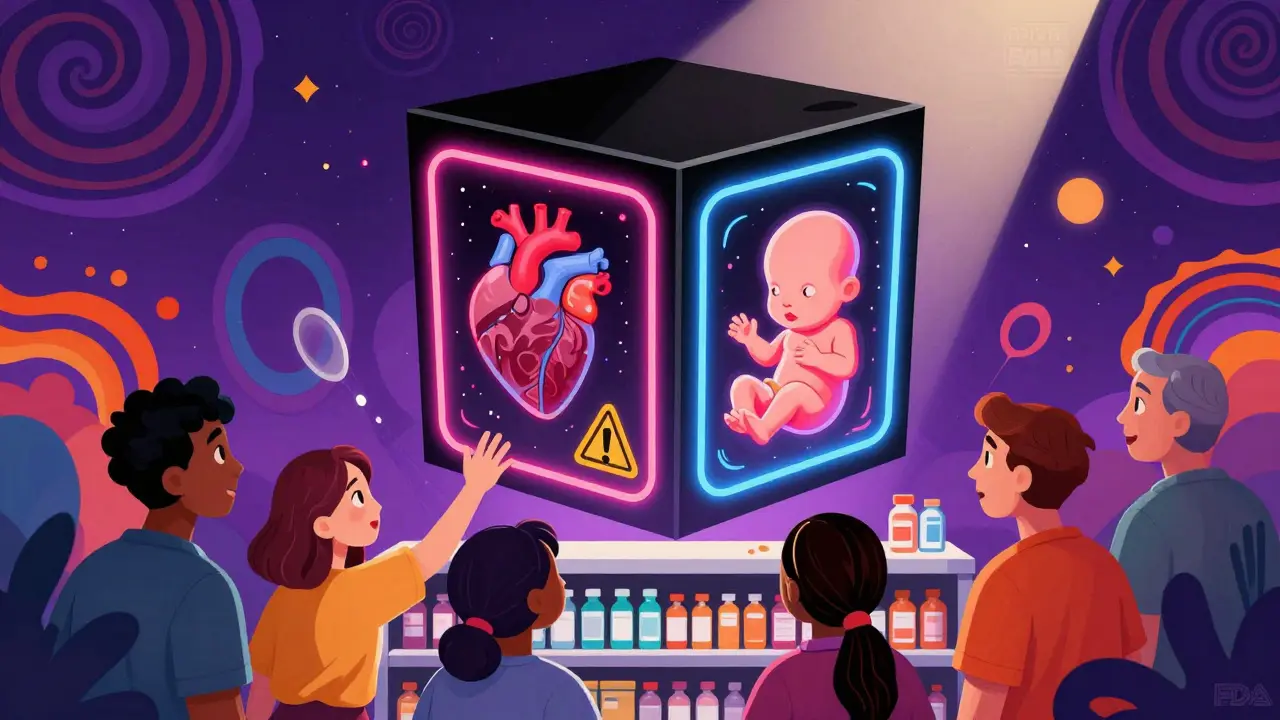
When you pick up a prescription, you might notice a bold, black-bordered box at the top of the medication guide. It looks like a warning label on a power tool-serious, urgent, impossible to miss. That’s a boxed warning, also called a black box warning. It’s the strongest safety alert the U.S. Food and Drug Administration (FDA) can require for a drug. And if you’ve been prescribed a medication with one, you deserve to understand exactly what it means-and what it doesn’t mean.
What a Boxed Warning Actually Means
A boxed warning doesn’t say, “Don’t take this drug.” It says, “This drug can cause serious harm or death-and you need to know how to avoid it.” The FDA requires these warnings when evidence shows a risk of fatal reactions, severe organ damage, or life-threatening side effects. Think heart attacks, liver failure, suicidal thoughts, or birth defects. These aren’t rare side effects you might ignore. These are events that can change your life-or end it. The warning gets its name from the thick black border that surrounds the text on the drug’s prescribing information, package insert, and sometimes even the packaging itself. The text inside is written in bold, clear language, often listing specific outcomes like “increased risk of death in elderly patients with dementia-related psychosis” or “can cause severe liver injury.” These aren’t vague phrases. They’re precise, evidence-based descriptions of real dangers. As of 2022, over 400 prescription drugs carry a boxed warning. That’s about 10-15% of all medications on the U.S. market. Many of them are essential treatments: antidepressants, antipsychotics, diabetes drugs, cancer therapies, and blood thinners. You might be surprised to learn that some of the most commonly prescribed drugs in America have these warnings. That’s not because they’re unsafe-it’s because they’re powerful.Why These Warnings Exist
The system started after the thalidomide disaster in the 1960s, when thousands of babies were born with severe limb defects because their mothers took a drug for morning sickness. That tragedy forced Congress to pass the Kefauver-Harris Amendments in 1962, requiring drug makers to prove safety and effectiveness before approval. The black box format itself didn’t appear until the 1970s, but it was born out of that same need for transparency. Today, most boxed warnings aren’t added at approval. In fact, about 70% are added years later-after the drug has been used by millions of people. Clinical trials usually involve only 1,000 to 5,000 participants. Real-world use reveals risks that never showed up in those small studies. For example, the antidepressant fluoxetine (Prozac) got its boxed warning for increased suicide risk in young adults after post-marketing data showed a spike in suicidal behavior among teens and young adults starting treatment. The FDA doesn’t add these warnings lightly. They’re based on data from millions of patient records, hospital reports, and studies. When a pattern emerges-like liver damage linked to methotrexate or heart failure linked to certain diabetes drugs-the agency acts. But here’s the catch: it often takes years. A 2019 study found that nearly half of all boxed warnings were issued more than five years after the drug hit the market. That delay means many patients are exposed to risk before the warning appears.What the Warning Doesn’t Tell You
Boxed warnings are powerful-but incomplete. They don’t tell you your personal risk. They don’t say, “If you’re a 65-year-old woman with high blood pressure, you’re 3 times more likely to have a reaction.” They give broad warnings: “Risk of severe liver injury.” “May cause fetal harm.” “Can lead to pancreatitis.” That’s where your doctor comes in. A good provider will take that warning and turn it into your personal safety plan. They’ll ask: Do you have a history of liver disease? Are you pregnant or planning to be? Are you on other drugs that might interact? Do you need regular blood tests? The warning tells you something bad can happen. Your doctor tells you whether it will happen to you. Many patients misunderstand the warning entirely. A 2022 survey found that 41% of people prescribed a drug with a black box warning thought they shouldn’t take it at all. That’s dangerous. For many, the benefits outweigh the risks. For example, the antipsychotic clozapine carries a boxed warning for agranulocytosis-a rare but deadly drop in white blood cells. But for people with treatment-resistant schizophrenia, it’s often the only drug that works. Without it, they might end up in the hospital-or worse. The warning doesn’t mean “avoid.” It means “monitor closely.”
What You Should Do If You’re Prescribed a Drug With a Boxed Warning
If your doctor prescribes a medication with a black box warning, don’t panic. Do this:- Ask for the exact risk. Don’t settle for “it has a warning.” Ask: “What’s the specific danger? Is it heart failure? Liver damage? Suicide risk?” Get the name of the reaction.
- Ask about your personal risk. “Based on my health history, am I more likely to have this reaction?” If you have kidney disease, diabetes, or are over 65, your risk may be higher. Your doctor should tell you.
- Ask about monitoring. Will you need blood tests? How often? What symptoms should you watch for at home? For example, if you’re on methotrexate, you’ll need liver function tests every 4-8 weeks. If you’re on an antidepressant, you need to watch for new or worsening depression, especially in the first few weeks.
- Ask about alternatives. Is there another drug with fewer risks? Sometimes yes. Sometimes no. But you deserve to know.
- Ask about the “teach-back” method. This is when your doctor asks you to explain the warning back in your own words. If they don’t do it, ask them to. It’s the best way to make sure you really understand.
What to Do If You Experience a Side Effect
If you notice something unusual-unexplained bruising, yellowing skin, sudden mood changes, chest pain, or severe nausea-don’t wait. Call your doctor or pharmacist immediately. Don’t assume it’s “just a side effect.” With a boxed warning, timing matters. Early detection can prevent disaster. You can also report the reaction directly to the FDA through their MedWatch program. It’s free, anonymous, and helps the agency spot new safety patterns. In 2022, over 2 million reports were submitted. Your report could help someone else avoid the same problem.
Common Drugs With Boxed Warnings (And What They Mean)
Here are a few real-world examples:- Fluoxetine (Prozac), sertraline (Zoloft) - Increased risk of suicidal thoughts in children, teens, and young adults under 25, especially in the first few weeks of treatment.
- Methotrexate - Can cause severe liver damage, lung problems, and bone marrow suppression. Requires regular blood tests.
- Isotretinoin (Accutane) - Causes severe birth defects. Requires enrollment in the iPLEDGE program and two forms of birth control.
- Clindamycin - Can cause life-threatening diarrhea from C. diff infection.
- SGLT2 inhibitors (e.g., dapagliflozin, empagliflozin) - Increased risk of serious urinary tract infections and genital yeast infections, especially in women.
How Boxed Warnings Are Changing
The FDA is trying to make these warnings more useful. In 2023, they started a pilot program to add plain-language summaries to boxed warnings-so patients can understand them without a medical degree. They’re also using real-time data from electronic health records (via the Sentinel Initiative) to spot risks faster. By 2024, they’re moving toward personalized risk alerts, not just one-size-fits-all boxes. But challenges remain. Only 60% of required follow-up studies to better understand boxed warning risks are completed on time. That means we’re still flying blind on some of the most dangerous drugs.Final Thought: Don’t Fear the Box. Understand It
A boxed warning isn’t a death sentence. It’s a roadmap. It tells you where the danger is-and how to avoid it. The right drug, with the right monitoring, can be life-changing. The wrong approach? That’s when things go wrong. Talk to your doctor. Ask questions. Know your risks. Don’t let fear stop you from getting the care you need-but don’t ignore the warning either. The black box is there to protect you. Use it as a guide, not a barrier.Does a boxed warning mean I shouldn’t take the medication?
No. A boxed warning means the drug has serious risks that require careful monitoring and informed decision-making. Many patients safely use these medications because the benefits outweigh the risks. Your doctor should help you weigh your personal risks against the potential benefits.
How common are boxed warnings?
As of 2022, over 400 prescription drugs in the U.S. carry a boxed warning. That’s about 10-15% of all prescription medications. Common categories include antidepressants, antipsychotics, diabetes drugs, cancer treatments, and blood thinners.
Can a boxed warning be removed?
Yes. If new evidence shows the risk is lower than originally thought-or if better monitoring reduces harm-the FDA can remove or modify the warning. This is rare, but it happens. For example, some older warnings for certain birth control pills were updated after better data showed lower risk than previously believed.
Do over-the-counter drugs have boxed warnings?
Rarely. Boxed warnings are almost always for prescription drugs. However, some high-risk OTC products like certain pain relievers (e.g., high-dose acetaminophen) have strong safety alerts on their labels, though not in the formal black box format.
What’s the difference between a boxed warning and a Drug Safety Communication?
A boxed warning is part of the drug’s official FDA-approved labeling and is legally required. A Drug Safety Communication is a public alert issued after a drug is on the market to inform about new risks. Boxed warnings are permanent unless changed by the FDA; communications are temporary updates.
Can I report a side effect from a drug with a boxed warning?
Yes. You can report any adverse reaction to the FDA through their MedWatch program. This helps the agency track patterns and update warnings. Reports can be submitted online or by phone, and you can remain anonymous.