
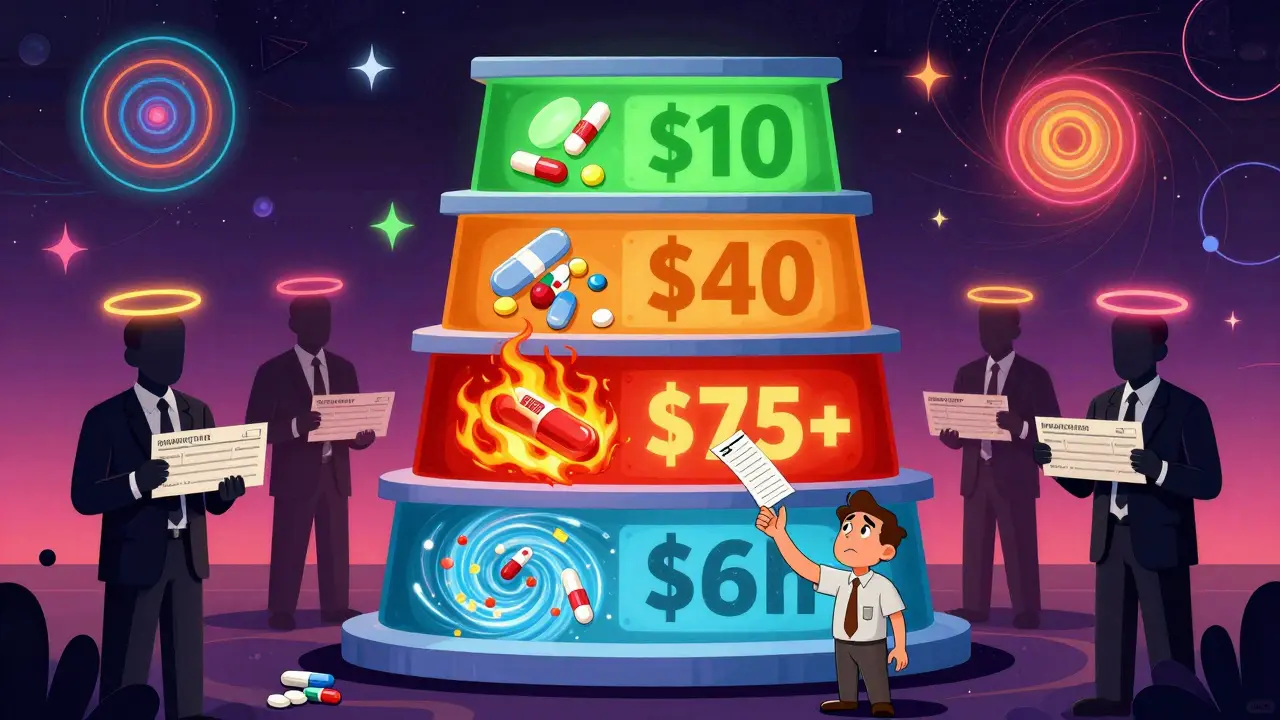
When you pick up a prescription at the pharmacy, you might not think about why one drug costs $10 and another costs $75-even if they treat the same condition. The answer lies in something most employees never see: your employer’s formulary. This hidden list controls which drugs your health plan covers, how much you pay, and whether you get a generic version or are stuck with a brand-name drug that costs ten times more.
How Formularies Work: The Tiered System
Your employer’s prescription drug plan doesn’t treat all medications the same. Instead, it sorts them into tiers. Think of it like a pricing ladder. The lower the tier, the less you pay out of pocket.- Tier 1: Generics - These are the cheapest. You’ll usually pay $10 or less per prescription.
- Tier 2: Preferred brand-name drugs - These are brand-name drugs your plan has negotiated a deal on. Expect to pay around $40.
- Tier 3: Non-preferred brand-name drugs - These are brand-name drugs your plan doesn’t encourage. Copays jump to $75 or more.
- Tier 4: Specialty drugs - Used for complex conditions like cancer, MS, or rheumatoid arthritis. These can cost hundreds or even thousands per month.
Here’s the key: if a brand-name drug becomes available as a generic, your plan will automatically move the generic to Tier 1 and push the brand version to Tier 4. That means if you keep taking the brand-name version, your out-of-pocket cost could spike overnight. No warning. No notice. Just a higher bill at the pharmacy counter.
Why Employers Push Generics
You might wonder: why do employers care so much about generics? It’s simple-money. The FDA confirms that generic drugs are just as safe and effective as brand-name ones. The only real difference? Price.Generics cost 80-85% less because they don’t need expensive clinical trials or marketing campaigns. They use the same active ingredients, same dosages, same safety standards. Yet, they save the U.S. healthcare system over $150 billion every year. That’s $3 billion a week.
Employers don’t just save money-they pass some of those savings to employees. A $10 copay for a generic instead of a $75 copay for the brand name means employees keep more money in their pockets. That’s why 99% of large employer health plans include prescription drug coverage, and nearly all of them structure it to favor generics.
Who Controls What Drugs Are Covered?
You might think your insurance company decides which drugs are on your formulary. But the real power lies with Pharmacy Benefit Managers, or PBMs. These are middlemen-companies like OptumRx, CVS Caremark, and Express Scripts-that manage drug benefits for most employer plans.PBMs don’t just list drugs. They decide which ones get excluded entirely. In January 2024, each of the three biggest PBMs removed over 600 drugs from their formularies. That’s more than 1,800 drugs gone in one month. Why? To pressure drug manufacturers into offering bigger discounts. If a company won’t give a deep enough rebate, the PBM drops the drug. No second chances.
Here’s the catch: the savings from those rebates don’t always reach you. PBMs use a system called gross-to-net pricing. A drug might have a list price of $100, but after rebates, discounts, and returns, the PBM pays only $45. That 55% difference is the gap between what’s listed and what’s paid. But your copay is still based on the original $100 price. So you’re paying more than the drug actually costs.

What Happens When Your Drug Gets Removed?
Imagine you’ve been taking a medication for years. One day, you go to refill it, and the pharmacist says, “Sorry, it’s no longer covered.” That’s not rare. It’s standard practice.If your drug is removed from the formulary, you have three options:
- Switch to a generic or preferred alternative-if one exists and is safe for you.
- Ask your doctor to file a medical exception request with your insurer.
- Pay full price out of pocket.
Medical exceptions aren’t guaranteed. You’ll need documentation from your doctor proving the drug is medically necessary and that alternatives won’t work. Some plans approve them quickly. Others take weeks. In the meantime, you might go without treatment.
And here’s the worst part: if your drug is removed because the manufacturer refused to pay a big enough rebate, you’re the one who loses-not the drug company, not the PBM. You’re stuck choosing between your health and your budget.
How to Find Out What’s Covered
You can’t rely on memory or your doctor’s word. Formularies change constantly. A drug covered this month might be gone next month.Here’s what you should do every time you get a new prescription:
- Check your insurer’s website for the current drug list. Look for “formulary,” “drug list,” or “prescription coverage.”
- Read your Summary of Benefits and Coverage (SBC). It’s required by law and should include a section on prescription drugs.
- Call your insurer directly. Ask: “Is [drug name] covered? What tier is it on? Is there a generic?”
- Ask your pharmacist. They often know what’s covered and what’s not before you even pay.
Don’t wait until you’re at the counter. A quick 5-minute check can save you $65-or more.
What Employers Can Do Better
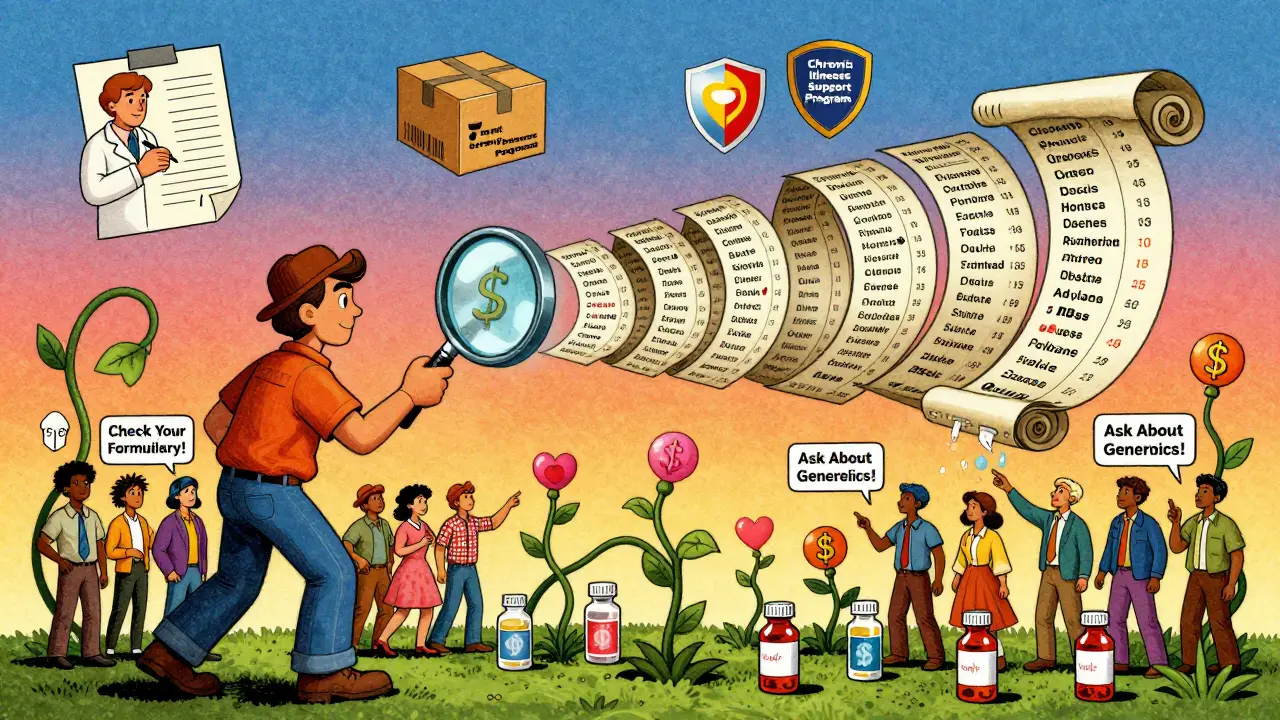
Many employees want to use generics-they just don’t know how to. A Schauer Group study found that employees are often willing to switch to generics, but they’re afraid they’re less effective or don’t understand the process.Employers who communicate clearly see better results. Simple actions make a big difference:
- Send emails with clear comparisons: “This generic saves you $65/month and works the same way.”
- Include generic drug info in payroll stuffers or onboarding packets.
- Offer free consultations with care managers who can help find affordable alternatives.
- Use tools like HealthOptions.org’s Price Assure Program, which automatically applies savings when you fill generics at in-network pharmacies.
When employees understand the system, they make better choices. And when they make better choices, everyone saves.
What You Can Do Right Now
You don’t need to wait for your employer to fix the system. You can take control today:- Look up your current prescriptions on your insurer’s formulary. Note the tier and copay.
- Ask your doctor: “Is there a generic version of this? Is it on our plan’s formulary?”
- If your drug is on Tier 3 or 4, ask if a Tier 1 or 2 alternative exists.
- Use mail-order pharmacies-they often have lower prices on 90-day supplies of generics.
- If you’re on a chronic condition like diabetes or high blood pressure, ask if your plan offers a Chronic Illness Support Program. These can reduce costs significantly.
Remember: your plan’s formulary is designed to save money. But it’s not designed to make your life easier. You have to be the one to navigate it.
What’s Changing in 2025?
The trend is clear: formularies are getting tighter. PBMs are removing more drugs. Rebates are getting bigger. And the gap between what drugs cost and what you pay is widening.Some states are starting to regulate PBMs to force more transparency. But for now, the system stays complex. The only thing that won’t change? Generics will always be the cheapest option. And if you can use them, you should.
The real question isn’t whether generics work. It’s whether you’ll let fear or ignorance stop you from saving hundreds-or thousands-of dollars a year.
Are generic drugs really as good as brand-name drugs?
Yes. The FDA requires generics to have the same active ingredients, strength, dosage form, and route of administration as the brand-name version. They must also meet the same strict standards for quality, purity, and performance. The only differences are in inactive ingredients (like fillers or dyes) and packaging. Generics are not cheaper because they’re lower quality-they’re cheaper because they don’t need to recoup research and marketing costs.
Why does my copay go up even though the drug price dropped?
Your copay is often based on the drug’s list price, not the net price after rebates. PBMs negotiate deep discounts with drugmakers, but those savings don’t always get passed to you. For example, a drug might have a list price of $100, but the PBM pays $45 after rebates. Your copay might still be $75 because the plan uses the list price to set cost-sharing. This is called the gross-to-net spread, and it’s why you’re not always seeing the savings.
Can my employer change my drug coverage without telling me?
Yes. Formularies can change at any time, often without advance notice. If a generic becomes available, or if a manufacturer refuses to pay a rebate, your plan can move or remove a drug overnight. That’s why you should check your formulary every time you refill a prescription. Don’t assume coverage stays the same.
What if I need a drug that’s not on the formulary?
You can request a medical exception from your insurer. Your doctor must submit documentation proving the drug is medically necessary and that alternatives won’t work. Approval isn’t guaranteed, and the process can take weeks. In the meantime, you may have to pay full price or go without. Always ask your doctor about alternatives before you start a new medication.
Are there programs to help with high-cost medications?
Yes. Many employer plans offer Chronic Illness Support Programs (CISP) for conditions like diabetes, asthma, COPD, and heart disease. These programs may include free or discounted medications, care management, and education. Ask your HR department or insurer if you qualify. You might also find savings through mail-order pharmacies or manufacturer assistance programs.
Bradly Draper
December 29, 2025 AT 03:21I had no idea my copay could jump like that. Just switched to a generic last month and saved $60. Wish I’d known sooner.
Gran Badshah
December 31, 2025 AT 02:02in india we dont even have this problem. generics are the only thing available. brand names are for rich people or corrupt doctors. why do you guys make it so complicated?
Ellen-Cathryn Nash
December 31, 2025 AT 06:35It’s not just about money-it’s about principle. PBMs are corporate vultures picking your bones clean while pretending to help. And you’re supposed to be grateful? No. This isn’t healthcare. It’s a rigged casino. You think your doctor’s helping you? They’re just following the script written by a spreadsheet in a Chicago basement.
Generics are fine, sure. But why should you have to beg for your own medicine? Why should your life be dictated by a rebate negotiation between faceless middlemen and drug companies who already made billions? You’re not a customer. You’re inventory.
And don’t get me started on the ‘medical exception’ farce. It’s a trap. A bureaucratic snare designed to make you give up. They know you’ll crack. They count on it.
My cousin spent six weeks without her seizure med because the PBM ‘decided’ to drop it. Six weeks. She had three seizures. One landed her in the ER. The PBM sent her a coupon for a free toothbrush.
So yeah. Check your formulary. But don’t pretend it’s your fault if the system eats you alive.
Samantha Hobbs
January 1, 2026 AT 22:21OMG I just checked my formulary and my blood pressure med is on tier 3?? I’ve been paying $80 a month?? I’m switching to the generic tomorrow. Like, right now. I’m so mad 😤
Nicole Beasley
January 2, 2026 AT 11:45Wait so you’re telling me I’ve been overpaying for years?? 😳 I just checked my insulin-generic is $15 vs $120?? I’m crying. Like, actual tears. 🥲💸
sonam gupta
January 4, 2026 AT 07:42Why do you let them control your life? In India we dont even ask. We take what works. Cheap. Fast. No paperwork. No drama. Your system is broken because you think too much. Just take the generic and move on.
Debra Cagwin
January 5, 2026 AT 03:10You’re not alone in feeling overwhelmed by this system. Many people don’t realize they have power-starting with asking one simple question: ‘Is there a generic?’
That small step can save hundreds. And if your doctor says no, ask why. If they say ‘it’s not covered,’ ask for the formulary link. Most don’t know it exists.
Also, many pharmacies offer discount programs even without insurance. GoodRx, SingleCare, and even Walmart’s $4 list can help.
And if you’re on a chronic condition, reach out to your plan’s care manager. They’re there to help, not to block you. You just have to ask.
You deserve to feel in control. Start small. One prescription at a time. You’ve got this.
Hakim Bachiri
January 5, 2026 AT 22:21Let me get this straight… you’re telling me that the government allows a bunch of corporate middlemen to jack up your copay based on a price that doesn’t even exist anymore? And you’re surprised people are angry? This isn’t capitalism-it’s feudalism with spreadsheets. PBMs are the new lords, and we’re the serfs paying for our own medicine while they get rich off the difference. I’m not even American anymore-I’m a patient in a dystopian pharmacy dystopia.
And don’t even get me started on ‘preferred’ drugs. That’s just a fancy word for ‘we got paid to push this.’ You think your doctor chose it for you? Nah. They got a kickback. Or a free lunch. Or a PowerPoint presentation from a rep who knows your plan’s rules better than you do.
And generics? Sure, they’re fine. But why should you have to fight to get the same damn drug for 1/10th the price? It’s not a miracle. It’s theft.
And now they’re removing 600 drugs a month? That’s not healthcare. That’s a blood sport.
Mimi Bos
January 7, 2026 AT 03:24So I just found out my mom’s arthritis med was removed from the formulary last month. She didn’t know. She kept filling it and paid $180. She cried. I called the insurer. They said ‘sorry, we sent an email.’ We never got it. That’s not customer service. That’s neglect.
Now I’m helping her switch. But why should I have to be her medical advocate? She’s 72. She shouldn’t need a PhD in insurance jargon just to get her pills.
Payton Daily
January 7, 2026 AT 17:14This whole system is a metaphor for America. You’re told you have freedom, but you’re locked in a cage made of paperwork, rebates, and corporate greed. The generics are the truth. The brand names are the lie. The PBM is the magician pulling the curtain. And you? You’re the audience clapping because you think you’re getting a show, not being robbed.
People say ‘just check your formulary.’ But what if you’re tired? What if you’re sick? What if you’re working two jobs and your kid has a fever and you just want to sleep? You don’t have time to be a healthcare detective.
This isn’t about choice. It’s about survival. And the system was never built for survival. It was built for profit.
And the saddest part? We all know it. We just keep playing the game because we think we have no other choice.
But we do. We just have to stop pretending it’s fair.
Kelsey Youmans
January 7, 2026 AT 17:52It is imperative that individuals exercise due diligence in verifying the current status of their prescribed medications through official channels, as formulary changes are both frequent and consequential. One must not rely upon memory or anecdotal information, as the financial and therapeutic implications may be profound. It is recommended that one consult the Summary of Benefits and Coverage, as well as engage directly with the insurer to ascertain accurate and up-to-date formulary information. The onus, though burdensome, remains upon the patient to ensure continuity of care.
Sydney Lee
January 9, 2026 AT 07:05Let me be clear: this isn’t about generics. It’s about power. The PBM doesn’t care if you live or die. They care about the rebate. If your drug doesn’t pay enough, it gets axed. Period. And you? You’re collateral damage. Your suffering is a line item on their quarterly earnings report.
And don’t tell me ‘just switch.’ What if the alternative causes migraines? What if it makes you nauseous? What if it’s not FDA-approved for your condition? Doesn’t matter. The algorithm doesn’t care. The spreadsheet doesn’t care. The CEO doesn’t care.
And the worst part? You’re told you’re lucky to have insurance at all. Like having a ticket to a prison that charges you extra for the bars.
Generics are a Band-Aid on a gunshot wound. The system is broken. And nobody in charge wants to fix it-because they’re the ones profiting from the breakage.
oluwarotimi w alaka
January 9, 2026 AT 08:08USA always make problem for simple thing. In Nigeria we just buy generic from local pharmacy. No formulary. No PBM. No email. No waiting. Just medicine. You think your system is advanced? It's just expensive. And you pay for it. Every day. Every pill. Every lie.
Celia McTighe
January 9, 2026 AT 22:41I just told my boss about this. She’s going to push HR to send out a formulary checklist every quarter. And we’re adding a quick video from our care manager explaining tiers in 2 minutes. Small change. Big difference. I used to feel helpless. Now I feel like I can actually help people. 💪❤️
Bradly Draper
January 10, 2026 AT 14:04Wait, you said your boss is doing that? That’s actually huge. I work at a small company-no HR person. I’m gonna print this out and hand it to our manager tomorrow. Someone’s gotta start somewhere.