
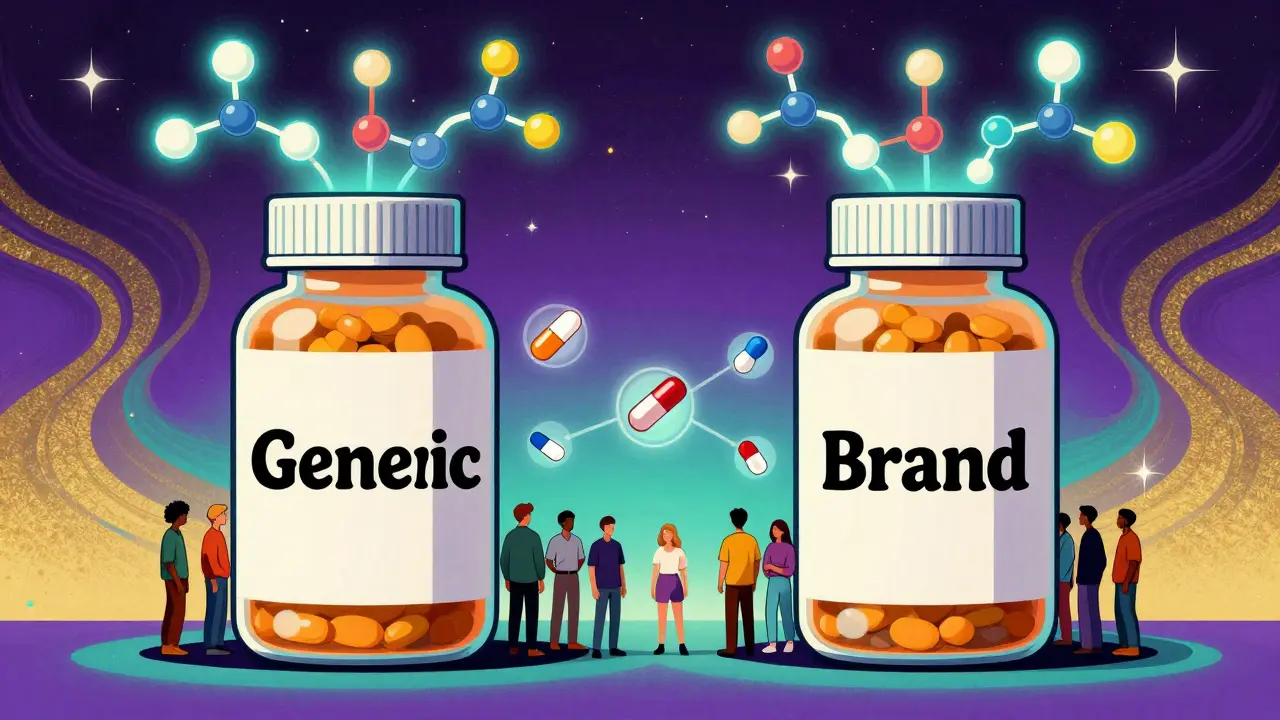
When you pick up a prescription, you might see two options: the brand-name version with a familiar logo, or a cheaper generic with a plain label. Many people wonder - does switching to a generic drug change how it interacts with other medications you’re taking? Is the risk of side effects or dangerous combinations higher? The short answer: no. The risk of drug interactions is essentially the same for generic and brand-name medications.
Why the confusion exists
It’s easy to think that because generics cost less, they must be different. But here’s the truth: every generic drug must contain the exact same active ingredient, in the same strength, and the same dosage form as the brand-name version. That means if you’re taking a generic version of lisinopril, you’re getting the same molecule that’s in Zestril. The same goes for metformin, sertraline, or atorvastatin. The active ingredient is what drives how a drug works - and how it interacts with other substances.So why do some people swear they felt different after switching? Sometimes, it’s not the drug itself. It’s the fillers. Generic drugs can use different inactive ingredients - things like lactose, dyes, or preservatives. For most people, these don’t matter. But if you’re allergic to lactose or sensitive to certain dyes, you might notice stomach upset or a rash. That’s not a drug interaction - it’s an allergic reaction to an excipient. And yes, brand-name drugs can have those too.
How regulators ensure safety
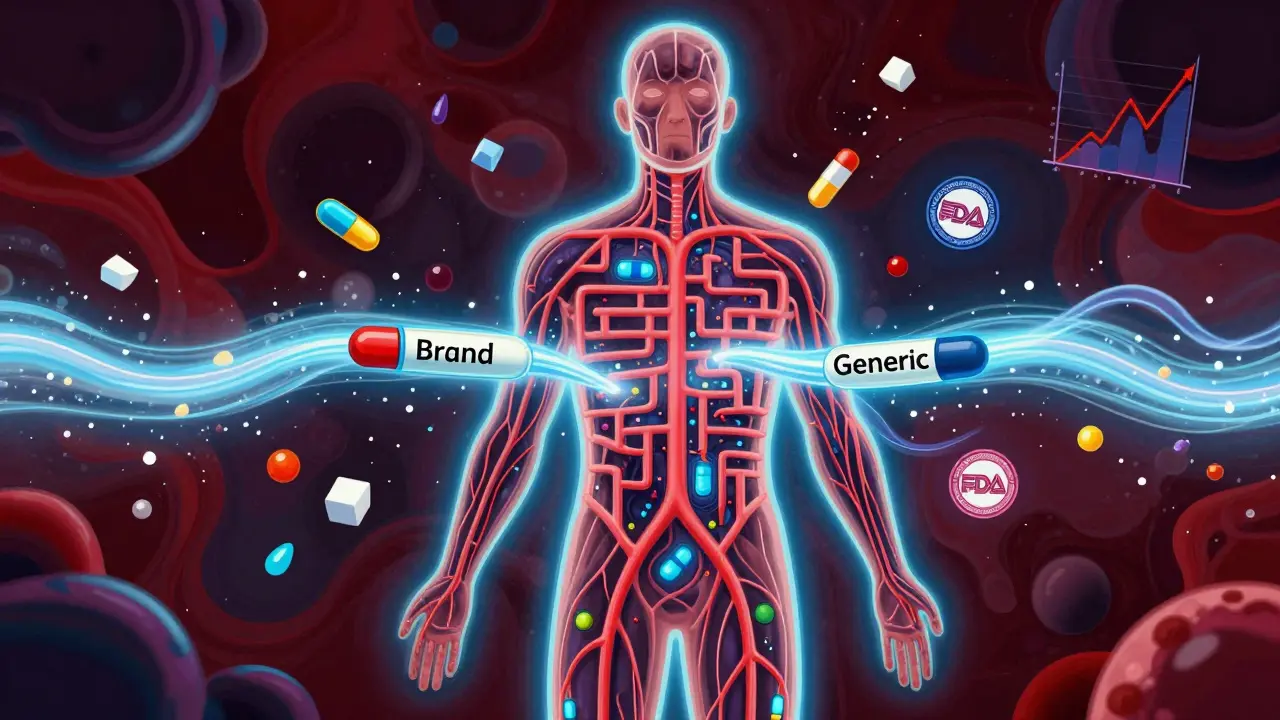
The U.S. Food and Drug Administration (FDA) doesn’t just approve generics based on price. Before a generic hits the shelf, it must pass strict bioequivalence testing. This means scientists measure how much of the drug enters your bloodstream and how fast. The generic must deliver between 80% and 125% of the brand-name drug’s levels. That’s not a wide gap - it’s a tight window designed to ensure the same effect. For drugs with a narrow therapeutic index - like warfarin or levothyroxine - the standard is even tighter: 90% to 111%.These tests are done with healthy volunteers, using blood samples over time. The goal? Prove that the generic behaves just like the brand in your body. And it works. A 2020 study in Scientific Reports looked at 17 cardiovascular drugs and found that patients on generics actually had lower rates of heart attacks and death than those on brand-name versions. That’s not a fluke. It’s data.
What about drug interactions?
Drug interactions happen when one substance changes how another is absorbed, broken down, or cleared from your body. That’s all about the active ingredient. If both the brand and generic contain the same molecule, they’ll interact with other drugs the same way.Take fluoxetine (Prozac) and warfarin (Coumadin). Both are known to increase bleeding risk when taken together. Whether you’re on brand or generic fluoxetine, the interaction is unchanged. The FDA’s own analysis of adverse event reports from 2015 to 2020 found no meaningful difference in interaction-related side effects between generics and brands. The rates were 0.78% for brand drugs and 0.82% for generics - a difference too small to be statistically significant.
Even the experts agree. Dr. Aaron Kesselheim from Harvard Medical School put it plainly: “The vast majority of evidence suggests that generic drugs are therapeutically equivalent to their brand-name counterparts, including regarding drug interaction profiles.” The American College of Clinical Pharmacology echoes this: bioequivalent products have equivalent interaction potential.
When things get tricky
There’s one scenario where switching between generics might matter - and it’s rare. Imagine you’re on a generic version of levothyroxine made by Company A. Then your pharmacy switches you to a different generic from Company B. Both are FDA-approved. Both are bioequivalent to Synthroid. But because Company A’s version is at the lower end of the 80-125% range and Company B’s is at the higher end, your thyroid hormone levels could shift slightly. For most people, this won’t matter. But for someone with thyroid cancer or severe hypothyroidism, even a small change can be risky.This is why doctors sometimes write “dispense as written” on prescriptions for drugs with a narrow therapeutic index. It’s not because generics are unsafe - it’s because consistency matters. If you’ve been stable on one generic for months, switching to another might cause your levels to drift. That’s not a safety issue with generics overall - it’s about minimizing unnecessary changes.
Real stories, real concerns
Online forums are full of people saying, “I switched to generic zolpidem and suddenly felt groggy all day.” One Reddit user reported increased drowsiness when switching from brand Ambien to generic zolpidem while also taking sertraline. Was it an interaction? Possibly. But it’s more likely the generic version delivered a slightly different amount of zolpidem - maybe 10% more - and combined with the SSRI, the effect was amplified. That’s not a flaw in the generic. It’s a quirk of individual biology and formulation.And here’s something interesting: a 2022 Consumer Reports survey found that 18% of people believed generics had different interaction risks. But only 4% had actually experienced a change after switching. That gap suggests a lot of fear, not fact. WebMD data shows complaints about generics spike in the first three months after a new version launches - then drop back to normal. That’s classic nocebo effect: you expect to feel different, so you do.
What you should do
- If your doctor prescribes a brand-name drug and you’re switching to a generic, don’t panic. You’re not risking more interactions. - If you notice new side effects after switching, talk to your pharmacist. They can check if the inactive ingredients changed - maybe you’re reacting to a dye or filler. - For critical drugs like warfarin, levothyroxine, or seizure meds, ask your pharmacist to keep you on the same generic brand if possible. Consistency beats variety. - Always tell your doctor and pharmacist about every medication, supplement, and even herbal product you take. That’s the real key to avoiding interactions - not whether the pill has a logo on it.The bottom line? Drug interactions are about chemistry, not branding. Your body doesn’t care if the pill says “Lipitor” or “atorvastatin.” It reacts to the molecule. And that molecule is identical. The FDA, Harvard, and real-world data all say the same thing: generics are just as safe when it comes to interactions.
What’s changing in 2026
The FDA is now investing $24 million through 2026 to study how multiple generic versions of the same drug might differ in subtle ways. They’re using advanced lab tests and real-world data to see if, under extreme conditions, certain formulations could affect interaction risks. But so far, no evidence suggests a pattern. This isn’t about proving generics are unsafe - it’s about making sure they’re as consistent as possible.Meanwhile, pharmacists are getting better at tracking excipients. The FDA’s Orange Book now lists inactive ingredients for every approved generic. That means your pharmacist can check if your new generic contains gluten, lactose, or a dye you’re sensitive to - before you even take it.
Casey Tenney
March 21, 2026 AT 07:50Generics are a scam. They’re not the same. I switched to generic lisinopril and my blood pressure went haywire. Don’t believe the FDA propaganda.
Sandy Wells
March 23, 2026 AT 00:15People really think chemistry is that simple
Bryan Woody
March 24, 2026 AT 20:29Oh wow so the FDA says generics are fine and you believe them like some kind of obedient citizen
Let me break it down for you in plain english
The active ingredient is the same sure but what about the dissolution rate
What about the coating
What about the fillers that make it cheaper to produce
That’s not chemistry that’s manufacturing
And yeah sure 98% of people won’t notice a difference
But what about the 2% who are on warfarin or levothyroxine
You think the system cares about them
They care about profit margins not your thyroid
And don’t even get me started on the 2020 study that showed generics had lower mortality
Of course they did
Because the people who get generics are the ones who can’t afford to miss doses
They’re not taking them sporadically like rich people who switch brands every month
So yeah the data is real
But the reason it’s real isn’t because generics are magically better
It’s because poverty makes you consistent
Chris Dwyer
March 25, 2026 AT 17:18Hey I get why people are skeptical
I used to be one of them
Switched to generic sertraline and felt like a zombie for two weeks
Turned out my pharmacy switched to a new generic with a different dye
Turns out I’m allergic to FD&C Yellow No. 5
Pharmacist checked the label and switched me back
Now I always ask for the same manufacturer
It’s not about brand vs generic
It’s about consistency
Same pill same filler same everything
And yeah the science backs this up
Drug interactions? Same molecule same effect
My grandma’s on generic warfarin and she’s had zero issues for 7 years
So chill out
It’s not magic
It’s science
Timothy Olcott
March 26, 2026 AT 03:14AMERICA IS BEING ROBBED
THEY WANT YOU TO THINK GENERICS ARE EQUAL
BUT THEY’RE NOT
THEY’RE MADE IN CHINA
THEY’RE MADE WITH TOXIC FILLERS
THEY’RE MADE BY CORPORATIONS WHO DON’T CARE
THE FDA IS A SHILL
TRUST NO ONE
USE BRAND NAME OR DIE
💀💊
Jackie Tucker
March 26, 2026 AT 14:23How quaint
To believe that pharmaceutical equivalence is a binary
As if biology were a spreadsheet
And pharmacokinetics a matter of corporate compliance
How very 20th century
Perhaps the molecule is identical
But the context of its delivery
The cultural weight of the pill
The placebo of brand loyalty
These are the real variables
And yet we reduce human physiology to a regulatory checkbox
How elegant
How tragic
Solomon Kindie
March 27, 2026 AT 21:36the fda is a joke
they approve anything as long as it looks good on paper
you think they test every batch
no they dont
they trust the company
and companies lie
you think generics are safe
youre the one who needs to wake up
Natali Shevchenko
March 28, 2026 AT 10:56I used to think the same thing
That generics were just as good
Then I had a friend on levothyroxine
Switched from one generic to another
Her TSH went from 2.1 to 8.9 in three weeks
She went from feeling fine to needing a wheelchair
It wasn’t the drug
It was the formulation
Two different companies
Two different dissolution curves
Both FDA approved
Both technically equal
But one made her body shut down
So yeah
The molecule is the same
But the body doesn’t care about molecules
It cares about rhythm
And consistency
And when you mess with that
You mess with someone’s life
Johny Prayogi
March 29, 2026 AT 08:50So many people overcomplicating this
Bottom line
Same active ingredient = same interactions
End of story
And if you have a reaction
It’s probably the filler
Not the drug
Ask your pharmacist
They know
Also
Generics save lives by making meds affordable
So stop being paranoid
And start being grateful
👍
Allison Priole
March 30, 2026 AT 20:47So I’ve been on generic metformin for 5 years
Never had an issue
Then one month my pharmacy switched to a new batch
I started having stomach cramps
Called my pharmacist
Turns out the new one had a different binder
Switched back
Cramps gone
So yeah
The drug works the same
But the little things matter
Especially if you’re sensitive
That’s why I always ask for the same one
Not because I distrust generics
But because I trust my body
And I trust my pharmacist
And I don’t let them swap me out without asking
Small thing
Big difference
shannon kozee
April 1, 2026 AT 09:35My mom’s on generic warfarin
Stable for 3 years
Pharmacist switched her to a different generic
INR jumped from 2.4 to 4.1
Had to go to ER
Back to original brand
Now stable
It’s not about brand vs generic
It’s about consistency
And pharmacists need to track this
Not just say ‘it’s the same’
trudale hampton
April 2, 2026 AT 00:39I used to be scared of generics
Then I started working in a pharmacy
Learned how they’re made
Realized most people who complain
Are just reacting to the change
Not the drug
Same molecule
Same effect
Same interactions
Just cheaper
And honestly
That’s a win
Shaun Wakashige
April 3, 2026 AT 08:02generics are fine
unless you're on warfarin
then you're playing russian roulette
Paul Cuccurullo
April 3, 2026 AT 17:31While the science is sound
The emotional experience of medication is deeply personal
For many
The brand name represents safety
Consistency
Trust
And dismissing that as mere placebo
Is itself a form of medical arrogance
Perhaps the molecule is identical
But the meaning of the pill
Is not
Nicole James
April 5, 2026 AT 05:18Did you know the FDA doesn't test generics themselves?
They rely on the manufacturer's data
And the manufacturers? They're in bed with big pharma
Same CEOs
Same lobbyists
Same profits
Generics are just a marketing tool
To keep you hooked on pills
And keep you paying
Even if you think you're saving money
You're not
You're just being manipulated
Again
And again
And again