
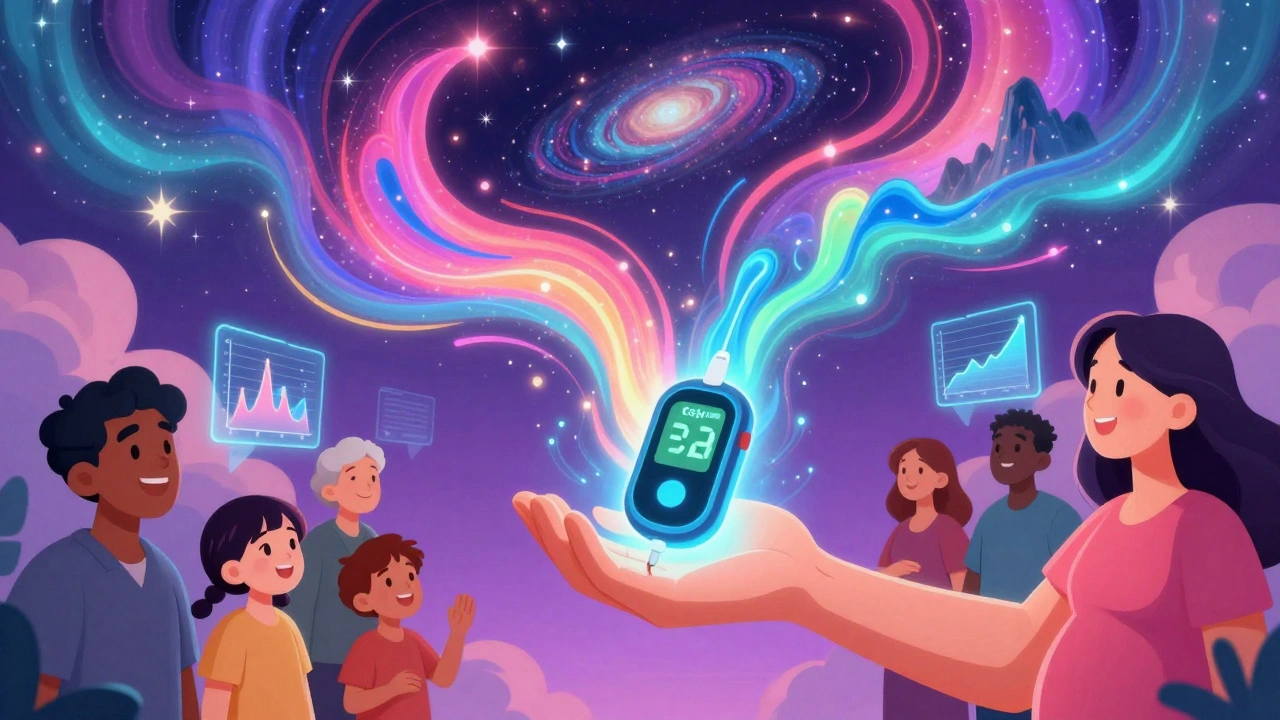
For people managing diabetes, the daily routine used to be simple: prick your finger, test your blood, guess how much insulin to take, and hope for the best. But that’s not the reality anymore. Today, diabetes care is being reshaped by technology that doesn’t just measure glucose-it predicts it, explains it, and even helps you act on it in real time. CGMs are no longer a luxury for Type 1 diabetes patients. They’re now a standard tool recommended for nearly everyone on insulin, including older adults, pregnant women, and children. And it’s not just about the device. It’s the whole ecosystem: smart pens that remember your doses, apps that turn numbers into actionable insights, and even implantable sensors coming down the pipeline.
What CGMs Actually Do (And Why They’re a Game Changer)
Continuous Glucose Monitors, or CGMs, don’t just give you a single number like a fingerstick test. They give you a story. Every five minutes, day and night, they track your glucose levels and show you how they move-up after meals, down during sleep, spiking after stress, dipping after exercise. This isn’t just data. It’s visibility into patterns you never knew existed.
Before CGMs, doctors relied on HbA1c tests, which average your blood sugar over three months. But that number hides the crashes and spikes that cause real harm. A 2025 study from the American Diabetes Association found that each 10% increase in time spent in the target glucose range (70-180 mg/dL) cuts microvascular complications by 64%. That’s not a small win. That’s life-changing.
Today’s top CGMs-Dexcom G7, Abbott FreeStyle Libre 3, and Medtronic Guardian 4-have accuracy levels that rival lab tests. The Libre 3, for example, has a MARD score of 8.1%, meaning its readings are, on average, just 8.1% off from a true blood glucose value. And Abbott’s technology is now linked to fewer hospitalizations for heart complications, according to their own 2025 data. Even more impressive? The Glucotrack implantable sensor, still in development, is showing a MARD of 7.7% in trials and measures glucose directly from blood instead of interstitial fluid. That means no more 5-15 minute delays. It’s real-time, like a heartbeat monitor for your sugar.
Smart Pens: The Quiet Helper in Your Pocket
If CGMs are the eyes, smart insulin pens are the hands. They don’t just deliver insulin-they record it. The Medtronic InPen, for instance, tracks every dose you give, calculates your insulin-to-carb ratio based on your CGM data, and even reminds you if you’ve missed a dose. It’s like having a personal diabetes coach in your pocket.
But here’s the catch: adoption is still low. Only 15% of insulin users are using smart pens, according to 2025 data from the American Association of Diabetes Care & Education Specialists. Why? Cost, complexity, and lack of awareness. Many people don’t realize their pen can talk to their CGM. Others think it’s just another gadget. But for those who use it, the results are clear: fewer errors, better consistency, and less mental load.
Smart pens work best when they’re connected. Pair one with a CGM and an app, and you get a system that doesn’t just react-it anticipates. If your glucose is dropping fast, the app can suggest reducing your next insulin dose. If you ate more carbs than planned, it can adjust your correction factor. It’s not magic. It’s math, powered by real data.
Apps That Turn Numbers Into Action
There are hundreds of diabetes apps. Some are beautiful. Some are clunky. But only a few actually work well with your hardware. The problem? Interoperability. A 2025 conference report found only 43% of third-party apps can sync with all major CGMs. That means if you use a Dexcom G7, your favorite app might not even see your data.
The winners? mySugr and One Drop. Both integrate with Dexcom, Abbott, and Medtronic devices. They don’t just show graphs-they explain them. “Your glucose spiked after lunch because you had pasta,” the app might say. “Try switching to quinoa next time.” They track trends, flag risks, and even let you share data with your doctor remotely.
But the real power isn’t in the app itself. It’s in what it enables. A 2025 Beyond Type 1 report followed 200 people using a remote CGM and app program. Over three months, their average A1c dropped from 10.4% to 7.5%. Foot wounds healed faster. Sleep improved. Anxiety dropped. People who lived in rural areas or couldn’t afford regular clinic visits saw the same gains as those with top-tier care. Technology didn’t replace the doctor-it made care accessible.
The Hidden Costs and Real Barriers
It’s easy to think this tech is everywhere now. But it’s not. For uninsured patients, CGM sensors can cost $300 a month. Even with insurance, 37% of people report prior authorization denials. Some insurers require you to prove you’ve tried fingersticks for six months before approving a CGM. That’s outdated thinking-because the data shows CGMs reduce emergency visits and hospital stays.
Then there’s the issue of adhesion. Forty-five percent of users say their sensors fall off during workouts, showers, or hot weather. Abbott’s Libre 3 is smaller and stickier than older models, but it still doesn’t last forever. And while Dexcom claims 92% first-contact resolution for tech issues, not everyone gets that level of support.
And then there’s data overload. Sixty-eight percent of new CGM users feel overwhelmed at first. Alarms go off at 3 a.m. for a 68 mg/dL reading. You start ignoring them. That’s why the ADA now recommends personalized alerts. If you’re a night-shift worker, your low glucose threshold might be 75 mg/dL, not 70. If you’re active, you might need fewer alerts during exercise. Customizing settings isn’t optional-it’s essential.
What’s Next? Implants, Predictions, and Needle-Free Insulin
The future of diabetes tech isn’t just better sensors. It’s smarter systems. Dexcom and EarlySense are launching a machine learning tool in mid-2026 that predicts glucose spikes 30 minutes ahead with 89% accuracy. Imagine getting a heads-up before your blood sugar crashes during a meeting-or before it spikes after dessert.
Glucotrack’s implantable sensor could be a game-changer. No more changing sensors every two weeks. No more tape, no more adhesive. Just a tiny device under your skin, lasting up to three years. It’s not approved yet, but early trials show it could prevent 12,000-15,000 severe low-blood-sugar events in the U.S. each year.
And then there’s Vaxess Technologies’ needle-free semaglutide patch. If it works, it could fix one of the biggest problems with GLP-1 drugs like Ozempic: adherence. People stop taking them because injections hurt or are inconvenient. A patch that delivers the drug through the skin could change that.

How to Get Started (Without Getting Overwhelmed)
If you’re thinking about switching to CGM tech, start here:
- Check your insurance coverage. Ask if CGMs are covered under your plan, and if prior authorization is required.
- Ask your doctor for a referral to a certified diabetes care and education specialist (CDCES). They’ll walk you through setup, alert customization, and data interpretation.
- Choose one system to start. Don’t try to use five apps and three devices at once. Pick the CGM your provider recommends, then pair it with one app.
- Give yourself two to four weeks to adjust. The first week is usually the hardest. Alarms feel constant. Data feels confusing. But by week three, you’ll start seeing patterns-and feeling more in control.
- Join a community. Reddit’s r/diabetes has over 145,000 members. Many share their sensor failures, app tips, and how they got their insurance to approve coverage. You’re not alone.
Diabetes technology isn’t about perfection. It’s about progress. It’s about knowing your body better than you ever could with a fingerstick. It’s about sleep without fear, meals without guilt, and life without constant guessing. The tools are here. The data is clear. The question isn’t whether you should use them-it’s when you’ll start.
Are CGMs covered by insurance?
Yes, most major insurers, including Medicare and Medicaid, now cover CGMs for people with Type 1 diabetes and those with Type 2 diabetes who use insulin. However, prior authorization is often required, and some plans still limit coverage to specific brands. Out-of-pocket costs can range from $0 to $300 per month depending on your plan and the device you choose.
Can CGMs replace fingerstick tests completely?
For most people, yes. Modern CGMs like the Abbott FreeStyle Libre 3 and Dexcom G7 are accurate enough to make treatment decisions without fingersticks. However, you should still test with a fingerstick if your CGM reading doesn’t match how you feel-like if you’re dizzy or shaky but the CGM says your sugar is normal. Always trust your symptoms over the device if there’s a mismatch.
Do smart insulin pens work with all CGMs?
Not yet. The Medtronic InPen works best with Medtronic CGMs and some third-party apps, but it doesn’t integrate with Abbott’s Libre or Dexcom’s systems directly. Always check compatibility before buying. Some newer apps, like One Drop, can link multiple devices, but full integration between brands is still limited.
What’s the best diabetes app for beginners?
mySugr is often recommended for beginners because of its simple interface, visual graphs, and guided onboarding. It works with Dexcom, Abbott, and Medtronic CGMs and offers a free version with basic tracking. One Drop is another strong option, especially if you want to track food, exercise, and medication together. Avoid apps that don’t clearly list which CGMs they support.
How long do CGM sensors last?
Most external CGMs last 10 to 14 days. Dexcom G7 and Abbott FreeStyle Libre 3 both last 14 days. Medtronic Guardian 4 sensors last 7 days. Implantable sensors like Glucotrack (still in development) are designed to last up to three years. Always follow the manufacturer’s instructions-wearing a sensor past its expiration can reduce accuracy and increase infection risk.
Can CGMs help with weight loss?
Yes, indirectly. By helping you understand how food affects your glucose, CGMs make it easier to choose meals that don’t cause spikes or crashes. A 2025 ADA study showed that combining CGM data with semaglutide (Ozempic) helped Type 1 diabetes patients lose an average of 18 pounds over six months-without increasing low-blood-sugar events. Better glucose control supports better eating habits, which supports weight loss.
Is it safe to share my CGM data with family?
Yes, and it’s often encouraged. All major CGMs allow you to share real-time data with up to 10 people via apps like Dexcom Share or LibreLinkUp. This is especially helpful for parents of children with diabetes or caregivers for older adults. However, make sure you’re using the official app from your CGM manufacturer, as third-party apps may have security risks. A 2025 JAMA study found 63% of non-official CGM apps had data security flaws.
Final Thoughts: It’s Not About the Tech-It’s About the Freedom
Diabetes technology doesn’t cure diabetes. But it gives you something just as powerful: control. Not the kind that comes from rigid rules and fear of mistakes. The kind that comes from knowing your body, seeing patterns, and making smarter choices without guessing. It’s about sleeping through the night without waking up scared. It’s about eating a slice of cake without panic. It’s about living your life, not managing your numbers.
The tools are better than ever. The data is undeniable. The only thing holding people back now is access-and awareness. If you’re still using fingersticks, ask your doctor about CGMs. If you’re already using one, ask yourself: have you customized your alerts? Are you using an app that helps you understand the data? Are you sharing your progress with someone who supports you?
Technology doesn’t replace human care. It just makes it better. And for people living with diabetes, that’s everything.
Saket Modi
December 2, 2025 AT 21:40John Webber
December 3, 2025 AT 05:56Shubham Pandey
December 4, 2025 AT 13:24Elizabeth Farrell
December 4, 2025 AT 17:34Sheryl Lynn
December 4, 2025 AT 23:25Paul Santos
December 6, 2025 AT 03:55John Morrow
December 6, 2025 AT 21:46Kristen Yates
December 8, 2025 AT 13:34Saurabh Tiwari
December 10, 2025 AT 11:42Anthony Breakspear
December 11, 2025 AT 11:56Zoe Bray
December 12, 2025 AT 23:35Girish Padia
December 13, 2025 AT 04:51