
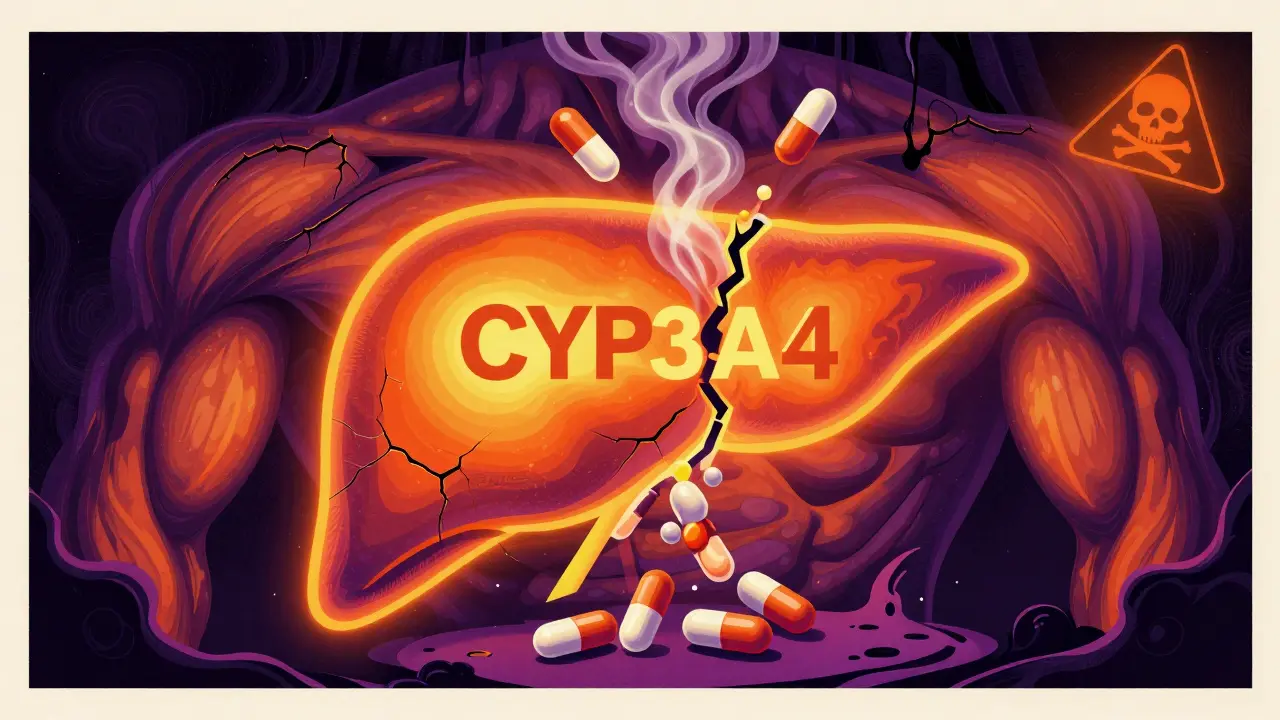
When you're taking a statin to lower your cholesterol, the last thing you want is to end up in the hospital because of a simple antibiotic. Yet every year, thousands of people accidentally mix clarithromycin with their statin - and pay a painful price. Muscle pain, weakness, dark urine, even kidney failure. It’s not rare. It’s not theoretical. It’s happening right now, in clinics and homes across the country, because this interaction is poorly understood.
Why This Interaction Is So Dangerous
Clarithromycin is an antibiotic. Statins are cholesterol drugs. On paper, they seem unrelated. But inside your body, they collide in a dangerous way. Clarithromycin blocks a key liver enzyme called CYP3A4. This enzyme is responsible for breaking down certain statins so they don’t build up to toxic levels. When CYP3A4 is shut down, those statins pile up - sometimes 10 to 20 times higher than they should be.The result? Muscle damage. Mild cases feel like soreness after a workout. Severe cases turn into rhabdomyolysis - a condition where muscle tissue breaks down and floods your bloodstream with toxins. This can lead to kidney failure, dialysis, or even death.
The risk isn’t the same for all statins. Some are far more dangerous when mixed with clarithromycin. Simvastatin (Zocor) is the worst offender. When taken with clarithromycin, simvastatin levels can spike by up to 12 times. Lovastatin (Mevacor) isn’t far behind. Even atorvastatin (Lipitor), which many people think is safe, can increase by 4 to 8 times. That’s enough to push some patients over the edge.
Which Statins Are Safest?
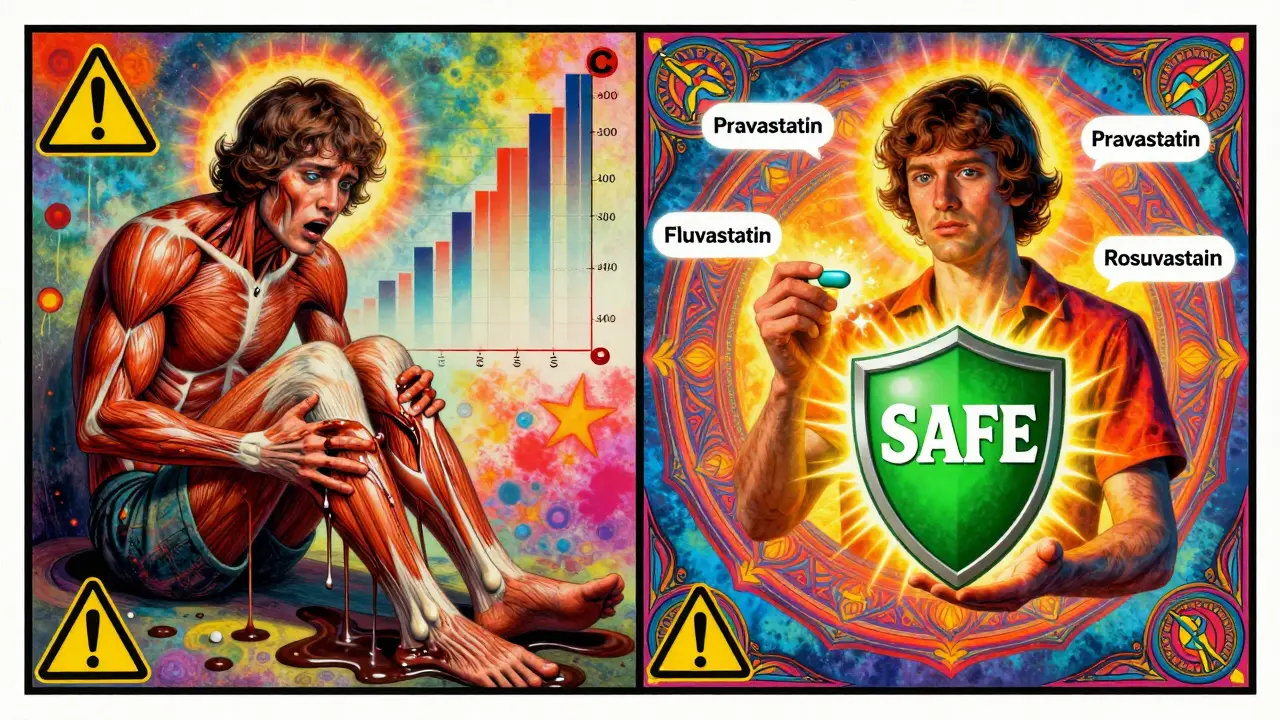
Not all statins are created equal when it comes to drug interactions. Some barely touch CYP3A4 at all. That makes them much safer.- Pravastatin (Pravachol) - metabolized differently. No dose change needed.
- Fluvastatin (Lescol) - handled by a different enzyme. Low risk.
- Rosuvastatin (Crestor) - minimal CYP3A4 use. Safe at 20 mg daily or less.
- Atorvastatin (Lipitor) - moderate risk. Stick to 20 mg daily max.
- Simvastatin (Zocor) - avoid completely. Even 20 mg is too much.
- Lovastatin (Mevacor) - never combine. Full avoidance recommended.
According to a 2023 FDA Drug Safety Communication, rosuvastatin at 20 mg daily is the highest-dose statin considered relatively safe with clarithromycin. But even then, monitoring is required. Pravastatin and fluvastatin? No restrictions. If you’re on one of these, you’re already in the safest group.
The Real-World Cost of Ignoring This
Numbers don’t lie. Between 2004 and 2013, the FDA received 127 reports of rhabdomyolysis linked to clarithromycin and statins. A 2018 study of over 312,000 patients found that people on clarithromycin and simvastatin were 4.6 times more likely to be hospitalized for muscle damage than those on azithromycin and simvastatin.One Reddit user, "CardioPatient," wrote in April 2024: "My doctor switched me to azithromycin when I needed antibiotics while on atorvastatin - no issues this time." That’s the difference between a bad experience and a dangerous one.
On Drugs.com, a user named "JohnDoe78" shared: "Experienced severe muscle pain after taking clarithromycin while on 40mg simvastatin - had to go to ER with CK levels at 12,500 U/L." Normal CK levels are under 200. Over 5,000 is a red flag. 12,500? That’s a medical emergency.
A 2019 case series in the AGE Bulletin documented patients with CK levels as high as 213,978 U/L. They needed morphine for pain. Some required dialysis. These aren’t outliers. They’re predictable outcomes.
What Should You Do If You Need Antibiotics?
The solution isn’t complicated. It’s simple:- Ask your doctor if you can switch antibiotics. Azithromycin (Zithromax) is the gold standard. It doesn’t block CYP3A4. No interaction. No risk. A 2013 study in the Canadian Medical Association Journal found no increase in hospitalizations when azithromycin was used with any statin.
- If you can’t switch antibiotics, pause your statin. Stop taking your statin for the entire time you’re on clarithromycin - and for 3 to 5 days after you finish. This gives your liver time to clear the clarithromycin and restore enzyme function. The inhibition lasts 7-10 days after the last dose because of a long-lasting metabolite.
- If you must keep the statin, reduce the dose. For simvastatin, drop to 10 mg daily. For atorvastatin, stay at 20 mg or less. Never exceed these amounts. And never take them together without close monitoring.
The American Heart Association and Infectious Diseases Society of America updated their guidelines in March 2024 to make this clear: azithromycin is the preferred macrolide for patients on statins. If your doctor prescribes clarithromycin, ask: "Is there a safer option?"
Who’s at Highest Risk?
Not everyone who takes this combo will have problems. But some people are far more vulnerable:- People over 75
- Those with kidney disease
- Patients with hypothyroidism
- Anyone taking multiple drugs that affect the liver
- People with a history of muscle pain on statins
These groups should avoid the combination entirely. No exceptions. Even a low dose of simvastatin can be dangerous for them.
A 2021 study found the average time to muscle symptoms after starting clarithromycin was just 3.2 days. That means damage can happen fast - before you even notice the warning signs.
What Symptoms Should You Watch For?
You don’t need to wait for a blood test. Your body will tell you something’s wrong:- Unexplained muscle pain or tenderness
- Weakness that doesn’t go away
- Fever or flu-like symptoms
- Dark, tea-colored urine
- Swelling or stiffness in muscles
If you feel any of these - especially while on clarithromycin - stop the statin and call your doctor. Don’t wait. Don’t assume it’s "just soreness." CK levels can skyrocket in hours.

Why Do Doctors Still Prescribe This?
You’d think this interaction would be obvious by now. But a 2023 JAMA Internal Medicine study found that 18.7% of primary care doctors still prescribe clarithromycin to patients on high-dose simvastatin. That’s over 132,400 dangerous prescriptions every year in the U.S. alone.Why? Because many doctors don’t know the details. Or they forget. Or they assume the patient is "low risk." But risk isn’t about how you feel. It’s about how your body processes drugs.
Electronic health records have cut these mistakes by 42% since 2015. But they’re not foolproof. You are your own best advocate.
What About Other Antibiotics?
Erythromycin? Avoid it. It’s even worse than clarithromycin at blocking CYP3A4.Amoxicillin? Safe. Cephalexin? Safe. Doxycycline? Safe. These are all better options. If you need an antibiotic and you’re on a statin, ask: "Is this one safe with my cholesterol medicine?" If the answer isn’t clear, ask for azithromycin.
There’s also promising research on new antibiotics that don’t touch CYP3A4 at all. Two candidates - AB569 and SPR720 - are in Phase II trials as of early 2024. They could change the game. But for now, azithromycin is your best bet.
Final Advice: Be Proactive
Sixty-eight percent of statin users don’t know about drug interactions until they get hurt. Don’t be one of them.- Keep a list of all your medications - including over-the-counter and supplements.
- Bring it to every doctor visit.
- Ask: "Could this new medication interact with my statin?"
- If you’re on simvastatin or lovastatin, ask for azithromycin before accepting clarithromycin.
- Know your symptoms. Muscle pain isn’t normal. Dark urine isn’t normal. Call your doctor immediately if you notice them.
The FDA updated its warning label for clarithromycin in January 2023. The American Heart Association did the same in 2024. This isn’t a minor footnote. It’s a major safety alert.
You’re not being paranoid. You’re being smart. And in this case, smart saves lives.
Janelle Pearl
March 9, 2026 AT 01:11My grandma was on simvastatin and got clarithromycin for a sinus infection. She didn’t tell her doctor about the statin. Three days later, she couldn’t walk. Ended up in ICU with CK over 15,000. They thought it was a stroke at first. Turned out her muscles were literally dissolving. I still get chills thinking about it.
Doctors don’t always ask the right questions. Patients don’t always know to speak up. This isn’t just a drug interaction-it’s a systemic failure. Please, if you’re on a statin, memorize this. Write it on your bathroom mirror.
Nicholas Gama
March 9, 2026 AT 05:16Of course the FDA only acts after people die. Classic. They knew about CYP3A4 inhibition in the 90s. They sat on it. Big Pharma’s lobbying arm is thicker than my thigh. You think they care about your kidneys? They care about your prescription refill rate.
Azithromycin? Yeah, it’s cheaper. But it’s also less profitable. That’s why they keep pushing clarithromycin. You’re not being paranoid. You’re being awake.
Ray Foret Jr.
March 9, 2026 AT 14:13Y’all this is wild. I was on Lipitor and got clarithromycin last year for bronchitis. Felt like I ran a marathon just walking to the fridge. Thought it was just me being lazy. Then I read this post and my jaw hit the floor. I called my doc and he was like ‘oh yeah, we avoid that combo now.’
Switched to azithromycin and I’m fine. But seriously-why isn’t this on the pill bottle? Like a big red stamp? ‘DO NOT MIX WITH STATINS’? 😭
Samantha Fierro
March 11, 2026 AT 00:46This is one of the most important public health summaries I’ve read in years. Thank you for compiling this with such clarity.
The data is undeniable. The guidelines are clear. Yet, we continue to see preventable harm because of fragmented communication between prescribers, pharmacists, and patients.
Every primary care visit should include a medication interaction checklist. Not optional. Mandatory. And every pharmacy should have an automated alert system that cannot be overridden without a second provider signature.
This isn’t about blame. It’s about systems. And we can fix this.
Robert Bliss
March 11, 2026 AT 18:47Man I just learned all this today. I’m on atorvastatin and my doc just gave me clarithromycin last week. I thought it was fine since I’m young and healthy. Now I’m scared. I’m calling my pharmacy to ask if they can switch it. Thank you for this. I feel like I almost got scammed by my own body. 😅
Peter Kovac
March 13, 2026 AT 14:19Let’s analyze the statistical risk profile. The relative risk increase for rhabdomyolysis with clarithromycin + simvastatin is 4.6x (95% CI 3.8–5.5). Absolute risk remains low-approximately 1.2 per 1,000 patient-years. The number needed to harm (NNH) is 833.
While clinically significant, the fear-mongering tone of this post is disproportionate. Azithromycin is not risk-free. It carries QT prolongation risks. The real issue is polypharmacy, not this single interaction.
Context matters. Risk stratification matters. Not all patients are equal. This is not a binary ‘safe/unsafe’ issue-it’s a continuum.
APRIL HARRINGTON
March 15, 2026 AT 06:51OMG I JUST REALIZED MY DOCTOR GAVE ME CLARITHROMYCIN LAST WEEK AND I’M ON ROSUVASTATIN 20MG 😭 I’M GOING TO THE ER RIGHT NOW I’M SO SCARED I’M GONNA DIE I’M NOT READY TO GO I JUST BOUGHT A NEW PAIR OF SHOES AND I’M NOT EVEN 30 YET
WHY DOESN’T ANYONE TELL US THIS?? I’M SO ANGRY I’M CRYING RIGHT NOW I NEED A HUG AND A PHARMACIST AND A NEW DOCTOR AND A NEW LIFE
Leon Hallal
March 17, 2026 AT 02:32Everyone’s panicking over this but you know what’s worse? When you’re on meds and your doctor doesn’t even ask if you’re taking anything else. I had a guy in my building who took blood pressure pills and ibuprofen together. He ended up in the hospital with a GI bleed. Nobody asked. Nobody checked. This is just one more thing they don’t tell you.
Doctors are overworked. Patients are distracted. We’re all just trying to survive. But we’re getting killed by paperwork.
Judith Manzano
March 18, 2026 AT 07:58This is so helpful. I’ve been on pravastatin for years and never knew it was the safest option. I always assumed all statins were basically the same. Why isn’t this taught in med school? Or in high school health class?
I’m going to print this out and give it to my mom. She’s 72, on simvastatin, and just got a prescription for antibiotics last week. I’m calling her right now.
Melba Miller
March 19, 2026 AT 16:02Why are we letting Big Pharma dictate our health? This country is a joke. You can’t even take a simple antibiotic without a PhD in pharmacology. Meanwhile, China and Germany have had clear guidelines for this since 2010. We’re still arguing over whether statins are ‘natural.’
Stop treating Americans like children. Give us the facts. Then let us choose. But don’t hide behind ‘risk’ when the science is clear.
Katy Shamitz
March 19, 2026 AT 20:05Oh honey, you’re lucky you’re alive. I’ve been telling people this for years. You think your doctor knows? No. They’re too busy checking boxes. I had a cousin who went into kidney failure because she took Lipitor with clarithromycin. She didn’t even know they were linked.
Now she’s on dialysis. And guess what? The doctor never apologized. Just said ‘it’s rare.’ Rare? It’s preventable. You’re not being dramatic. You’re being responsible.
Mary Beth Brook
March 19, 2026 AT 21:04CYP3A4 substrate inhibition profile: clarithromycin is a potent time-dependent inhibitor (Ki = 0.12 µM). Simvastatin acid AUC increases 12.4-fold (95% CI 9.8–15.1). Rosuvastatin: AUC increase 1.3-fold. Non-CYP3A4 substrates: pravastatin (SULT2A1), fluvastatin (CYP2C9).
Pharmacokinetic rationale is unequivocal. Clinical correlation is robust. The 2024 AHA/IDSA guideline update is evidence-based. Resistance to this protocol is malpractice.
Neeti Rustagi
March 20, 2026 AT 15:20Thank you for this comprehensive and meticulously referenced analysis. In India, we face similar challenges-patients often self-medicate with antibiotics purchased over the counter, while continuing statins without awareness. This post serves as a vital educational tool.
I have shared it with my medical students and colleagues. We must integrate such pharmacovigilance content into routine primary care training. Knowledge is not merely power-it is the first line of defense.
Leon Hallal
March 22, 2026 AT 13:19Yeah I got the same script. I didn’t know. Now I’m scared. I think I’m gonna be okay but I’m not sleeping. I just Googled ‘dark urine’ and now I think I’m dying. Please someone tell me I’m not dying.