

Bleeding Risk Assessment Tool
Is this an Emergency?
Answer a few quick questions to help determine if your current symptom requires immediate emergency care or home management.
Result Title
Detailed explanation of the result.
Taking a blood thinner can feel like a constant balancing act. On one hand, these medications are lifesavers-they stop the clots that cause strokes and heart attacks. On the other, they make your body less efficient at stopping a leak. The real challenge isn't just managing the meds, but knowing when a bruise is just a bruise and when a nosebleed is a sign that you need to get to the hospital immediately. Understanding this difference is critical because uncontrolled bleeding can lead to hypovolemic shock in as little as 30 to 60 minutes.
What are blood thinners and why do they cause bleeding?
First, let's get the terminology straight. Blood thinners is the common term for anticoagulants, medications that slow down the blood clotting process to prevent thromboembolic events. They don't actually "thin" the blood's consistency; they just make it take longer for a clot to form.
Common versions include Warfarin (often known as Coumadin) and newer direct oral anticoagulants (DOACs) like Apixaban (Eliquis), Rivaroxaban (Xarelto), and Dabigatran (Pradaxa). While these drugs reduce stroke risk by 60-70% for people with atrial fibrillation, they also increase the risk of bleeding. For some, this means a few more bruises; for about 3% of users, it can lead to a major bleeding event every year.
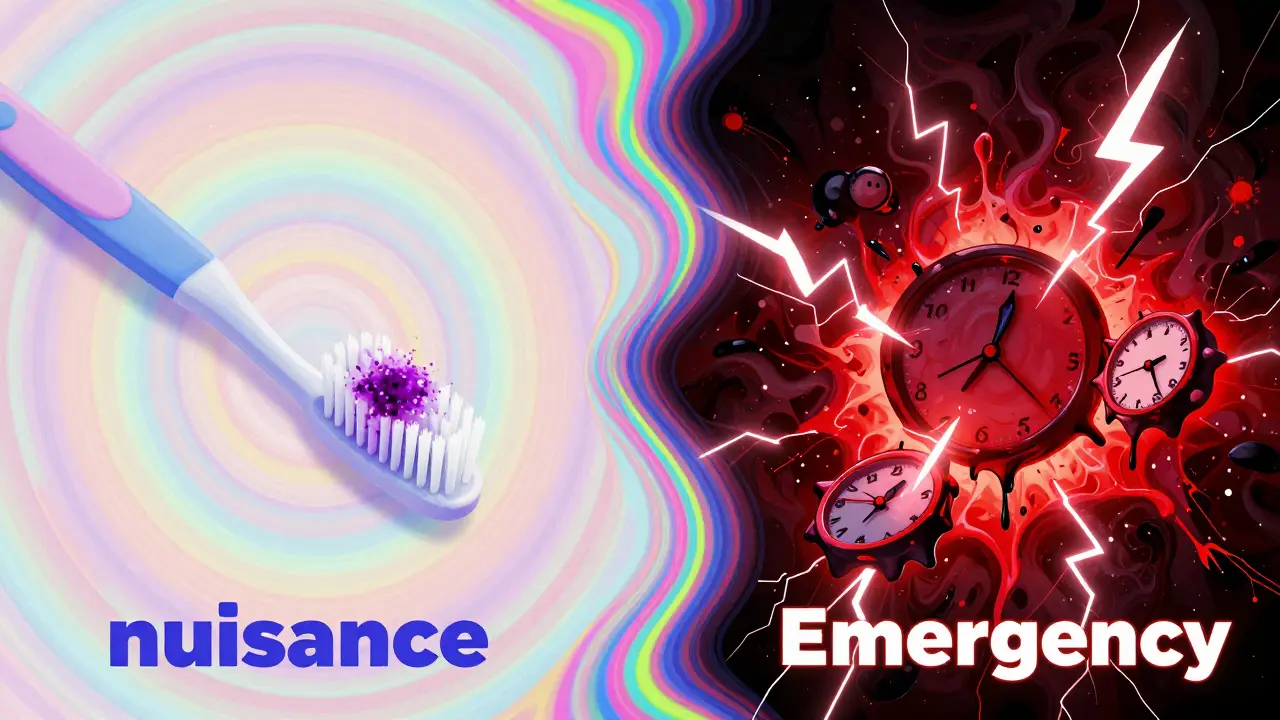
Nuisance bleeding vs. emergency bleeding
Medical professionals divide bleeding into two main categories: "nuisance" and "life-threatening." Knowing the difference can save you an unnecessary trip to the ER and, more importantly, prevent you from making the dangerous mistake of stopping your medication without a doctor's order.
Nuisance bleeding includes things like bleeding gums when you brush your teeth, easy bruising, or small cuts that take longer than usual to stop. Interestingly, these minor issues account for over half of all ER visits by people on anticoagulants. Many patients panic, head to the emergency room, and then decide to stop their meds out of fear. This is a huge mistake-stopping your blood thinner bleeding management arbitrarily can increase your stroke risk by 300% in the first week.
Life-threatening bleeding is different. It involves internal organs or large volumes of blood loss. This includes intracranial hemorrhage (bleeding in the brain), gastrointestinal bleeding, or retroperitoneal hemorrhage. These aren't just "nuisance" issues; they are medical emergencies with high mortality rates if not treated instantly.
Red flags: When to call 911 or go to the ER
If you notice any of the following, don't wait for a callback from your clinic. Get to the emergency room immediately:
- Uncontrolled external bleeding: Any cut or wound that continues to bleed after 10-15 minutes of continuous, firm, direct pressure.
- Blood in your output: Vomiting blood, coughing up blood, blood in your urine, or stools that look black and tarry (like coffee grounds or tar).
- Neurological changes: A sudden, severe headache, confusion, or difficulty speaking, especially after a bump to the head.
- Severe pain: Sudden and intense back pain or chest pain.
- Heavy menstrual flow: For women, bleeding that is significantly heavier than your normal period.
- Signs of shock: Feeling lightheaded, shortness of breath, or extreme fatigue. These often happen when blood loss exceeds 15-20% of your total volume.
A special warning for head injuries: even a minor bump to the head can cause a slow bleed in the brain. Symptoms might not show up for 24 to 72 hours, so any significant impact requires an immediate medical evaluation.
| Feature | Nuisance Bleeding | Emergency Bleeding |
|---|---|---|
| Examples | Gum bleeding, minor bruises, small cuts | Black stools, coughing blood, severe head trauma |
| Duration | Stops with pressure within 15 mins | Does not stop with pressure; persists |
| Symptoms | Localized to the cut/bruise | Dizziness, shortness of breath, fainting |
| Action | Home care or call doctor | Immediate Emergency Room / 911 |
How to manage minor bleeding at home
If you're dealing with a minor cut or a nosebleed, the goal is to achieve hemostasis (stopping the flow) without panicking. Most minor cuts in people on blood thinners stop within 5-7 minutes with proper pressure, whereas a person not on meds might stop in 2-3 minutes. It just takes a bit longer.
- Apply Firm Pressure: Use a clean cloth or gauze. Apply continuous, firm pressure for at least 10 full minutes. Do not lift the gauze every 30 seconds to "check" if it's stopped; this breaks the clot that's trying to form. Experts suggest the pressure should "hurt a little" to be effective.
- Elevate the Site: If the cut is on your arm or leg, keep it raised above the level of your heart.
- Avoid Irritants: Don't use hydrogen peroxide on the wound, as it can actually damage the tissue and slow down the healing process.
- Nosebleed Technique: Pinch the soft part of your nose firmly and hold it for 10-15 minutes without letting go. If it's still bleeding after 30 minutes, it's time for the ER.

What happens at the hospital?
When you arrive at the ER, the first thing the team will do is assess the volume of blood loss and your vital signs. Depending on which medication you're taking, they may use Reversal Agents. These are specialized drugs designed to "turn off" the blood thinner quickly.
For example, Andexanet alfa (Andexxa) can be used to reverse the effects of Apixaban or Rivaroxaban, potentially cutting the time it takes to stop bleeding from several hours down to 30-60 minutes. In the future, we may see universal reversal agents like ciraparantag, which aim to work across all types of anticoagulants.
Should I stop my medication if I start bleeding?
No. Never stop taking your blood thinners without talking to your doctor. The risk of having a stroke or pulmonary embolism increases dramatically within 24-48 hours of skipping a dose. If you are bleeding, seek medical help, but let the doctor decide when to pause the medication.
How long is too long for a nosebleed?
While nosebleeds are common on anticoagulants, if a nosebleed lasts longer than 30 minutes despite continuous firm pressure, you should seek emergency care.
Are some blood thinners safer than others regarding bleeding?
Yes, data suggests some DOACs have lower bleeding profiles. For instance, Apixaban has shown a lower risk of major bleeding events compared to Warfarin in long-term studies.
What does "tarry stool" mean?
Tarry stools are stools that look black, sticky, and resemble tar. This is a classic sign of upper gastrointestinal bleeding and is a medical emergency for anyone on blood thinners.
Is a bruise always a cause for concern?
Not necessarily. Small bruises are common. However, if you have severe bruising without a known injury, or if bruises are appearing in unusual places, you should notify your healthcare provider.
Next Steps for Your Safety
To stay safe while on these medications, keep a small "emergency card" in your wallet that lists the specific blood thinner you take and the dose. This is vital for paramedics or ER doctors if you're unable to speak. If you're feeling anxious about your bleeding risk, ask your doctor about a structured bleeding management plan or a telemedicine option for quick consultations when you're unsure if a bleed is "nuisance" or "emergency." This can prevent unnecessary ER trips and keep your therapy on track.
dwight koyner
April 6, 2026 AT 08:22It is imperative to emphasize that the timing of medical intervention cannot be overstated. For those managing anticoagulation therapy, the distinction between a minor bruise and a systemic hemorrhage is often subtle until it becomes critical. I strongly recommend that patients not only carry the emergency card mentioned but also share their specific medication list with a trusted family member or caregiver who can recognize neurological changes if the patient is unable to communicate. Furthermore, maintaining a consistent diet, particularly regarding Vitamin K intake for those on Warfarin, is essential to keep the INR levels within the therapeutic range and reduce the risk of these bleeding events.
jack hunter
April 7, 2026 AT 06:19why do we even trust these things anyway... just more ways for the systm to keep us dependent on pills. its all just a cycle of side effects leading to more meds. we pretend we have control but we just trade one risk for another and call it progress. really just a slow fade into nothingness while paying a pharmacy for the privilige
Ethan Davis
April 7, 2026 AT 12:49Big Pharma loves this stuff. They push the "emergency" narrative so you stay terrified and keep buying the expensive DOACs instead of looking into natural ways to manage blood flow. It's a racket designed to keep you in the ER loop where they can charge you five grand for a 10-minute checkup!
Jamar Taylor
April 7, 2026 AT 16:26You've got this! It can feel scary at first, but knowledge is power. Just keep that emergency card handy and stay positive! We can all manage this with the right mindset and a bit of preparation. Keep pushing forward!
Grace Lottering
April 8, 2026 AT 21:14The chemicals are just hiding the truth. They want us scared of our own blood.
Srikanth Makineni
April 10, 2026 AT 05:20just use the pressure technique works every time
Victoria Gregory
April 11, 2026 AT 06:17Life is such a fragile dance, isn't it??? 🌸 It's actually quite beautiful how our bodies try to heal themselves, even when the medicine makes it a little harder... we just have to be patient and kind to ourselves during the process!!! ✨💖
Jitesh Mohun
April 12, 2026 AT 04:28listen carefully you idiots if you dont follow the pressure rule you are just wasting doctors time stop being lazy and actually hold the gauze for 10 minutes without peeking it is not rocket science
Jay Vernon
April 13, 2026 AT 22:25Thanks for the tips! I'll make my card today 📝😊
Timothy Burroughs
April 15, 2026 AT 06:29Only in this country do we have people so clueless they need a chart to tell them if they are bleeding to death!! Absolute disgrace to the intelligence of the great American people we used to be strong and knew how to handle a cut without a manual!!
Stephen Luce
April 16, 2026 AT 19:45I totally get how anxiety-inducing this is. I remember the first time I saw a huge bruise after a tiny bump and I almost panicked. Just breathe, follow the guide, and remember you aren't alone in this struggle.