

When someone has symptoms that look like lupus, but also have stiff fingers like scleroderma and muscle weakness like polymyositis, doctors don’t always know what to call it. That’s because they’re not dealing with one clear disease-they’re facing an autoimmune overlap syndrome. These are conditions where the body’s immune system attacks multiple tissues at once, blending features of at least two well-known autoimmune diseases. It’s not rare. About 1 in 4 people with an autoimmune connective tissue disease will develop signs of another within five to ten years. And yet, many patients spend years jumping from specialist to specialist before anyone puts the pieces together.
What Exactly Is an Autoimmune Overlap Syndrome?
An autoimmune overlap syndrome isn’t just having two diseases side by side. It’s when a person meets the official diagnostic criteria for two or more of the five classic connective tissue diseases: systemic lupus erythematosus (SLE), scleroderma, polymyositis or dermatomyositis, rheumatoid arthritis (RA), and Sjögren’s syndrome. The most common of these is mixed connective tissue disease (MCTD), first identified in the 1970s. What sets MCTD apart isn’t just the mix of symptoms-it’s the presence of very high levels of anti-U1-RNP antibodies, often above 1:10,000. This one blood marker is like a fingerprint: if it’s there, you’re likely dealing with MCTD, even if the skin, joints, and lungs show signs of several different diseases.
Other overlap syndromes have their own signatures. Antisynthetase syndrome, for example, is defined by antibodies against enzymes that help build proteins in cells-most commonly anti-Jo-1. Patients with this syndrome often have severe muscle inflammation, scarring in the lungs (interstitial lung disease), and a telltale sign called mechanic’s hands: cracked, dirty-looking skin on the fingers. Then there’s polymyositis/scleroderma overlap (PM/Scl), where patients have both muscle weakness and tight, thickened skin, often with lung involvement. These aren’t random combinations. Each has a distinct antibody profile, pattern of symptoms, and expected course.
Why Diagnosis Takes So Long
Here’s the problem: there’s no official checklist for overlap syndromes. The American College of Rheumatology and European League Against Rheumatism have clear rules for diagnosing lupus or scleroderma alone, but no standard criteria exist for when they show up together. As a result, 30 to 40% of patients who start out with what’s called undifferentiated connective tissue disease (UCTD)-meaning vague symptoms that don’t fit one disease-end up developing a full overlap syndrome within five years. But by then, they’ve often been misdiagnosed or undertreated.
One patient in Australia described going to seven different doctors over three years. She had Raynaud’s, swollen hands, and trouble breathing. One specialist called it early scleroderma. Another said it was lupus. A third thought it was just arthritis. No one connected the dots until a rheumatologist ordered a detailed antibody panel and found anti-U1-RNP. That’s when the diagnosis clicked: MCTD. She wasn’t alone. A 2021 survey from the Myositis Association found that 72% of patients with overlap syndromes waited more than 18 months for a correct diagnosis-nearly double the delay seen in single-disease cases.
The Hidden Threat: Lung Damage
One of the biggest dangers in these syndromes isn’t the joint pain or the rash-it’s what’s happening inside the lungs. Interstitial lung disease (ILD) shows up in 65 to 70% of antisynthetase syndrome cases and in nearly half of PM/Scl overlap patients. Left unchecked, this scarring can lead to permanent breathing loss. That’s why experts now insist on routine lung testing for anyone suspected of having an overlap syndrome. Pulmonary function tests and high-resolution CT scans aren’t optional-they’re essential.
And it’s not just about catching it early. The type of lung damage matters. In antisynthetase syndrome, the scarring often responds well to immunosuppressants like rituximab or mycophenolate. In 2023, the FDA approved tocilizumab specifically for ILD linked to antisynthetase syndrome, based on a trial showing a 55% reduction in disease progression. But if you miss the lung component and only treat the skin or joints, you’re leaving the most life-threatening part unchecked.

Why Care Coordination Isn’t Optional
Imagine seeing a rheumatologist for your arthritis, a pulmonologist for your lung issues, a dermatologist for your skin tightness, and a gastroenterologist for your dry mouth-all while taking five different medications. No one is talking to each other. That’s the reality for most patients. A 2022 survey by the Sjögren’s Foundation found that 68% of people with overlapping Sjögren’s and lupus struggled to get coordinated care. They missed appointments, took conflicting drugs, or didn’t realize their breathing problems were tied to their autoimmune condition.
But there’s a better way. Centers like Johns Hopkins, Mayo Clinic, and Hospital for Special Surgery now run dedicated overlap syndrome programs. These teams include rheumatologists, pulmonologists, physical therapists, and care coordinators who manage everything from test scheduling to medication reviews. One internal study from the Cleveland Clinic showed that patients with a dedicated care coordinator had 35% fewer hospital visits and 42% better medication adherence. That’s not just convenience-it’s survival.
Treatment: Less Is Often More
It’s tempting to throw every drug at the problem. Steroids, methotrexate, mycophenolate, rituximab-why not use them all? But research shows that’s dangerous. A 2019 study in JAMA Rheumatology found that 35% of patients with overlap syndromes were on three or more immunosuppressants, even though there’s little proof this improves outcomes. Worse, triple therapy increases the risk of serious infections by nearly double compared to single or dual treatment.
The smart approach starts simple: low-dose prednisone (0.5-1 mg per kg of body weight) plus one immunosuppressant, usually methotrexate or mycophenolate. Then, you add more only if needed. If lung disease is the main threat, add rituximab. If arthritis is dominating, consider a biologic like abatacept. The goal isn’t to crush every symptom-it’s to control the most dangerous one while minimizing side effects.
What’s Changing Now
The field is moving fast. In January 2023, the NIH launched a $15 million initiative to find biomarkers that predict who will develop overlap syndromes and who will respond to which drugs. Machine learning tools are already being tested to scan electronic health records and flag patients at risk before symptoms even become clear-some AI models can predict overlap development up to a year in advance with 82% accuracy.
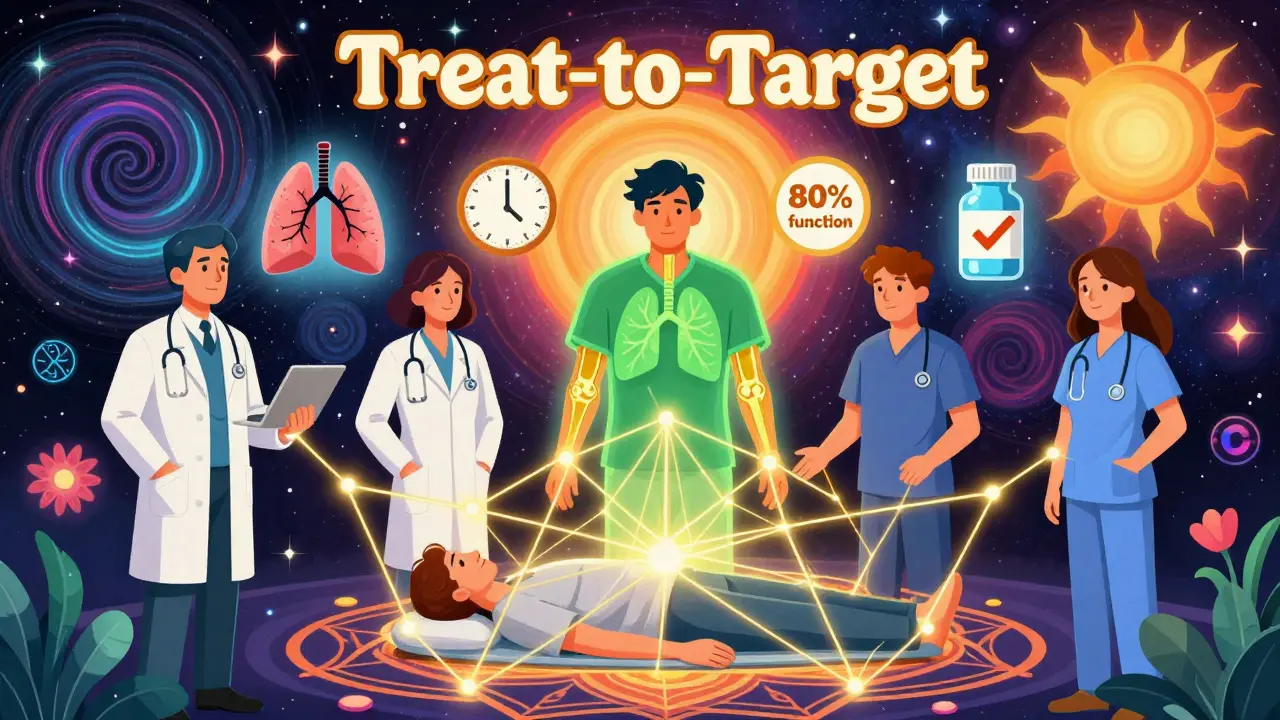
Also new: treat-to-target goals. Instead of just saying “control the disease,” doctors now aim for specific numbers: keep lung function above 80% of predicted, keep skin thickening scores below 15, and reach minimal disease activity for joint pain. These aren’t vague hopes-they’re measurable targets that guide treatment changes.
And the pipeline is full. Anifrolumab, a drug already approved for lupus, is now in phase 2 trials for MCTD. If it works, it could become the first targeted therapy specifically for mixed connective tissue disease.
What Patients Need to Know
If you’ve been told you have lupus but also have stiff fingers, trouble breathing, or muscle weakness-don’t let anyone dismiss it as “just a mix.” You’re not just complicated. You have a real, defined condition that needs specific care. Ask for:
- A full autoimmune antibody panel (not just ANA)
- Pulmonary function testing and a high-res CT scan of your lungs
- A rheumatologist who specializes in connective tissue diseases
- A care coordinator or multidisciplinary clinic if available
And if your doctors are treating you for one disease while ignoring another symptom-speak up. Overlap syndromes don’t fix themselves. They need someone to connect the dots.
Can you have an autoimmune overlap syndrome without meeting full criteria for either disease?
Yes. Many patients start with what’s called undifferentiated connective tissue disease (UCTD), where symptoms are present but don’t fully meet the diagnostic criteria for any single condition. Over time, about 30-40% of these patients develop features that clearly meet criteria for an overlap syndrome. This is why ongoing monitoring is critical-even if you don’t fit neatly into a box now, you might in a year or two.
Are overlap syndromes hereditary?
There’s no direct inheritance pattern like in cystic fibrosis or Huntington’s. But genetics play a role. People with certain HLA gene variants (like HLA-DR3 or HLA-DR52) are more likely to develop these syndromes, especially if they’re exposed to environmental triggers like viral infections, silica dust, or certain medications. It’s not passed down directly, but your genetic background can increase your risk.
Can you outgrow an autoimmune overlap syndrome?
No. These are chronic, lifelong conditions. However, disease activity can fluctuate. Some patients go into long-term remission, especially with early and targeted treatment. Others experience flare-ups triggered by stress, infection, or hormonal changes. The goal isn’t cure-it’s control. With the right care, many people live full, active lives without major complications.
Is it safe to get pregnant with an autoimmune overlap syndrome?
Pregnancy is possible but requires careful planning. Some medications used to treat overlap syndromes, like mycophenolate and methotrexate, are dangerous during pregnancy and must be stopped months in advance. Others, like hydroxychloroquine and low-dose prednisone, are considered safer. The biggest risks come from active disease-especially lung or kidney involvement. Working with a rheumatologist and maternal-fetal specialist before conception can reduce complications for both mother and baby.
Why don’t more doctors know about these syndromes?
Most medical training focuses on single diseases. Rheumatology is a subspecialty, and overlap syndromes are rare even within that field. Many general rheumatologists haven’t seen more than a handful of cases. Specialized centers are leading the way, but awareness is still growing. If your doctor seems unsure, ask for a referral to a center with a dedicated connective tissue disease program. They’re more likely to have the experience and tools to manage these complex cases.
Anil bhardwaj
February 26, 2026 AT 05:13Been there. Had Raynaud’s, stiff fingers, and weird lung scans for years. Doctors kept saying "it’s probably nothing" until I pushed for the anti-U1-RNP test. Turned out MCTD. Took 4 years. Don’t wait. Get the full antibody panel. Your lungs don’t care if your doctor is busy.
lela izzani
February 27, 2026 AT 17:53This is so important. I work in a rheumatology clinic and see this over and over. Patients get shuffled between specialists who treat one piece of the puzzle while ignoring the rest. A care coordinator isn’t a luxury-it’s the difference between managing symptoms and preventing irreversible damage. Especially with ILD. Once the fibrosis sets in, it’s game over. Early CT scans save lives.
Joanna Reyes
February 28, 2026 AT 01:21I’ve been living with PM/Scl overlap for 8 years now. I didn’t even know it had a name until I found this post. I thought I was just "a weird mix of arthritis, tight skin, and always being tired." The lung scarring was dismissed as "age-related" until I insisted on a high-res CT. Turns out it was active fibrosis. My pulmonologist was shocked no one had caught it. I’m on mycophenolate now and my O2 levels are stable. But I still have to remind every new doctor I see: "It’s not just scleroderma. It’s not just myositis. It’s both. And your lungs are in danger."
William James
March 1, 2026 AT 08:24It’s wild how medicine still treats the body like a collection of separate machines. You wouldn’t fix a car by having one mechanic look at the engine, another at the tires, and a third at the radio-and none of them talk to each other. Yet that’s what we do with autoimmune overlap. We need systems, not specialists. We need teams. And we need patients to stop apologizing for being "complicated." You’re not complicated-you’re a whole system that’s been broken by siloed thinking.
David McKie
March 2, 2026 AT 05:26Oh, here we go again. Another "awareness post" about how doctors are incompetent. Newsflash: if you’re seeing seven doctors and still can’t get a diagnosis, maybe YOU’RE the problem. Maybe you’re hypochondriacal. Maybe you’re Googling symptoms and convincing yourself you have a rare disease. I’ve seen this before. A woman in London spent 5 years chasing "overlap syndromes"-turned out she had anxiety and vitamin D deficiency. Stop romanticizing suffering. Not every weird symptom is a mystery. Sometimes it’s just stress.
Vanessa Drummond
March 3, 2026 AT 20:08David McKie, you’re the reason people don’t trust doctors. You’re not helping. You’re gaslighting people who are literally dying because no one took them seriously. I’ve watched my sister lose lung capacity because her rheumatologist said "it’s probably just allergies." She had anti-Jo-1. She had mechanic’s hands. She had ILD. And you think she’s "hypochondriacal"? Go read the JAMA study on triple immunosuppressants and infection risk. Then go cry in a corner.
Southern Indiana Paleontology Institute
March 4, 2026 AT 20:52USA is the only country that lets this happen. In China, they have one clinic for all connective tissue stuff. No bouncing around. No 3-year waits. You go in, get the antibody test, get the CT, get the treatment. Done. Meanwhile here? You need 3 referrals, 2 insurance approvals, and a prayer. This isn’t medicine. This is a bureaucracy with stethoscopes.
Nerina Devi
March 6, 2026 AT 09:40My mom had MCTD. She lived to 82 because she found a clinic that did coordinated care. They scheduled all her appointments on the same day. One doctor reviewed all her meds. They even called her primary care to update her records. She never had to repeat her story. That’s the kind of care that saves lives-not just the drugs, but the dignity of being seen as a whole person.
Dinesh Dawn
March 8, 2026 AT 04:42Just wanted to say thanks for writing this. I’m from India and we don’t have much info on this here. My cousin was misdiagnosed for 6 years. Now she’s on rituximab and her lungs are stable. But she almost didn’t make it because no one in our town knew about antisynthetase syndrome. Maybe this post will help someone else.
Shalini Gautam
March 9, 2026 AT 02:21I’m a nurse in a rural clinic. We get patients from all over who’ve been bounced around. I’ve started keeping a printed checklist: 1. Full antibody panel (not just ANA), 2. Pulmonary function test, 3. High-res CT, 4. Referral to specialized center. I hand it to them. No one’s ever said no. Sometimes, all it takes is someone who knows what to ask for.
Spenser Bickett
March 9, 2026 AT 07:50Oh wow. So the solution to doctors not knowing about rare diseases… is to throw more money at AI? Next you’ll tell me we should put a chatbot in every ER. "Hi, I’ve got stiff fingers and trouble breathing. Can you tell me if I have MCTD?" Meanwhile, real doctors are overworked because we turned medicine into a corporate spreadsheet. Maybe instead of AI, we should hire more damn rheumatologists?
Christopher Wiedenhaupt
March 11, 2026 AT 05:17Thank you for the comprehensive overview. The data on lung involvement in overlap syndromes is particularly compelling. The 2023 FDA approval of tocilizumab for antisynthetase-associated ILD is a significant milestone. However, access remains a barrier in many regions due to cost and lack of specialist infrastructure. The treat-to-target model, while ideal, requires robust monitoring systems that are not universally available. This highlights the urgent need for policy-level interventions alongside clinical innovation.