
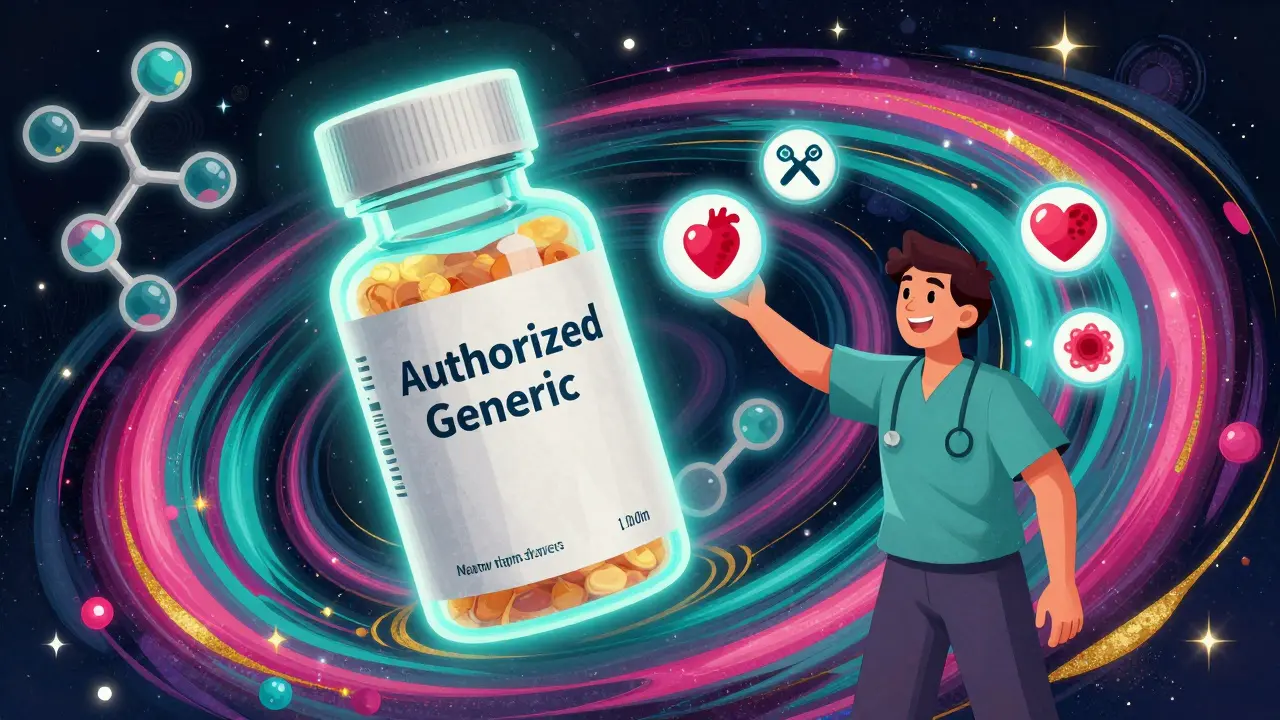
When you’ve been on a brand-name medication for years, switching to a generic can feel risky. What if it doesn’t work the same? What if you start feeling off? You’re not imagining it - for some people, the difference isn’t just in price, it’s in how their body reacts. That’s where authorized generics come in. They’re not just cheaper versions. They’re the exact same pill, just without the brand name on the bottle.
What exactly is an authorized generic?
An authorized generic is made by the same company that produces the brand-name drug. It uses the same active ingredients, the same inactive ingredients - even the same manufacturing process. The only difference? No brand logo, no fancy packaging, and a much lower price tag. It’s like buying the same coffee beans, but in a plain bag instead of the branded one.
The FDA calls these drugs ‘listed drugs’ marketed under the original brand’s New Drug Application (NDA). That means they don’t go through the usual generic approval process (ANDA). They don’t need to prove bioequivalence because they’re identical. No guesswork. No testing. Just the same medicine you’ve been taking, sold at generic prices.
Why do they exist?
Authorized generics were never meant to be the main solution. They emerged as a side effect of the 1984 Hatch-Waxman Act, which gave the first generic company 180 days of exclusive rights to sell a generic version after challenging a brand patent. But here’s the twist: brand companies could launch their own generic version during that window. And they did - often right on day one.
Why? Because it drives down prices. When both the first generic and the brand’s own authorized generic hit the market at the same time, competition spikes. Prices drop 25-30% more than if only the first generic entered. The FTC found this in 2011, and data from 2022 confirms it still holds. Patients pay less. Pharmacies save money. Insurers benefit. Everyone wins - except maybe the brand company’s profit margin.
Authorized generic vs. traditional generic: what’s the real difference?
Traditional generics only need to match the active ingredient. The rest - the fillers, dyes, binders - can be different. That’s fine for most drugs. But for medications with a narrow therapeutic index, even tiny changes can cause problems.
Think levothyroxine for thyroid issues, warfarin for blood thinning, or seizure meds like phenytoin. These drugs have a very small window between effective and toxic. A change in inactive ingredients? That’s enough to throw off absorption, leading to under- or over-dosing. A 2023 study in US Pharmacist found that 32% of patients reported side effects after switching from brand to traditional generic for these drugs.
Authorized generics avoid this entirely. They’re exact copies. No reformulation. No surprises. That’s why pharmacists and doctors often recommend them for patients who’ve had bad reactions to other generics. One Reddit user, a pharmacist with 12 years of experience, shared that for patients on levothyroxine, switching to an authorized generic cut adverse reactions by 70% based on patient feedback.
Are they cheaper? How much?
Yes. Authorized generics typically cost 15-20% less than the brand version. That’s not as deep a discount as some traditional generics, which can be 80% cheaper. But here’s the catch: authorized generics are often priced just above the cheapest generic - meaning you get the exact same formulation without paying brand prices.
Insurance plans treat them like generics. Medicare Part D covers them at generic copay levels 92% of the time. Commercial insurers do so in 78% of cases. That’s better than many traditional generics, which sometimes get stuck in higher tiers if they’re not on formulary.
And if you’re paying cash? GoodRx shows authorized generics for drugs like Lipitor or Synthroid often run $5-$15 a month - sometimes less than the co-pay on your insurance plan.
Why don’t you hear more about them?
Because they’re hidden. Pharmacies don’t always tell you. A 2022 Kaiser Family Foundation survey found that 28% of patients didn’t realize they’d been switched to an authorized generic until after they got the bottle. The label looks different. The pill color might be off. The shape might be slightly changed. If you’re used to your brand pill, it can look like a whole new drug.
And here’s the kicker: the FDA doesn’t list authorized generics in the Orange Book, the official directory of approved drugs. That means pharmacists have to cross-reference National Drug Codes (NDCs) manually. Most chain pharmacies have systems for this - 87% do, according to the American Pharmacists Association - but it’s not automatic. If your pharmacist isn’t trained to spot them, you might never know they’re an option.
How to get one
Ask. That’s it. Don’t assume your pharmacy will offer it. When your prescription is refilled, say: ‘Is there an authorized generic version of this drug?’
Not every brand has one. As of 2023, only 15-20% of brand-name drugs have an authorized generic available. But for high-cost, high-risk meds - especially those with narrow therapeutic windows - the chances are better. Check the FDA’s quarterly list of authorized generics. It’s public. You can search by drug name.
If your prescriber wrote ‘dispense as written’ or ‘no substitution,’ you’ll need to ask them to change it. But if they didn’t, your pharmacist can legally substitute an authorized generic - same as any other generic.
What about the criticism?
Yes, there’s controversy. Critics say brand companies use authorized generics to sabotage the first generic competitor. By launching their own version during the 180-day exclusivity window, they flood the market and drive down profits - sometimes so hard that the first generic can’t survive. The Generic Pharmaceutical Association says 43% of authorized generics launch during that critical window, which undermines the incentive for companies to challenge patents in the first place.
That’s a real concern for the future of generic competition. But for you, the patient? It doesn’t change the fact that you’re getting the same drug, cheaper, with fewer side effects. The system might be flawed. But the medicine? It’s solid.
Who benefits the most?
Anyone on a drug where consistency matters:
- Patients on levothyroxine, warfarin, or seizure meds
- People who had bad reactions to traditional generics
- Those paying cash or with high-deductible plans
- Seniors on Medicare Part D who want predictable results
It’s not for everyone. If you’ve switched to a traditional generic and feel fine? Stick with it. But if you’ve struggled with side effects, or if your doctor warned you about formulation sensitivity, authorized generics are the safest bridge between brand and generic.
What’s changing in 2024 and beyond?
The FDA is finally adding a dedicated section for authorized generics to the Orange Book in Q2 2024. That means pharmacists will be able to look them up easily. No more NDC cross-referencing headaches.
The Biden administration is also pushing back on anti-competitive behavior. A 2022 executive order specifically called out authorized generics used to block generic competition. Whether that leads to new rules or just more scrutiny remains to be seen.
But here’s what won’t change: the demand. IQVIA data shows authorized generics grew from 5.2% of generic prescriptions in 2018 to 8.7% in 2022. Experts predict they’ll hit 12-15% by 2026. More drugs will get them. More patients will ask for them. And more pharmacies will be ready to give them.
You don’t have to settle for a generic that doesn’t feel right. You don’t have to pay more for the brand name. Authorized generics give you the middle ground - the exact same medicine, without the markup. All you need to do is ask.
Are authorized generics the same as brand-name drugs?
Yes. Authorized generics contain the exact same active and inactive ingredients as the brand-name version. They’re made in the same facility, using the same process. The only differences are the label, packaging, and price.
Can I switch from a brand to an authorized generic without my doctor’s approval?
Yes, unless your prescription says ‘dispense as written’ or ‘no substitution.’ Pharmacists can legally switch you to an authorized generic just like any other generic. But if you’ve had bad reactions to generics before, it’s smart to talk to your doctor first.
Why don’t pharmacies always tell me I’m getting an authorized generic?
Because they often don’t know themselves - or they assume you won’t care. Authorized generics aren’t listed in the FDA’s Orange Book, so pharmacists have to manually check NDC codes. Many aren’t trained to spot them. Always ask if one’s available.
Are authorized generics covered by insurance?
Yes. Most insurance plans, including Medicare Part D, cover them at the generic copay level. Medicare covers them 92% of the time. Commercial insurers do so in about 78% of cases. They’re treated like any other generic.
How do I find out if my drug has an authorized generic?
Check the FDA’s quarterly list of authorized generic drugs online. You can search by brand name. Or ask your pharmacist directly: ‘Is there an authorized generic for [drug name]?’ If they’re unsure, they can look up the NDC code in their system.
Do authorized generics cost more than traditional generics?
Sometimes, but not usually. They’re typically priced just above the cheapest generic - often $5-$15 a month. For drugs with narrow therapeutic windows, the slight extra cost is worth it for consistency. Many patients pay less than their insurance co-pay when using cash or GoodRx coupons.
Cara Hritz
December 23, 2025 AT 08:07i just got my synthroid switched and didnt even notice till the bottle looked diffrent lol
Kathryn Weymouth
December 24, 2025 AT 02:04This is such an important topic that gets buried under pharmacy bureaucracy. I’m a nurse practitioner, and I’ve seen patients crash their thyroid levels after switching to a generic with different fillers. Authorized generics are the only ethical bridge between cost and safety. The system should make them the default for narrow-therapeutic-index drugs - not a hidden option.
Vikrant Sura
December 24, 2025 AT 07:07Why are we even talking about this? Just take the cheap one. If it doesn't work, go back to brand. End of story.
Art Van Gelder
December 25, 2025 AT 07:06Let me tell you about my uncle in Arizona who took his warfarin generic and ended up in the ER with a hemorrhage. They switched him to the authorized version - same pill, different label - and he’s been stable for three years. This isn’t just about money, it’s about your body trusting the chemistry. The FDA’s silence on this? It’s criminal. Pharmacies don’t tell you because they’re not trained, and the manufacturers don’t push it because they don’t want you to know how easy it is to game the system. We’re all just guessing with our pills, and that’s terrifying.
Aliyu Sani
December 25, 2025 AT 19:18man i been on levothyroxine for 8 years and switched to generic last year - felt like i was drowning in slow motion. my doc was like 'it's the same chem' but my body knew better. found out later it was an authorized generic that fixed me. why don't they just call it 'brand but cheaper' and stop the mystery? people need to know this shit. it's not magic, it's just transparency.
Jim Brown
December 26, 2025 AT 04:37One cannot help but observe the paradoxical nature of pharmaceutical capitalism: the very entities that profit from brand-name exclusivity are simultaneously the ones who, through authorized generics, undermine their own pricing architecture. The Hatch-Waxman Act, intended to foster competition, has instead birthed a corporate ballet wherein the monopolist becomes the low-cost disruptor - a Hegelian dialectic played out in pill form. The patient, caught between regulatory opacity and economic incentive, becomes the unwitting beneficiary of a system that should not function this way - yet does, beautifully, in its flawed way.
Nader Bsyouni
December 27, 2025 AT 04:30So the big pharma companies are just playing us like puppets? They make the brand, then make the generic version to kill off real competitors? That’s not capitalism, that’s a cartel with a prescription pad. And they wonder why people hate pharmacies?
Sai Keerthan Reddy Proddatoori
December 28, 2025 AT 16:28USA always thinks it knows better. In India we just take the cheapest pill and survive. This overthinking of inactive ingredients is a rich man’s problem. If you can’t handle a pill change, maybe you shouldn’t be on medicine at all.
Tarun Sharma
December 30, 2025 AT 14:17Authorized generics are a legitimate option. However, their availability remains inconsistent across regions and pharmacies. Patients must proactively inquire. This is not a systemic failure - it is a procedural gap that requires pharmacist education and standardized labeling.
Jamison Kissh
December 31, 2025 AT 09:16I wonder if this is why some people feel 'off' after switching - not because the drug is different, but because their brain expects the brand. The placebo effect is powerful. But if the authorized generic actually reduces side effects, as the data says, then maybe it’s not just placebo. Maybe it’s the fillers. And if that’s true… why aren’t we regulating those like we regulate the active ingredient?
Herman Rousseau
January 2, 2026 AT 07:31Y’all need to ask for this! Seriously. I work at a pharmacy and 90% of patients don’t know this exists. Just say 'Hey, is there an authorized generic for this?' and boom - $15 instead of $80. It’s that easy. 🙌 Don’t let the system hide it from you. You’re worth the extra 30 seconds of asking.
Jeremy Hendriks
January 4, 2026 AT 02:36So let me get this straight - the brand company makes the exact same pill, sells it cheaper, and then gets accused of killing competition? That’s not evil, that’s just smart business. If you want real competition, stop giving 180-day monopolies. Let everyone play. The market will sort it. Stop pretending this is about patients - it’s always been about profits. And if your body freaks out over a pill change, maybe you’re the problem, not the filler.
Julie Chavassieux
January 4, 2026 AT 14:20Wait - so you’re telling me I’ve been paying $70 for Lipitor for years… and all along, there was a version that’s literally identical… for $8? And no one told me? I feel violated. Like I was sold a lie. And now I’m mad. And I’m telling everyone. This is a scam. A. Scam.