
Drug Safety Signal Detection Calculator
How AI Changes Drug Safety Monitoring
The article shows AI can detect adverse events up to 90% faster and uncover 3-5 times more signals than traditional methods. This calculator demonstrates how these improvements impact patient safety and efficiency.
Based on article statistics: AI detects 3-5x more signals than traditional methods, cuts detection time by over 90%, and processes millions of reports daily. The FDA's Sentinel system analyzes over 300 million patient records with AI.
Real-world impact: In one case, AI detected a dangerous drug interaction within 3 weeks of launch, potentially preventing 200-300 serious adverse events that might have taken years to identify through traditional methods.
Every year, millions of people take medications that save lives. But for some, those same drugs cause unexpected harm. Before artificial intelligence, detecting these dangers was slow, manual, and often missed the early warning signs. Now, AI is changing that. It doesn’t just look at reports-it finds patterns no human could see in time. This isn’t science fiction. It’s happening right now in hospitals, labs, and regulatory agencies across the world.
What AI Actually Does in Drug Safety
Traditional drug safety monitoring relied on doctors and patients reporting side effects. Those reports piled up in databases, waiting for someone to spot a trend. But with millions of prescriptions filled daily, that system was drowning in data. Most reports were ignored simply because no one had time to read them all.
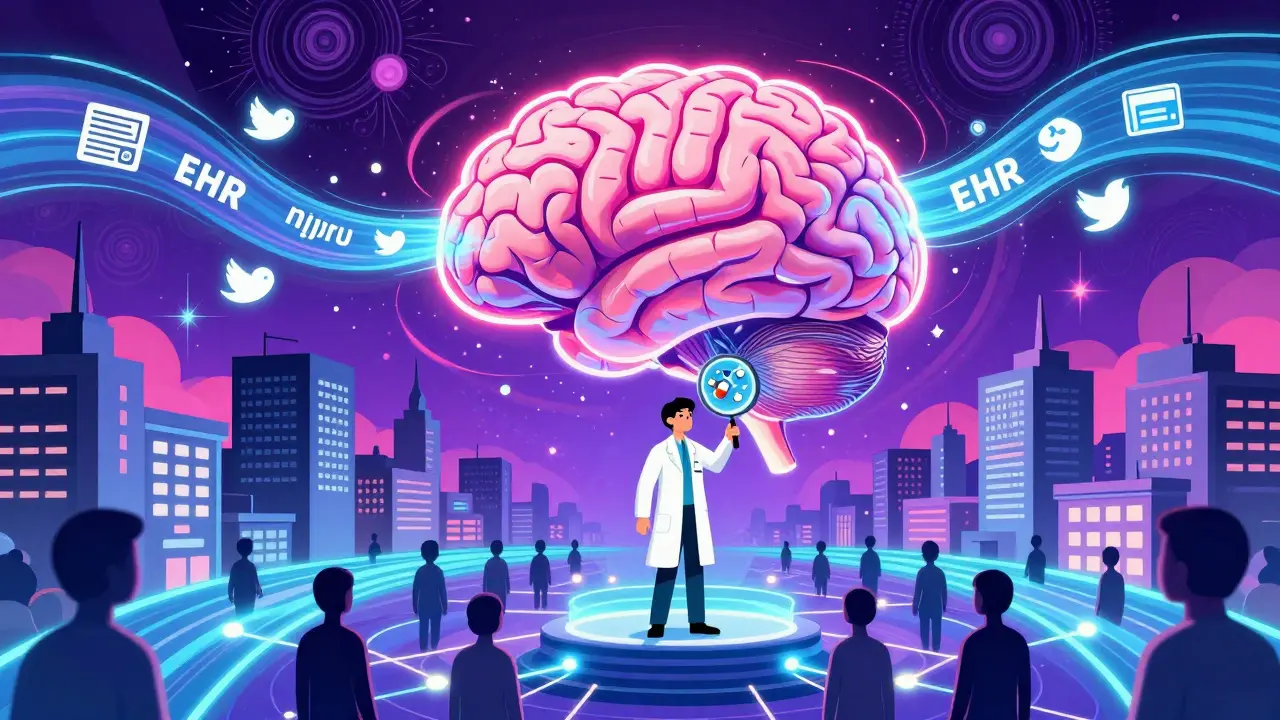
AI changes that. Systems now scan everything: Electronic Health Records, insurance claims, social media posts, clinical trial notes, even patient forums. Natural Language Processing (NLP) tools pull out key details from messy, unstructured text. One 2025 study by Lifebit.ai showed these tools extract adverse event information with 89.7% accuracy-far better than manual coding, which often missed details or misclassified symptoms.
Machine learning models then look for hidden connections. For example, if 12 different patients in different states all reported dizziness after taking Drug A and a common over-the-counter painkiller, the system flags it-not because someone told it to look for that combo, but because the data itself revealed the pattern. That’s how GlaxoSmithKline caught a dangerous interaction between a new anticoagulant and an antifungal drug just three weeks after launch. Without AI, it might have taken years.
The FDA’s AI Push: Sentinel and EDSTP
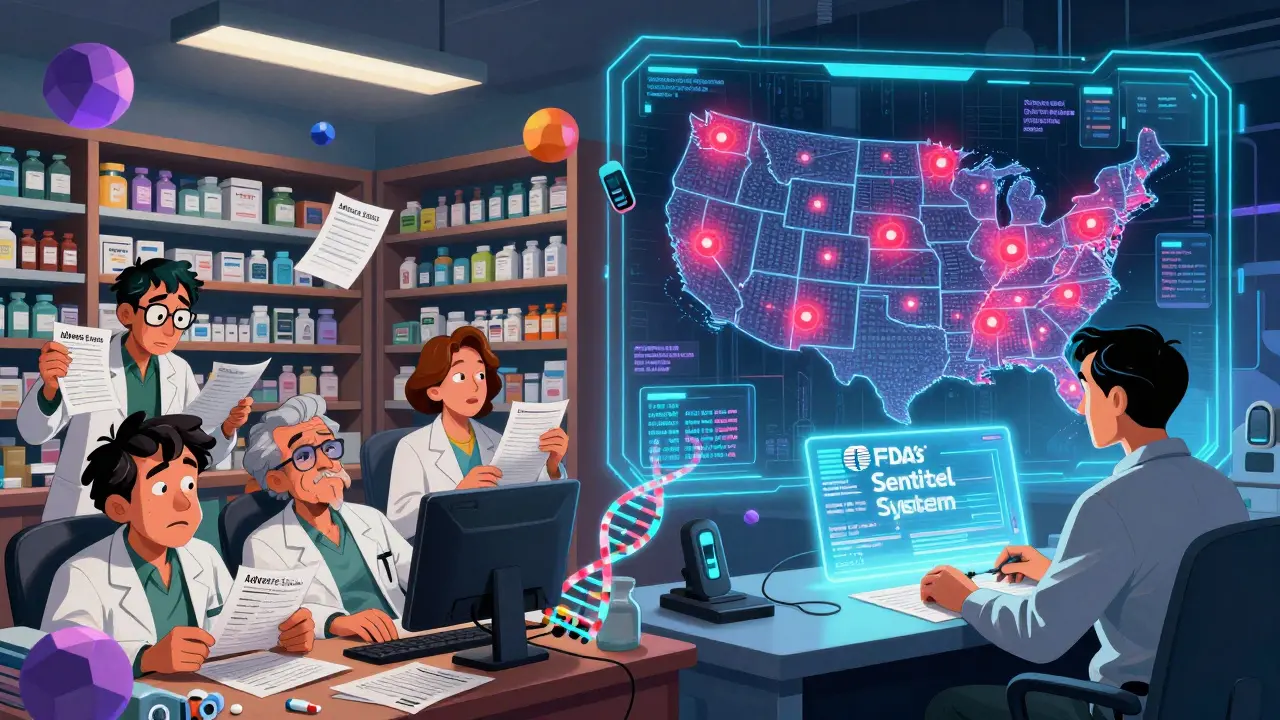
The U.S. Food and Drug Administration didn’t wait for the industry to catch up. In 2023, it launched the Emerging Drug Safety Technology Program (EDSTP) a program established by the FDA to evaluate and integrate AI-driven tools into post-market drug safety monitoring. Its flagship tool, the Sentinel System a nationwide network of healthcare data sources used by the FDA to actively monitor drug safety using real-world evidence, now analyzes data from over 300 million patient records. Since going live, it’s completed more than 250 safety analyses. That’s more than the entire global pharmacovigilance industry did in the previous decade.
Sentinel doesn’t just react-it predicts. When a new drug hits the market, the system starts monitoring immediately. In one case, it identified a safety signal for a new diabetes medication within 48 hours of approval. Manual review would have taken months. The FDA’s own data shows AI reduces signal detection time from weeks to hours. That’s not an improvement-it’s a revolution.
How AI Beats Old Methods
Old-school pharmacovigilance reviewed maybe 5-10% of available data. Why? Because it was too time-consuming. AI scans 100%. It doesn’t get tired. It doesn’t miss a tweet. It doesn’t overlook a patient note because it was written in shorthand.
Here’s what that looks like in practice:
- Manual review: A pharmacist reads 50 reports a day. Finds one possible link between a blood pressure drug and kidney issues. Reports it. It takes 6 months for a committee to review.
- AI system: Scans 1.5 million reports daily. Flags 17 unusual kidney-related patterns tied to the same drug across 12 states. Analyzes patient age, other medications, lab results, and even zip code data. Generates a risk score. Alerts regulators in 3 hours.
Coste et al. (2025) found AI cuts detection time by over 90% and uncovers 3-5 times more signals than manual methods. It’s not just faster-it’s smarter. It spots signals in low-income communities, rural areas, and among elderly patients who rarely get included in clinical trials. That’s huge. For decades, drug safety systems ignored these groups. AI doesn’t.
The Dark Side: Bias and Black Boxes
But AI isn’t perfect. And it doesn’t fix broken data.
If a hospital system doesn’t record that a patient is homeless, or if a clinic doesn’t document domestic violence, AI won’t magically know. It only sees what’s there. A 2025 Frontiers analysis found AI tools missed safety signals for women in rural Appalachia because their EHRs lacked key social determinants of health. The algorithm didn’t make a mistake-it reflected a gap in the data.
Another problem? Transparency. Many AI models are “black boxes.” They say, “This drug might be dangerous,” but can’t explain why. That’s a dealbreaker for regulators. If a company can’t prove how its algorithm reached a conclusion, the FDA won’t approve it. That’s why the FDA’s May 2025 discussion paper now requires full algorithmic transparency documentation-over 200 pages per tool.
Reddit threads from pharmacovigilance professionals echo this frustration. One user wrote: “My NLP tool cut coding errors by 70%, but when it flagged a rare reaction, no one could tell me how it figured it out. I had to manually trace 300 records just to verify.”
Who’s Using AI-and How
As of Q1 2025, 68% of the top 50 pharmaceutical companies use AI in drug safety. But not all the same way.
IQVIA a global health data and analytics company integrating AI across its pharmacovigilance platform for 45 of the top 50 pharma firms uses AI to automate case processing. Their clients report a 40-60% drop in time spent on paperwork. One manager said, “We used to have 12 people just coding adverse events. Now we have two. The AI handles the rest.”
Lifebit a specialized AI vendor processing 1.2 million patient records daily for 14 pharmaceutical clients, with focus on federated learning and causal inference goes further. Their systems analyze data across 12 hospital networks without moving the data-using federated learning. That means patient privacy stays intact, but patterns still emerge. They also use reinforcement learning, where the AI learns from feedback. After flagging a false alarm, human reviewers tell it why it was wrong. The system adjusts. It gets better.
Even wearable data is being used now. Fitbits, Apple Watches, and glucose monitors feed real-time heart rate, sleep, and activity trends into safety models. One trial found 8-12% of previously unreported adverse events were tied to medication non-adherence-something patients never told their doctors.
The Skills Gap: Training the New Pharmacovigilance Team
AI didn’t replace pharmacovigilance professionals. It changed what they do.
Today’s safety officer isn’t just a pharmacist. They need to understand data pipelines. They need to ask, “Where did this signal come from?” and “Is this bias or a real risk?”
According to IQVIA’s 2025 assessment, 73% of companies now train staff for 40-60 hours on data literacy. That’s not optional. If you can’t interpret an AI output, you can’t trust it. And if you can’t explain it to regulators, you’re at risk.
One company in Germany reported that after training, their team caught a drug interaction that had been hidden in 18 months of data. “We didn’t know it was there,” said their lead scientist. “The AI did. But only because we knew how to question it.”
What’s Next? Causal AI and Genomic Safety
The next leap isn’t just finding patterns-it’s figuring out cause.
Right now, AI sees correlation: “People who took Drug X and Y had more headaches.” But was it the drugs? Or were they stressed? Did they sleep less? AI is starting to use counterfactual modeling-asking, “What if this patient hadn’t taken the drug?” That’s how Lifebit claims it will improve causal inference by 60% by 2027.
And then there’s genomics. Seven academic medical centers are testing AI systems that combine drug safety data with a patient’s DNA. Why? Because some people metabolize drugs differently. A side effect that’s rare for most could be deadly for someone with a specific gene variant. AI can now flag those risks before the drug even hits the market.
By 2030, the goal is fully automated case processing-no human needs to touch a report. The system detects, investigates, validates, and alerts. But even then, humans will still be in the loop. As FDA Commissioner Robert Califf said in January 2025: “AI won’t replace pharmacovigilance professionals. Professionals who use AI will replace those who don’t.”
Final Thoughts: AI as a Force Multiplier
AI in drug safety isn’t about replacing people. It’s about giving them superpowers.
It lets a single analyst monitor millions of records. It lets regulators act before harm spreads. It lets patients get safer drugs faster. But it only works if the data is clean, the models are transparent, and the people behind them understand both medicine and machine learning.
The future of drug safety isn’t just smarter software. It’s smarter teams. Teams that ask better questions. That challenge assumptions. That know when to trust the algorithm-and when to dig deeper.
Can AI really detect drug side effects before they’re widely reported?
Yes. AI systems analyze millions of data points daily-from EHRs, social media, and insurance claims-to find subtle patterns. For example, AI flagged a dangerous interaction between an anticoagulant and antifungal drug within three weeks of launch, preventing an estimated 200-300 serious adverse events. Traditional methods would have taken years to catch this.
Why do some experts warn about bias in AI drug safety tools?
AI learns from data. If that data is incomplete-like EHRs that don’t record homelessness, poverty, or lack of transportation-AI will miss safety signals in those populations. A 2025 study showed AI overlooked adverse reactions in rural communities because their medical records lacked key social context. The tool didn’t fail; the data did.
How does the FDA ensure AI tools are safe and reliable?
The FDA requires full transparency. Since May 2025, any AI tool used for safety signal detection must include over 200 pages of validation documentation, including how the model was trained, what data it used, and how it makes decisions. The agency also runs pilot programs testing AI across 5 million patient records to validate performance before approval.
Do I need to be a data scientist to use AI in drug safety?
No. But you do need to understand how AI works. Pharmacovigilance teams now spend 40-60 hours training on data literacy-learning to interpret AI outputs, question assumptions, and spot potential bias. The best users aren’t coders-they’re clinicians who know medicine and can ask the right questions of the machine.
Is AI being used globally, or just in the U.S.?
Yes, globally. The European Medicines Agency (EMA) issued guidance in March 2025 requiring transparency and human oversight in AI systems. Major pharmaceutical companies like Novartis and Roche use AI tools from IQVIA and Lifebit across Europe and Asia. Adoption varies by region, but the top 50 global pharma firms all have AI in their safety pipelines as of 2025.
The shift from reactive reporting to proactive prevention is underway. AI isn’t the end of human judgment-it’s the beginning of better judgment. And for patients, that’s the most important safety net of all.
Dylan Patrick
March 15, 2026 AT 17:35Ali Hughey
March 15, 2026 AT 20:23Alex MC
March 17, 2026 AT 06:12rakesh sabharwal
March 17, 2026 AT 06:44Aaron Leib
March 18, 2026 AT 22:20Kathy Leslie
March 18, 2026 AT 22:25Elsa Rodriguez
March 20, 2026 AT 11:00Amisha Patel
March 21, 2026 AT 00:55