
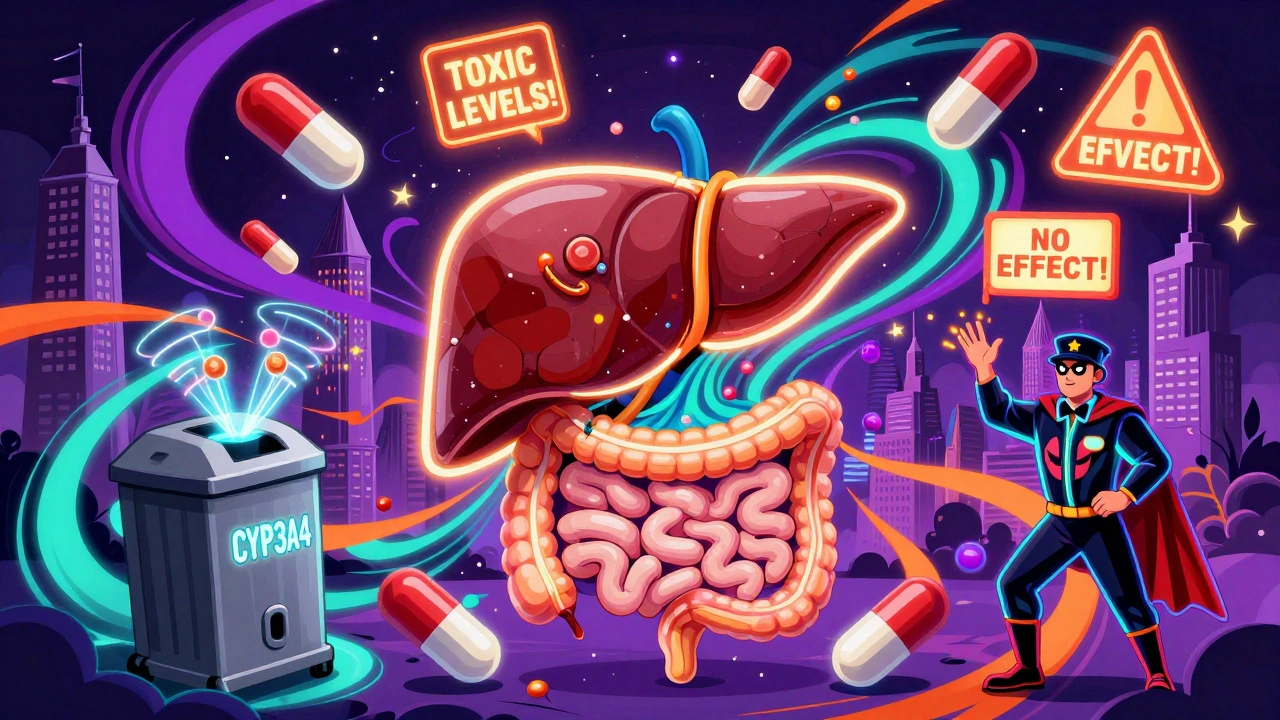
When you're taking antiviral meds for HIV or hepatitis C, the goal is simple: suppress the virus and stay healthy. But what many don’t realize is that these powerful drugs don’t work in isolation. They interact with other medications - sometimes dangerously - through two key biological systems: CYP3A4 and P-glycoprotein. These aren’t just technical terms. They’re the gatekeepers that decide how much of your drug actually gets into your bloodstream, and how fast it leaves. Get this wrong, and you could end up with toxic levels of medication… or no effect at all.
What Are CYP3A4 and P-glycoprotein?
CYP3A4 is the most common enzyme in your liver and gut. It breaks down about half of all prescription drugs you take. Think of it like a trash compactor for chemicals. P-glycoprotein (or P-gp) is a transporter that acts like a bouncer at the door of your cells. It kicks out drugs before they can be absorbed - especially in the gut and brain. Together, they control how much of your antiviral drug actually reaches its target.
These systems became critical in antiviral therapy when doctors discovered that one drug, ritonavir, could shut down CYP3A4. Originally developed as an HIV protease inhibitor, ritonavir was found to be so good at blocking this enzyme that even small doses (100 mg) could boost the levels of other antivirals. That’s how boosted regimens were born - using ritonavir or cobicistat to make other drugs work better at lower doses.
Why This Matters for Antivirals
Most modern antivirals - whether for HIV or hepatitis C - are designed to be taken with a booster. That’s because they’re made to be broken down quickly by CYP3A4. Without the booster, they’d be gone before they could do their job. But here’s the catch: if you’re taking another drug that also uses CYP3A4 or P-gp, you’re creating a traffic jam.
Take simvastatin, a common cholesterol drug. When taken with the hepatitis C combo paritaprevir/ritonavir/ombitasvir/dasabuvir, simvastatin levels can spike by over 1,700%. That’s not a typo. That’s enough to cause life-threatening muscle damage. The FDA label for this combo explicitly warns against it.
Or consider apixaban, a blood thinner. A 2021 case report described a 68-year-old man who started darunavir/cobicistat and ended up in the ER with severe internal bleeding. His apixaban levels were nearly double the safe range. He wasn’t told about the risk. His doctor didn’t check.
These aren’t rare accidents. A 2021 study of nearly 5,000 HIV and hepatitis C patients across Europe found that 17.3% of serious drug reactions were caused by unmanaged interactions. That’s more than 1 in 6 people.
Key Antivirals and Their Interaction Profiles
Not all antivirals are the same when it comes to interactions. Here’s how they stack up:
- Ritonavir (boosted): The strongest CYP3A4 inhibitor. Increases levels of many drugs by 300-500%. Also induces CYP1A2, which can lower levels of drugs like duloxetine. This dual effect makes it unpredictable.
- Cobicistat (boosted): Similar to ritonavir for CYP3A4 inhibition, but doesn’t induce CYP1A2. Safer for some combinations, but worse for kidney function - it elevates creatinine, which can look like kidney damage even when it’s not.
- Darunavir (unboosted): Minimal interaction risk. Often preferred when patients are on multiple other meds.
- Glecaprevir/pibrentasvir (HCV): Only 17% of common drugs need dose changes. One of the safest modern HCV regimens.
- Sofosbuvir: Doesn’t rely much on CYP3A4, but it’s a P-gp substrate. So it can be affected by drugs like digoxin or ranolazine.
Even the newer drugs aren’t risk-free. Grazoprevir is contraindicated with cyclosporine because of OATP1B1 inhibition - a transporter even many doctors overlook. A 2016 study showed this combo caused a 17-fold spike in grazoprevir levels. That’s a recipe for liver toxicity.
Hidden Risks: Herbs, Food, and Supplements
It’s not just prescription drugs that cause problems. Natural products can be just as dangerous.
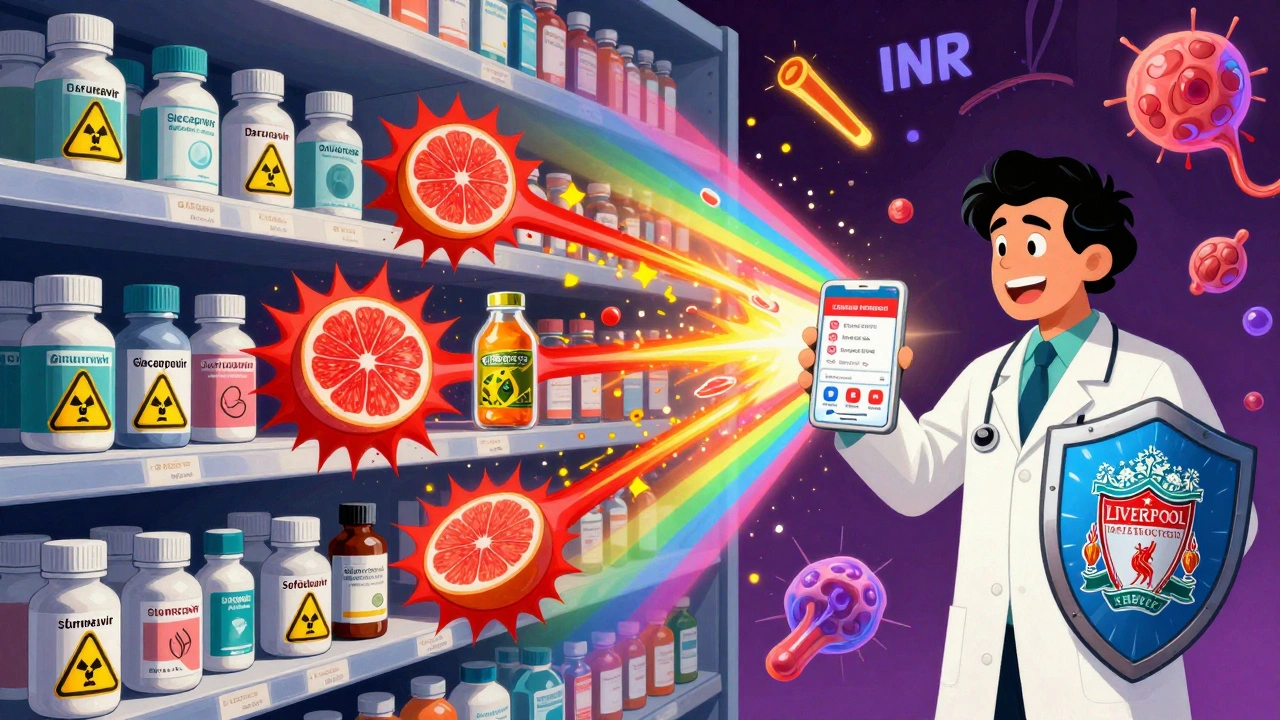
- St. John’s wort: This herbal antidepressant can slash ritonavir levels by 57%. That’s enough to make your HIV treatment fail.
- Grapefruit juice: Contains bergamottin, which blocks CYP3A4. One glass can raise antiviral levels by 23%. If you’re on a boosted regimen, skip it.
- Curcumin (turmeric): Inhibits P-gp. Could increase absorption of antivirals - but nobody knows how much. Better to avoid unless under supervision.
Patients often assume natural means safe. It doesn’t. These substances aren’t regulated. Their potency varies. And they’re rarely documented in medical records.
How to Stay Safe: Practical Steps
You don’t need to be a pharmacist to avoid dangerous interactions. Here’s what works:
- Make a full list of every pill, patch, vitamin, and herb you take. Include over-the-counter meds like ibuprofen and antacids.
- Use the Liverpool HIV Drug Interactions Checker. It’s free, web-based, and used by clinics worldwide. Scan your meds before starting any new antiviral. Download the app - it’s been used over 1.2 million times.
- Ask your pharmacist. Not your doctor. Your pharmacist. They’re trained to spot these clashes. Most will run a free interaction check if you bring in your list.
- Don’t start new meds without checking. Even something as simple as a new antibiotic or allergy pill can trigger a reaction.
- Time your doses. In some cases, spacing out meds helps. For example, delaying warfarin until a month after starting antivirals can avoid dangerous peaks.
A 2022 study of 347 HIV patients showed that using the Liverpool app cut interaction-related problems from 18.7% to just 5.2% in one year. That’s a 72% drop. It’s not magic. It’s just doing the math.
What Happens When You Don’t Check
Real stories tell the truth better than statistics.
A Reddit user named u/HIVWarrior wrote: “My psychiatrist won’t prescribe me anything for anxiety because of my darunavir regimen. It’s like choosing between mental health and viral suppression.” That’s not an isolated case. Many antidepressants, anti-anxiety meds, and even sleep aids are CYP3A4 substrates. Doctors fear prescribing them because they don’t know the risks.
In another case, a patient on warfarin and ritonavir was hospitalized three times in six months for bleeding. Each time, the INR (blood clotting measure) was off the charts. No one connected the dots until a pharmacist reviewed his full list.
These aren’t failures of the drugs. They’re failures of systems. Many clinics still don’t screen systematically. In the U.S., only 68% of HIV clinics use formal interaction checks. In Europe, it’s 92%.
What’s Changing - and What’s Next
Regulators are catching up. Since 2012, the FDA and EMA require all new antivirals to be tested against CYP3A4, P-gp, and at least two other transporters. Pharmaceutical companies now spend $3 million per drug just on interaction studies.
Electronic health records are getting smarter. Epic Systems added automated alerts for antiviral interactions in 2021. In one Mayo Clinic study, that cut severe interactions by 31%.
But the real game-changer is lenacapavir, a new HIV drug approved in 2022. It doesn’t rely on CYP3A4 at all. That means fewer interactions. Fewer pills. Fewer restrictions. It’s the future - and it’s already here.
Still, as more people with HIV live into their 60s and 70s, they’re taking more meds for heart disease, diabetes, arthritis. The average person with HIV now has 4.7 chronic conditions. Managing interactions isn’t optional anymore. It’s the difference between living well… and ending up in the hospital.
Final Takeaway
Antiviral medications save lives. But they’re not harmless. Their power comes with complexity. CYP3A4 and P-glycoprotein are invisible forces shaping how your drugs behave. Ignoring them is like driving a car without checking the fuel line.
You don’t need to memorize every enzyme or transporter. You just need to know this: Always check before you start or change any medication. Use the Liverpool app. Talk to your pharmacist. Bring your full list. Don’t assume your doctor knows every interaction. They’re human. They’re overwhelmed. But you can protect yourself.
There’s no shame in asking. There’s only risk in silence.
Taya Rtichsheva
December 9, 2025 AT 03:05So basically if I eat grapefruit and take my HIV meds I might as well just hug a cactus and wait for the universe to decide my fate
Christian Landry
December 10, 2025 AT 00:25holy crap i had no idea st johns wort could mess with my meds 😳 i’ve been taking it for anxiety for years… gonna check my list right now
Philippa Barraclough
December 10, 2025 AT 04:28It is not merely a matter of pharmacokinetic interactions between CYP3A4 and P-glycoprotein substrates, but rather a systemic failure in clinical education and patient communication. The fact that nearly one in six serious adverse events stem from unmanaged interactions suggests that the burden of vigilance is being improperly placed on the patient rather than being institutionalized through standardized screening protocols and automated decision support systems. This is not an individual responsibility-it is a public health infrastructure deficit.
Tim Tinh
December 11, 2025 AT 02:58just had my doc switch me to darunavir unboosted bc i was on like 7 other meds… life changed. no more panic attacks every time i get a new prescription. also the liverpool app is a godsend. saved my butt when i tried to start melatonin.
Mona Schmidt
December 12, 2025 AT 09:27It is critical to note that the omission of P-gp interactions in routine clinical assessments remains a significant oversight. While CYP3A4 is frequently emphasized, P-gp’s role in limiting drug absorption across the blood-brain barrier and intestinal epithelium is often underappreciated. For instance, the interaction between sofosbuvir and digoxin, as referenced, demonstrates that even non-CYP-metabolized drugs can precipitate toxicity through transporter-mediated mechanisms. Clinicians must expand their mental model beyond hepatic metabolism to include membrane transport physiology.
Katie Harrison
December 12, 2025 AT 22:58My pharmacist flagged my simvastatin + HCV combo before I even asked. She said, ‘If you take this, you might not walk again.’ I cried. Then I switched to pravastatin. She didn’t charge me. She just handed me a printed list of safe alternatives. That’s the kind of care we need more of.
Guylaine Lapointe
December 14, 2025 AT 17:28Of course people are dying from drug interactions-they’re not even trying. I read a study that said 72% of patients on boosted regimens don’t even know what CYP3A4 is. And yet we let them walk out with prescriptions? This isn’t healthcare-it’s Russian roulette with pills. If you’re not checking your meds with a pharmacist before you take them, you’re just gambling with your liver.
Tiffany Sowby
December 16, 2025 AT 08:30Lenacapavir sounds great… but why does it take 10 years for the US to catch up to Europe? We’re still using paper lists while they’ve got AI alerts. It’s embarrassing. And don’t get me started on how we treat HIV patients like second-class citizens when it comes to mental health meds. If this were diabetes, we’d have a whole department for this.