
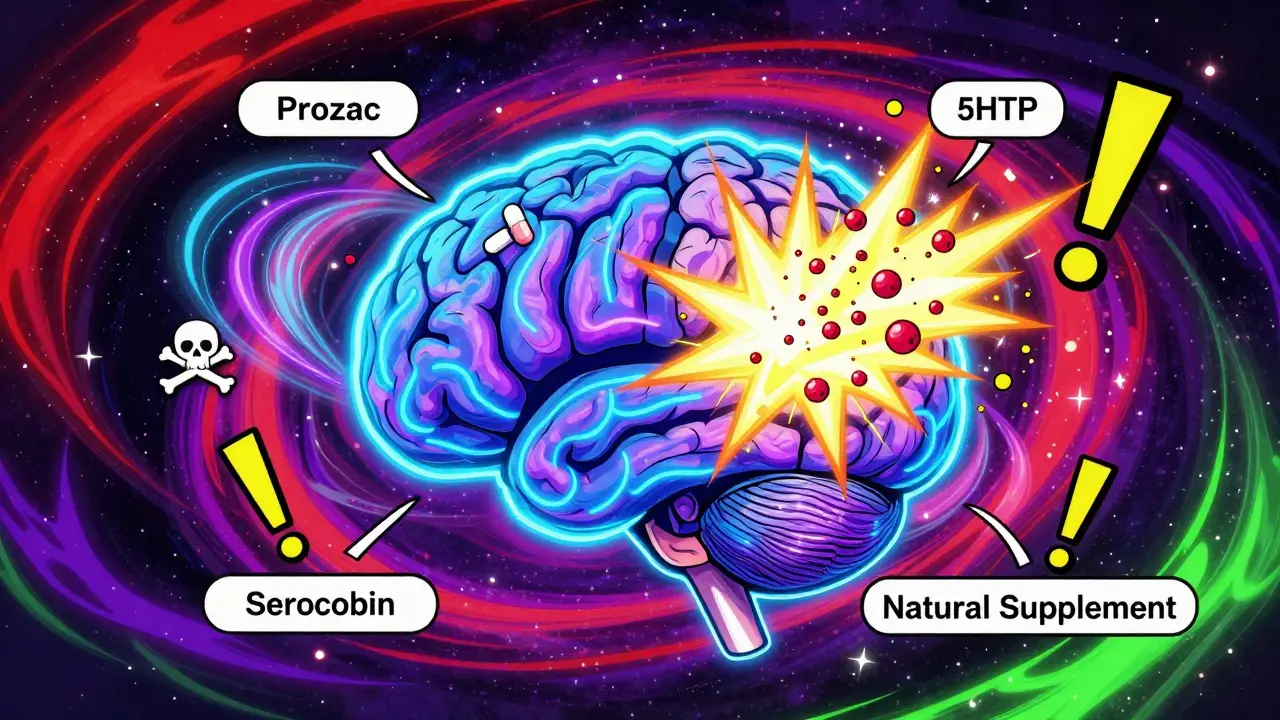
SSRI & Supplement Safety Checker
Check Your Medication Combination
This tool helps you identify dangerous combinations of SSRIs and serotonin-boosting supplements that could cause serotonin syndrome. Remember: there is no safe threshold for 5-HTP with SSRIs.
Combining 5-HTP with SSRIs isn't just a bad idea-it can land you in the emergency room. This isn't theoretical. People are doing it every day, thinking because 5-HTP is "natural," it's safe. But when your body already has too much serotonin, adding more from a supplement can push you into a dangerous condition called serotonin syndrome. And it doesn't take much to trigger it.
What Exactly Is Serotonin Syndrome?
Serotonin syndrome isn't a vague feeling of being "too wired." It's a real, measurable medical emergency caused by too much serotonin in your brain and nervous system. First identified in the late 1950s after MAOIs hit the market, the term was officially named in 1986. Today, we know it happens when serotonin levels spike past 300-400 ng/mL-far above the normal range of 101-283 ng/mL. This overload overstimulates your 5-HT2A receptors, which controls everything from muscle movement to body temperature.
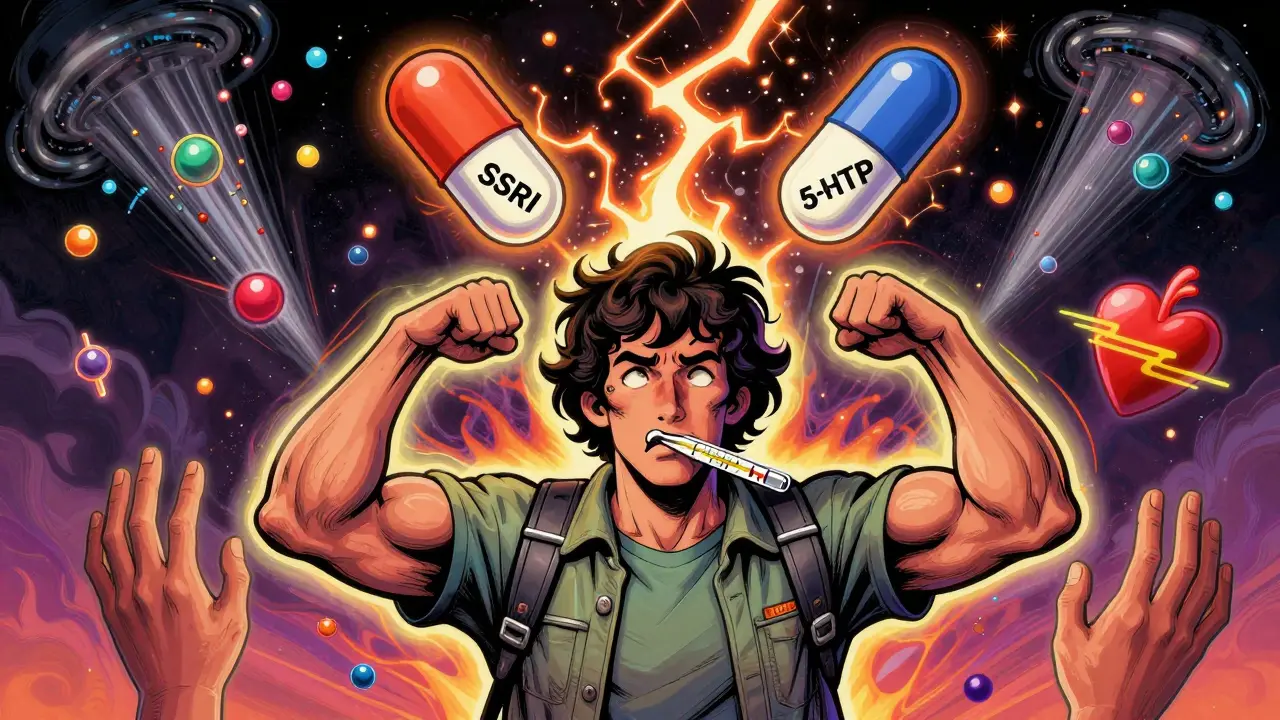
Symptoms range from mild to deadly. Mild cases might include shivering, diarrhea, or a slight tremor. But severe cases? That’s when your body temperature spikes above 41.1°C (106°F), your muscles lock up like a rigid board, your heart races uncontrollably, and you start having seizures. In the worst cases, it can be fatal. Studies show 2-12% of hospitalized patients with serotonin syndrome don’t survive. And here’s the scary part: many of these cases are preventable.
How 5-HTP and SSRIs Work Together (and Why That’s Dangerous)
SSRIs like fluoxetine (Prozac), sertraline (Zoloft), or escitalopram (Lexapro) work by blocking the reabsorption of serotonin. That means more serotonin stays in your brain, helping lift your mood. Simple enough.
But 5-HTP? It’s the direct building block of serotonin. Your body turns tryptophan into 5-HTP, then into serotonin. When you take 5-HTP as a supplement, you’re skipping the natural control point-the enzyme that normally regulates how much serotonin gets made. So your body starts cranking out serotonin like a factory on overtime.
Now imagine this: you’re on an SSRI, which keeps serotonin from being cleared out. Then you add 5-HTP, which floods your system with more of it. That’s not synergy-it’s a perfect storm. The American College of Medical Toxicology calls this combination "contraindicated." That’s medical speak for "don’t do it, ever."
The Numbers Don’t Lie
SSRIs alone rarely cause serotonin syndrome-only about 0.08 to 0.52 cases per 1,000 people each year. But add 5-HTP? The risk jumps dramatically. It’s comparable to mixing SSRIs with MAOIs, one of the most dangerous drug combos known to medicine.
Compare it to other risky combinations:
- SSRI + tramadol: 4.6% risk
- SSRI + St. John’s Wort: 2.3% risk
- SSRI + 5-HTP: estimated at 10-15% risk (based on case reports and expert consensus)
And here’s the kicker: 5-HTP supplements aren’t regulated like drugs. A 2022 test by ConsumerLab.com found that 31% of 5-HTP products had dosages that varied by up to 56% from what was on the label. One pill might have 72 mg. The next might have 128 mg. You have no idea how much you’re actually taking. That’s not a supplement-it’s a gamble.
Who’s at Risk? The Real-World Data
It’s not just people on SSRIs. It’s also people who think they’re "just trying something natural" to help with anxiety or sleep. A 2022 survey of over 1,000 supplement users found that 41% believed "natural supplements can’t cause dangerous drug interactions." That’s dangerously wrong.
On Reddit’s r/SSRI community, over 1,200 posts between 2020 and 2022 mentioned 5-HTP. Of those, 62% were from people self-medicating without telling their doctor. And 237 of them reported serious side effects: one user had a fever of 104°F after adding 100 mg of 5-HTP to 20 mg of fluoxetine. Another described tremors so bad they ended up in the ER.
Even more alarming? A 2022 National Health Interview Survey found that 12.8% of antidepressant users in the U.S. were taking 5-HTP at the same time. That’s over 4 million people. And the highest usage? Women aged 35-54. Many of them are using it to "boost mood" or "improve sleep," unaware they’re playing Russian roulette with their nervous system.
What Do Experts Say?
The consensus is overwhelming. The FDA issued a Drug Safety Communication in 2020 after reviewing 127 adverse events-including 9 deaths-linked to 5-HTP and SSRIs between 2015 and 2019. The American Psychiatric Association now recommends doctors specifically ask patients about 5-HTP and other serotonin-precursor supplements during every mental health evaluation.
Dr. David Juurlink, a leading toxicologist in Toronto, said in 2021: "The combination of prescription serotonergic drugs with unregulated supplements like 5-HTP represents one of the fastest-growing categories of serotonin syndrome cases." Between 2010 and 2020, cases involving supplements like 5-HTP jumped from 7% to 22% of all reported incidents.
There’s one outlier: Dr. Kent Holtorf, who claims in his book that 5-HTP can be safely combined with SSRIs under medical supervision. But his view has no backing in peer-reviewed literature. No major medical organization supports it. No large-scale study confirms it. And every major hospital in the U.S. and Australia trains its staff to treat this combo as a red flag.
What Should You Do If You’re Taking Both?
If you’re currently taking an SSRI and thinking about starting 5-HTP-or already are-stop. Immediately. Don’t wait for symptoms. Don’t "just try a small dose." There’s no safe dose when you’re on an SSRI.
If you want to stop your SSRI and switch to 5-HTP, you need a 2-week washout period-and even that’s not enough for some SSRIs. Paroxetine, for example, lingers in your system for up to 4 weeks. That means you need to wait at least a month before starting 5-HTP. And even then, you need medical supervision.
And if you’re already experiencing symptoms? Go to the ER. Don’t wait. Don’t call your doctor tomorrow. Headache, tremor, fever, confusion, rapid heartbeat? These are early signs. Muscle rigidity and high fever? That’s a medical emergency. The antidote is cyproheptadine, but it only works if given fast.
Why Isn’t This More Widely Known?
Because supplements aren’t held to the same standards as drugs. The Dietary Supplement Health and Education Act of 1994 lets companies sell 5-HTP without proving it’s safe to mix with medications. The FDA can only act after harm happens. And even then, enforcement is slow.
Meanwhile, the supplement industry is booming. The 5-HTP market was worth $187 million in 2022 and growing fast. Marketing tells you "natural = safe." But your body doesn’t care if something is natural-it cares about the chemistry. And the chemistry here is dangerous.
Even doctors aren’t always aware. A 2020 survey found only 38% of primary care physicians correctly identified 5-HTP as a serotonin syndrome risk. That means many patients are being given mixed messages-or no warning at all.
The Bottom Line
You don’t need to take 5-HTP while on an SSRI. There’s no proven benefit that outweighs the risk. Studies that suggest it might help are tiny, experimental, and not repeatable. Meanwhile, the evidence of harm is clear, consistent, and growing.
If you’re on an SSRI and want to feel better, talk to your doctor about adjusting your dose, adding therapy, or trying other evidence-backed strategies. Don’t risk your life for a supplement that’s not regulated, not tested, and not safe.
5-HTP and SSRIs don’t mix. Not even a little.
Can I take 5-HTP with a low dose of SSRI?
No. Even low doses of SSRIs, like 10 mg of sertraline or 5 mg of escitalopram, still block serotonin reuptake. Adding 5-HTP increases serotonin production. That combination-no matter how small-can still trigger serotonin syndrome. There is no safe threshold. The risk is not linear; even a small increase in serotonin can push you over the edge.
How long should I wait after stopping an SSRI before taking 5-HTP?
The general rule is a 2-week washout period. But that’s not enough for all SSRIs. Paroxetine and fluoxetine have very long half-lives-up to 3 to 4 weeks. For those, you need to wait at least 4 weeks. Always check with your doctor. They can check your specific medication’s half-life and give you a safe timeline. Don’t guess.
Are there any supplements that are safe to take with SSRIs?
Some supplements are low-risk when used carefully. Omega-3 fatty acids, magnesium, and vitamin D have no known interaction with SSRIs and are often recommended for mood support. But avoid anything that boosts serotonin: St. John’s Wort, SAM-e, L-tryptophan, and 5-HTP are all high-risk. Always check with your doctor before adding any supplement.
What are the early warning signs of serotonin syndrome?
Early signs include shivering, diarrhea, muscle twitching, sweating, restlessness, and a rapid heartbeat. You might feel unusually anxious or confused. If you notice these symptoms after starting or increasing a supplement like 5-HTP, stop it immediately and seek medical help. Don’t wait for fever or rigidity-that’s already a severe case.
Is serotonin syndrome reversible?
Yes-if caught early. Mild cases usually resolve within 24 to 72 hours after stopping the offending substances. Severe cases require hospitalization, IV fluids, medications like cyproheptadine, and sometimes sedation. But if you wait too long, it can lead to organ failure, seizures, or death. Time matters. The sooner you act, the better your outcome.
Randall Walker
March 10, 2026 AT 15:32Miranda Varn-Harper
March 11, 2026 AT 18:00Kenneth Zieden-Weber
March 12, 2026 AT 11:16Chris Bird
March 14, 2026 AT 08:04David L. Thomas
March 15, 2026 AT 02:48Bridgette Pulliam
March 17, 2026 AT 02:47Mike Winter
March 17, 2026 AT 05:40Alexander Erb
March 17, 2026 AT 15:58Donnie DeMarco
March 18, 2026 AT 22:55Tom Bolt
March 19, 2026 AT 23:55Shourya Tanay
March 20, 2026 AT 16:13